Absolute possessive pronouns replace a whole noun phrase rather than standing in front of one. Mine replaces my book entirely, so “That book is mine” needs no noun after the pronoun. The form never takes an apostrophe, which is why yours is written without one and your’s is not English. Every absolute form has a matching adjective form that goes in front of a noun instead.
What Are Absolute Possessive Pronouns?
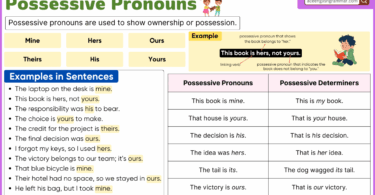
An absolute possessive pronoun shows ownership and replaces the noun phrase that names what is owned. No noun follows it, and it is never written with an apostrophe.
- That coat is mine.
- The decision is yours.
- The red car is theirs.
- She lost her keys, and I lost mine.
Note that the term names the same forms grammarians also call independent possessives or possessive pronouns proper. The word absolute marks the contrast with the dependent forms my and your, which cannot appear without a noun behind them.
The Six Absolute Possessive Pronouns
Six forms cover every person and number in English. Each one corresponds to a possessive adjective that performs the same job in front of a noun.
| Person | Absolute form | Adjective form | Example |
|---|---|---|---|
| First person singular | mine | my | The seat is mine. |
| Second person | yours | your | The choice is yours. |
| Third person masculine | his | his | The jacket is his. |
| Third person feminine | hers | her | The idea was hers. |
| First person plural | ours | our | The garden is ours. |
| Third person plural | theirs | their | The victory was theirs. |
Note that his is the one form spelled identically in both columns. Only its position in the sentence reveals which one is present, so “his coat” uses the adjective form and “the coat is his” uses the absolute form.
Sentence Positions for Mine and Ours
An absolute possessive pronoun occupies any position a noun phrase occupies. Five positions take in nearly every use of the form.
As the subject:
- Mine arrived before the others.
- Ours cost twice as much.
As the object of a verb:
- She returned his last week.
- I packed yours with the rest.
As a subject complement after be:
- The larger office is hers.
- Those boots are theirs.
After a preposition:
- He sat beside mine.
- The fault lies with ours.
As a one-word answer:
- Whose coat is this? Mine.
- Is this seat taken? Yes, it is hers.
The one-word answer is the most frequent use of the form in speech. A full reply would repeat the whole noun phrase, and the absolute form replaces that repetition with a single word.
Note that no noun follows the pronoun in any of these positions. A noun appearing after it signals the adjective form instead, so “mine book” is never English and “my book” replaces it.
The Apostrophe Rule for Yours, Hers and Theirs
No absolute possessive pronoun takes an apostrophe, whatever the form looks like. The final s belongs to the word itself rather than marking possession, so the apostrophe has no work to do.
- ✓ The choice is yours. ✗ The choice is your’s.
- ✓ The idea was hers. ✗ The idea was her’s.
- ✓ The garden is ours. ✗ The garden is our’s.
- ✓ The victory was theirs. ✗ The victory was their’s.
Compare:
- ✓ That book is Sara’s, a noun taking the possessive apostrophe.
- ✓ That book is hers, a pronoun taking no apostrophe.
Note that the contraction it’s is the single trap in this area. It’s means it is, while its is the adjective form, and neither word is an absolute possessive pronoun.
Verb Agreement With the Absolute Form
An absolute possessive pronoun takes a singular or a plural verb depending on what it replaces, not on the shape of the pronoun itself. Mine looks singular and takes a plural verb whenever the noun phrase behind it is plural.
- My seat is free, so mine is free.
- My seats are free, so mine are free.
- Their results arrived late, so theirs arrived late.
- Your answer was correct, and hers was correct too.
Compare:
- ✓ Yours are on the table, when yours replaces your keys.
- ✓ Yours is on the table, when yours replaces your key.
Note that the spelling of the pronoun shows no number at all. Only the earlier noun phrase settles the verb, so an absolute possessive needs a nearby noun phrase for the reader to match it against.
The Missing Absolute Form for It
No absolute possessive pronoun exists for it. The adjective form its is ordinary and appears everywhere, and no matching word fills the absolute slot.
- ✓ The dog chewed its bone. Adjective form.
- ✗ The bone is its. No absolute form exists.
- ✓ The bone belongs to the dog. The usual repair.
Note that several published lists name its as an absolute form. The test settles it: an absolute possessive completes “That one is ___,” and its cannot finish that sentence in standard English.
The Double Possessive After Of
An absolute possessive pronoun follows of in a construction grammarians call the double possessive. The form is standard rather than an error, and it singles out one item from several.
- a friend of mine
- that habit of yours
- an old photograph of hers
- those neighbours of theirs
Compare:
- a photograph of her, meaning she is in the picture
- a photograph of hers, meaning she owns the picture
Note that the adjective form never appears in this slot. “A friend of my” is not English, which makes the double possessive one of the clearest tests for telling the two forms apart.
The Difference Between Absolute Possessives and Possessive Adjectives
Both sets show ownership, and the position in the sentence separates them. An absolute possessive replaces the noun phrase; a possessive adjective modifies the noun that follows it.
| Absolute possessive | Possessive adjective | |
|---|---|---|
| Forms | mine, yours, his, hers, ours, theirs | my, your, his, her, its, our, their |
| Noun after it | Never | Always |
| Stands alone | Yes | No |
| Form for it | None | its |
| Example | The book is mine. | This is my book. |
Modern grammars class the adjective forms as possessive determiners rather than adjectives, since they occupy the same slot as the and a. The older label stays common in teaching, and both names point at the same seven words.
Compare:
- ✓ This is my coat, and that one is yours.
- ✗ This is mine coat, and that one is your.
Common Mistakes With Absolute Possessive Pronouns
Five errors take in nearly every misuse. Three of them happen when the absolute form and the adjective form are swapped.
1. Adding an apostrophe. We write yours, hers, ours and theirs with no apostrophe, since the s is part of the spelling rather than a possessive mark.
2. Putting a noun after the pronoun. We write “my coat,” not “mine coat,” because an absolute form replaces the noun rather than introducing it.
3. Using its as an absolute form. No absolute possessive exists for it, so “the bone is its” is rewritten as “the bone belongs to the dog.”
4. Confusing it’s with its. It’s is the contraction of it is, and neither spelling belongs to the absolute set.
5. Using the adjective form after of. We write “a friend of mine,” not “a friend of my,” since the double possessive takes the absolute form only.
Practice Questions
Choose the correct form for each sentence.
- That jacket is (your / yours).
- (Her / Hers) was the only answer that worked.
- The dog wagged (its / it’s) tail.
- I borrowed a book of (her / hers).
- This is (my / mine) seat, and that one is (their / theirs).
- The bone is (its / the dog’s).
- My keys are on the table, so (mine is / mine are) on the table.
Answers: 1. Yours, a subject complement. 2. Hers, the subject. 3. Its, the adjective form before a noun. 4. Hers, the double possessive after of. 5. My before the noun, theirs standing alone. 6. The dog’s, since no absolute form exists for it. 7. Mine are, since the pronoun replaces a plural noun phrase.
FAQs
Q1. What is an absolute possessive pronoun?
An absolute possessive pronoun is a word that shows ownership and replaces the whole noun phrase naming what is owned. Mine, yours, his, hers, ours and theirs are the six forms in English. No noun follows the pronoun, and none of the six is written with an apostrophe.
Q2. Do possessive pronouns have an apostrophe?
No, absolute possessive pronouns never take an apostrophe. Yours, hers, ours and theirs all end in s that belongs to the spelling of the word rather than marking possession. Writing your’s or their’s is an error in every register.
Q3. Do absolute possessive pronouns come before nouns?
No, they replace the noun instead of introducing it. “Mine book” is not English, and “my book” uses the adjective form for that position. A noun appearing after the word is the clearest sign that the adjective form is needed.
Q4. Is its an absolute possessive pronoun?
No, and no absolute form exists for it at all. The adjective form its is correct in “its bone,” while “the bone is its” fails in standard English. A rewrite with the noun, as in “the bone belongs to the dog,” replaces the missing form.
Q5. Can a possessive pronoun be the subject of a sentence?
Yes, an absolute possessive pronoun takes the subject position like any noun phrase. “Mine arrived first” and “Hers was the only workable answer” both open with the pronoun as subject. Without the pronoun, each sentence would repeat the noun phrase in full.
Q6. Is his a possessive pronoun or a possessive adjective?
His is both, and only the position in the sentence separates the two. In “his coat” the word stands in front of a noun, which makes it the adjective form. In “the coat is his” no noun follows, which makes it the absolute possessive pronoun.
Q7. Are possessive pronouns capitalized in titles?
Yes, every pronoun takes a capital in title case, since pronouns count as principal words. “A Friend of Mine” and “The Choice Is Yours” both capitalize the absolute form. Only articles, short prepositions and coordinating conjunctions stay in lower case.
Q8. Why is theirs written without an apostrophe?
Theirs is a single word rather than a noun with a possessive ending attached. The apostrophe marks possession on nouns, as in the dog’s bone, and possession is already built into the spelling of a pronoun. That is why hers, ours and yours follow the same pattern.
Read More