
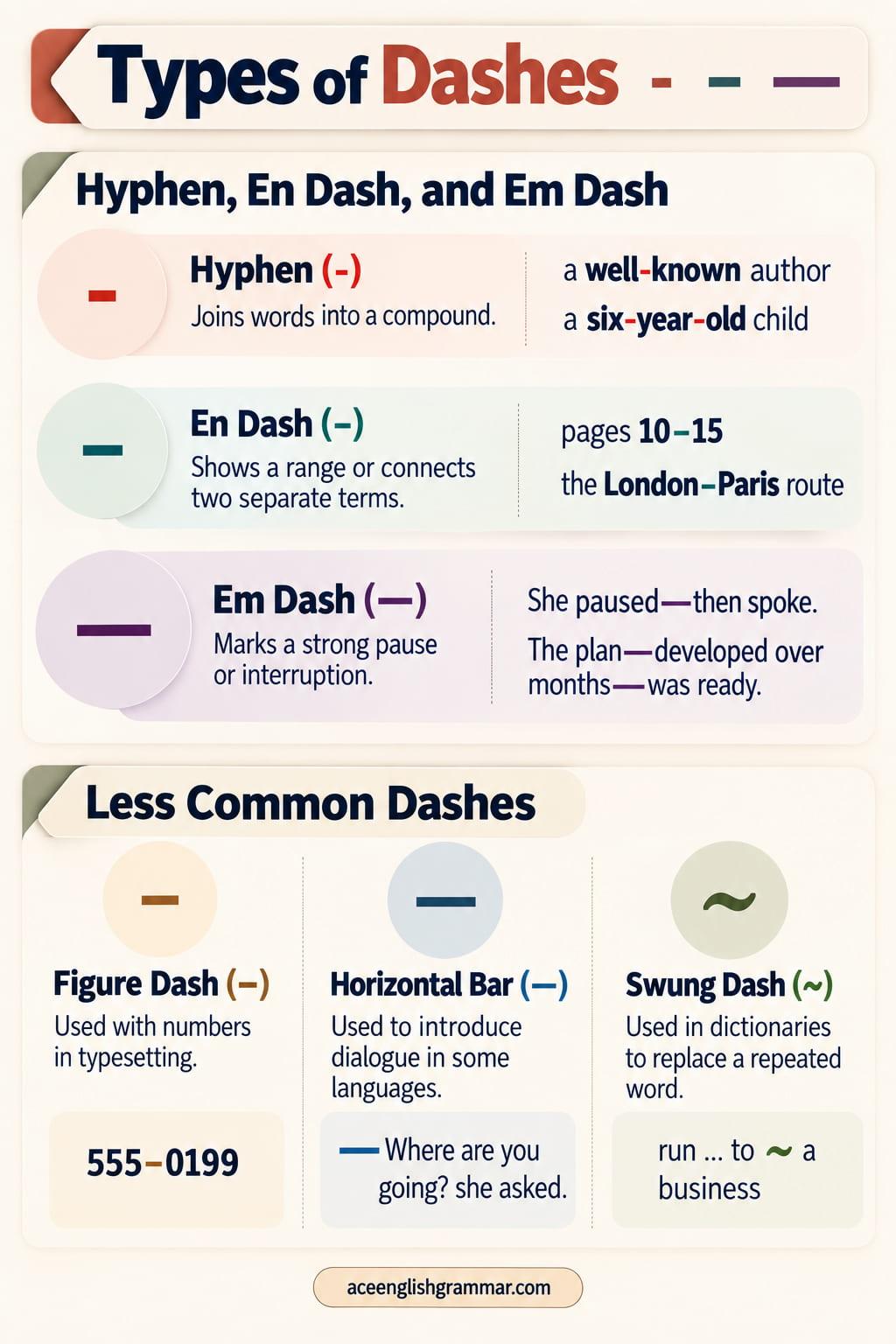
The dash symbol is a horizontal punctuation mark with six distinct widths, each named for its size in typography. Three of these types of dashes are in everyday use: the hyphen (-), the en dash (–), and the em dash (—).
The three differ by function rather than by length alone. The hyphen joins words into a compound. The en dash indicates a range between two values. The em dash sets off an element or marks a break in thought. The remaining forms of the dash symbol, namely the figure dash, the horizontal bar, and the swung dash, belong to specialist typesetting rather than to general writing.
What Is a Dash?
A dash is a horizontal punctuation mark that connects or separates parts of a sentence. The word covers several marks of different lengths, each with its own grammatical function.
The name “dash” alone denotes the em dash, the mark chosen for a strong pause. The em dash is also called the long dash, and a pair of hyphens (–) is the typewriter substitute for it. The hyphen is technically a separate mark rather than a dash, though everyday usage groups the three together.
- a well-known author (hyphen)
- pages 10–15 (en dash)
- She paused—then spoke. (em dash)
Note that all three marks look similar on screen and differ only in width. The grammatical function rather than the visual length is what settles the choice.
Types of Dashes in English
Six horizontal marks appear in English typography. Three are used daily, and three appear in specialist or historical contexts.
| Mark | Name | Width | Main function |
|---|---|---|---|
| – | Hyphen | Shortest | Joins words into one compound |
| – | En dash | Width of N | Spans a range or links two units |
| — | Em dash | Width of M | Interrupts a sentence |
| ‒ | Figure dash | Width of a digit | Aligns with numbers in tables |
| ― | Horizontal bar | Longest | Introduces quoted dialogue |
| ~ | Swung dash | Varies | Stands in for a repeated word |
Note that the hyphen, the en dash, and the em dash cover every ordinary writing need. The other three appear in typesetting, dictionaries, and non-English conventions.
The Hyphen
The hyphen (-) is the shortest mark and the only one on a standard keyboard. It joins two or more words into a single compound, attaches prefixes, and divides a word at the end of a line.
- a well-known author
- her mother-in-law
- an ex-president
- twenty-one applicants
The main rule is positional. A compound adjective takes a hyphen before the noun and drops it afterward, so “a full-time job” becomes “She works full time.”
Note that a hyphen never spans a range and never interrupts a sentence. Those two functions belong to the en dash and the em dash.
The En Dash
The en dash (–) is longer than the hyphen and shorter than the em dash. It spans a range between two values and links two words that keep their separate identities.
- Read pages 10–15.
- The 1939–1945 war affected every family.
- The London–Paris route runs hourly.
- The team won 3–2.
The en dash also replaces the hyphen in a compound adjective when one element is already an open compound, as in “a post–World War II economy.”
Note that “from” and “between” cancel the en dash. We write “from 2018 to 2024,” not “from 2018–2024.”
The Em Dash
The em dash (—) is the longest of the three everyday marks. It signals a strong pause, sets off a parenthetical element, or replaces a colon, semicolon, or pair of commas for emphasis.
- She made her decision—there was no turning back.
- The plan—developed over months—was ready.
- One thing mattered—success.
- “I was going to say—” she stopped.
The em dash is the most flexible mark in English punctuation and the easiest to overuse. Two in a single sentence is the practical limit.
Note that the em dash is more informal than the marks it replaces. Academic and technical writing prefers the colon, semicolon, or comma in the same positions.
Less Common Dashes
Three further dashes appear in specialist typography. Most writers never need them, though they explain characters that turn up in dictionaries, tables, and translated text.
1. The figure dash (‒) matches the width of a digit in the same typeface, which keeps columns of numbers aligned. It appears in phone numbers and tabulated data in professionally typeset work.
- 555‒0199 (typeset phone number)
2. The horizontal bar (―), also called the quotation dash, introduces a line of dialogue in French, Spanish, Russian, and Polish writing. English uses quotation marks instead.
- ―Where are you going? she asked. (Spanish and French convention)
3. The swung dash (~) stands in for a repeated headword in dictionary entries, saving space on the page.
- run … to ~ a business (the tilde replaces “run”)
Note that the tilde (~) also has separate uses in mathematics and computing, where it means “approximately” or marks a home directory path.
The Double Hyphen
Two hyphens together (–) stand in for an em dash in plain-text writing, where no em dash character is available. The convention comes from typewriters, which had no em dash key.
- She paused — then spoke. (plain-text substitute)
- She paused—then spoke. ✓ (proper em dash)
Note that Microsoft Word and Google Docs convert a double hyphen into an em dash automatically. In LaTeX, two hyphens produce an en dash and three produce an em dash.
Compare:
- Plain text: The plan — all ninety pages — arrived Monday.
- Typeset: The plan—all ninety pages—arrived Monday. ✓
Dash vs Minus Sign
The minus sign (−) is a mathematical operator, not a dash. It is wider than a hyphen and aligns vertically with the plus sign, which the hyphen does not.
| Mark | Name | Unicode | Use |
|---|---|---|---|
| – | Hyphen | U+002D | Joins words |
| − | Minus sign | U+2212 | Mathematical subtraction |
| – | En dash | U+2013 | Spans a range |
- 7 − 3 = 4 ✓ (proper minus sign)
- 7 – 3 = 4 (hyphen substituted, common in plain text)
Note that a negative temperature or a negative figure takes the minus sign in typeset work. Everyday digital writing substitutes the hyphen, which is accepted in informal contexts.
Two further marks are confused with dashes in measurements. The prime (′) marks feet and the double prime (″) marks inches, so five feet ten inches is written 5′10″. Neither mark is a dash, and neither is an apostrophe or a quotation mark.
- 5′10″ ✓ (prime and double prime)
- 5’10” (straight apostrophe and quotation mark, common substitute)
- 5-10- ✗ (hyphens are wrong for measurement)
When to Use a Dash in a Sentence
A dash belongs where a comma is too weak and a colon or parentheses too formal. Three situations call for one, and a lighter mark reads better outside them.
1. To interrupt a sentence with a sharp break. The em dash marks a change of direction too abrupt for a comma.
- She reached for the file—then stopped.
- The proposal—all ninety pages of it—arrived on Monday.
2. To span a range or link two units. The en dash replaces the word “to” between two values.
- the 2020–2025 period
- the London–Paris route
3. To join words into a single modifier. The hyphen joins two or more words acting as one adjective before a noun.
- a well-known author
- a six-year-old child
Compare:
- ✓ She paused, then spoke. (a comma is enough)
- ✗ She paused—then spoke—and left—without a word. (three dashes fragment the sentence)
- ✓ The plan—all ninety pages—arrived Monday. (one interruption, one pair)
Note that a dash is the wrong choice where a comma already does the work. A sentence built on three or four dashes reads as fragments rather than as prose.
How to Choose the Right Dash
Three questions settle which mark a sentence needs. Working through them in order resolves nearly every dash decision.
- Am I joining two words into one idea? Use a hyphen.
- a well-known author, a six-year-old child, twenty-one applicants
- Am I spanning a range or linking two separate units? Use an en dash.
- pages 10–15, the 2020–2025 period, the London–Paris route
- Am I interrupting the sentence or adding a strong pause? Use an em dash.
- She paused—then spoke. The plan—all ninety pages—arrived Monday.
Note that the three functions never overlap. A mark that fits one question never fits another, and the em dash versus en dash choice is the one writers get wrong most.
Spacing Around Each Dash
Spacing differs by mark and, for the em dash, by style guide. The hyphen and the en dash take no spaces in their standard uses.
| Mark | Standard spacing | Exception |
|---|---|---|
| Hyphen | No space either side | None |
| En dash | No space either side | Spaced in British parenthetical use |
| Em dash | No space (Chicago, MLA, APA) | Spaced in AP style |
- a well-known author ✓ (hyphen: closed)
- pages 10–15 ✓ (en dash: closed)
- She paused—then spoke. ✓ (em dash: Chicago, closed)
- She paused — then spoke. ✓ (em dash: AP, spaced)
Note that consistency within one document matters more than the choice between Chicago and AP conventions.
How to Type Each Dash
Only the hyphen appears on a standard keyboard. The other marks need a shortcut, an autocorrect rule, or a character code.
| Mark | Windows | Mac | Unicode | HTML |
|---|---|---|---|---|
| – Hyphen | The hyphen key | The hyphen key | U+002D | – |
| – En dash | Alt + 0150 | Option + hyphen | U+2013 | – |
| — Em dash | Alt + 0151 | Option + Shift + hyphen | U+2014 | — |
| − Minus | Alt + 8722 | Option + Shift + minus | U+2212 | − |
In Microsoft Word and Google Docs, typing a word, a spaced hyphen, and another word produces an en dash, while a double hyphen with no spaces produces an em dash. On iOS and Android, holding the hyphen key on the symbols layer reveals both dashes.
British vs American Dash Use
The two dialects agree on the hyphen and the en dash for ranges but differ on the parenthetical dash. A closed em dash is standard under American style, while a spaced en dash is common in British publishing for the same position.
- American: The plan—developed over months—was ready.
- British: The plan – developed over months – was ready.
- Both: pages 10–15, a well-known author
Note that more prefix compounds carry a hyphen in British English than in American English. British style retains “co-operate” and “re-elect,” while the American forms are “cooperate” and “reelect.”
When Not to Use a Dash
Five situations call for a different mark even though a dash looks right.
- A range after “from” or “between.” These words take “to” or “and.”
- from 2018–2024 ✗
- from 2018 to 2024 ✓
- A formal list introduction. A colon introduces a list after a complete clause.
- Buy these items—bread, milk, and eggs. ✗
- Buy these items: bread, milk, and eggs. ✓
3. A compound adjective after the noun. The hyphen drops in that position.
- The author is well-known. ✗
- The author is well known. ✓
4. More than two em dashes in one sentence. Repeated interruptions break the sentence apart.
- She—thanking her hosts—then—having said goodbye—left. ✗
- She thanked her hosts, said goodbye, and left. ✓
- Academic writing where a colon or semicolon fits. The em dash reads as informal.
- The study reached one conclusion—the hypothesis held. (informal)
- The study reached one conclusion: the hypothesis held. ✓ (formal)
Common Errors With Dashes
Six errors recur most commonly when writers use dashes in English.
- Using a hyphen for a range. We write “pages 10–15,” not “pages 10-15.” A range takes an en dash.
- Using a hyphen as a parenthetical dash. We write “She paused—then spoke,” not “She paused – then spoke.” An interruption takes an em dash.
- Using an en dash in a compound word. We write “well-known author,” not “well–known author.” A compound modifier takes a hyphen.
- Mixing spacing conventions in one document. We follow either Chicago or AP throughout, not both. Switching mid-document reads as careless.
- Overusing the em dash. We limit a sentence to two em dashes. Three or more break the sentence apart and confuse the reader.
- Leaving a double hyphen in typeset work. We convert “–” to a proper em dash before publishing. The double hyphen is a plain-text substitute only.
FAQs
Q1. When do you use a dash in a sentence?
Use a dash where a comma is too weak and a colon or parentheses too formal. An em dash marks a sharp interruption, an en dash spans a range between two values, and a hyphen joins words into one modifier. Six dash marks exist in all, but those three cover every ordinary writing need.
Q2. What is the difference between a hyphen, an en dash, and an em dash?
The three differ in width and function. A hyphen joins two words into one compound, as in “well-known.” An en dash spans a range or links two separate units, as in “pages 10–15.” An em dash interrupts a sentence for emphasis, as in “She paused—then spoke.”
Q3. What is the long dash called?
The long dash is the em dash (—), named for its width, which matches the capital letter M in the same typeface. It is the longest of the three everyday dashes and the mark most people mean when they say “dash” without qualifying it.
Q4. What is a double hyphen?
A double hyphen (–) is a plain-text substitute for an em dash, carried over from typewriters that had no em dash key. Microsoft Word and Google Docs convert it into a proper em dash automatically. In LaTeX, two hyphens produce an en dash and three produce an em dash.
Q5. Is a dash the same as a minus sign?
No. The minus sign (−, U+2212) is a mathematical operator that aligns vertically with the plus sign. A hyphen (-, U+002D) is shorter and does not align. Typeset mathematics uses the true minus sign, while everyday digital writing substitutes the hyphen.
Q6. Do dashes take spaces around them?
The hyphen and the en dash take no space on either side in their standard uses. The em dash takes no space in Chicago, MLA, and APA styles, and one space on each side in AP style. Consistency within one document matters more than the choice.
Q7. How do I type each dash?
The hyphen is on every keyboard. On Windows, the en dash is Alt + 0150 and the em dash is Alt + 0151. On Mac, the en dash is Option + hyphen and the em dash is Option + Shift + hyphen. Word and Google Docs also convert a double hyphen into an em dash automatically.
Read More

Leave a Comment