English treats many nouns as separate items that can be counted one by one. You can say one apple, two books, three chairs, or several students because each noun names an individual unit. These nouns are called countable nouns, and they affect the words around them in a sentence.
A countable noun does not only name something. It also controls article choice, plural form, number use, and quantity words such as many, few, and several. A sentence like I saw a dog sounds complete because the singular noun dog has the article a before it. A sentence like I saw three dogs changes the noun because the number is plural.
By the end, you should be able to recognize countable nouns in real sentences, choose the correct article or plural form, and avoid the mistakes that make noun phrases sound incomplete or unnatural.
Definition Of Countable Nouns
A countable noun is a noun that names a person, place, thing, animal, or idea English treats as a separate unit, so it can appear in singular or plural form and combine with numbers, articles, and plural quantifiers.
The noun book is countable because you can say one book, two books, or many books. The form changes when the number changes.
More examples:
- A teacher → two teachers
- A chair → four chairs
- An orange → six oranges
- A ticket → several tickets
This countable pattern shapes the noun phrase. A singular countable noun usually needs support from an article or determiner, while a plural countable noun can stand with a number or quantity word.
Examples Of Countable Nouns
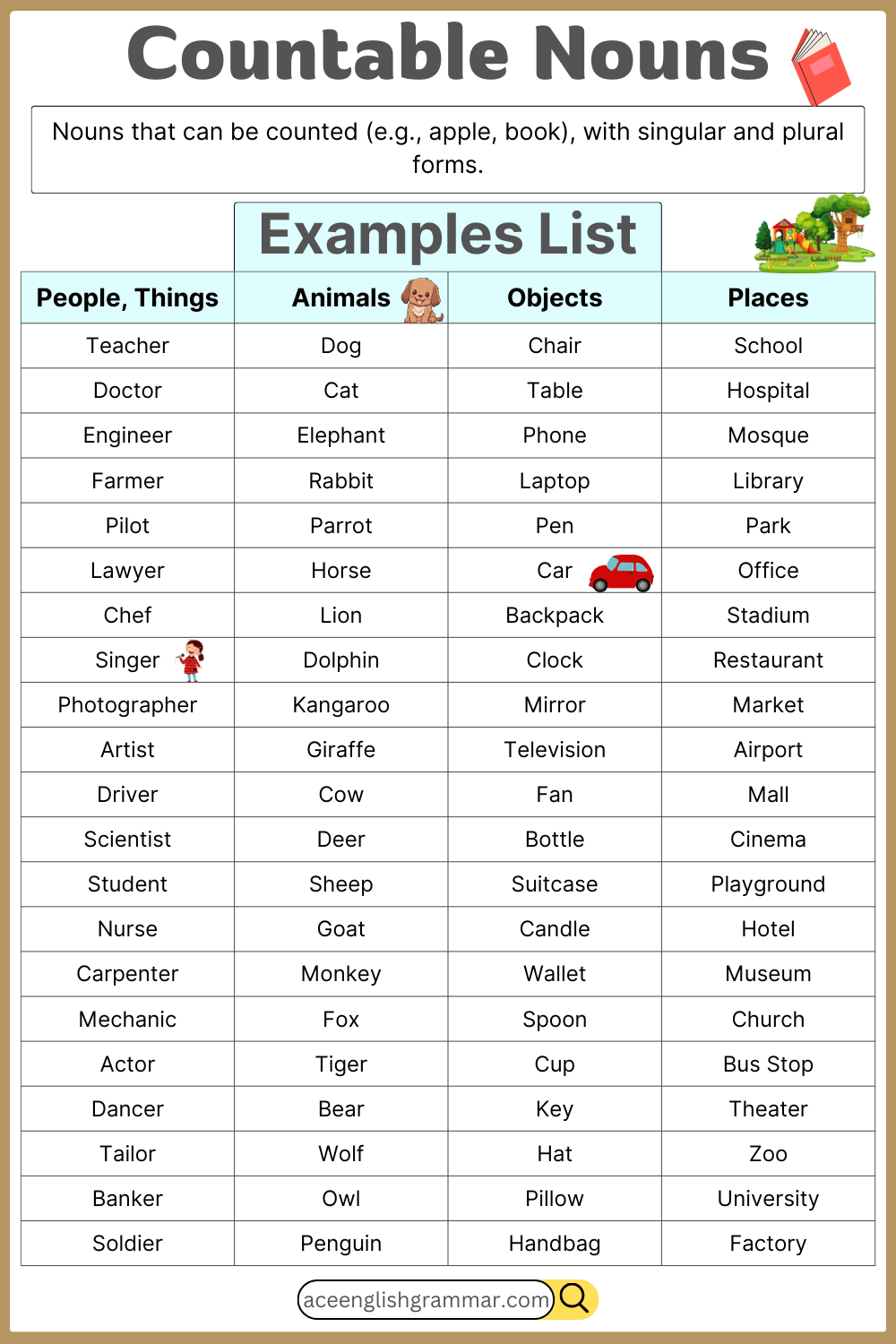
Countable nouns appear in everyday speech and writing because they name people, objects, places, animals, and separate items.
| Category | Countable noun examples |
|---|---|
| Common objects | Chair, table, lamp, phone, bottle |
| People and jobs | Teacher, doctor, artist, chef, student |
| Food items | Apple, sandwich, cupcake, cookie, egg |
| Places | House, school, restaurant, mosque, stadium |
| Animals | Dog, cat, rabbit, elephant, parrot |
| Travel items | Ticket, suitcase, passport, bag, camera |
These nouns can take numbers directly.
- I bought two tickets for the concert.
- The room has six chairs.
- A chef prepared three sandwiches.
- Several students waited outside the classroom.
The number belongs directly to the noun. You do not need a measurement phrase because each noun already names a separate item.
Rules For Countable Nouns
Countable nouns follow a clear grammar pattern. The sentence must show whether the noun refers to one item, more than one item, or a specific item the reader already knows.
Use Singular And Plural Forms
A singular countable noun names one item. A plural countable noun names more than one.
- A cat is sleeping on the sofa.
- Three cats are playing outside.
The first sentence refers to one animal, so cat stays singular. The second sentence refers to more than one animal, so the noun changes to cats.
Use Articles With Singular Countable Nouns
A singular countable noun usually needs an article, possessive word, or determiner before it.
- I saw a dog in the park.
- She opened the window.
- My friend called me yesterday.
- This student finished the work early.
The sentence I bought pencil sounds incomplete because pencil is singular and countable. English expects a word such as a, the, this, that, or my before it.
Correct form:
- I bought a pencil.
Use Numbers Before Countable Nouns
Numbers can come directly before countable nouns.
- We bought five tickets.
- She owns two bicycles.
- Ten students joined the competition.
When the number is more than one, the noun usually takes a plural form.
Use The Right Quantifiers
Plural countable nouns work with quantifiers that refer to number.
- Many students attended the lecture.
- I have a few books on my desk.
- Several cars were parked outside.
- A number of guests arrived early.
Use many, not much, with plural countable nouns.
- Many chairs were empty.
- Much chairs were empty. ❌
Form Plurals Correctly
Most countable nouns form the plural by adding -s or -es.
| Singular | Plural |
|---|---|
| Book | Books |
| Chair | Chairs |
| Box | Boxes |
| Bus | Buses |
| Watch | Watches |
Some countable nouns have irregular plural forms.
| Singular | Plural |
|---|---|
| Child | Children |
| Man | Men |
| Woman | Women |
| Tooth | Teeth |
| Mouse | Mice |
Irregular plurals matter because the noun still behaves as countable, but it does not follow the usual -s pattern.
- Two children were playing in the garden.
- The men carried heavy boxes.
Countable Nouns In Sentences
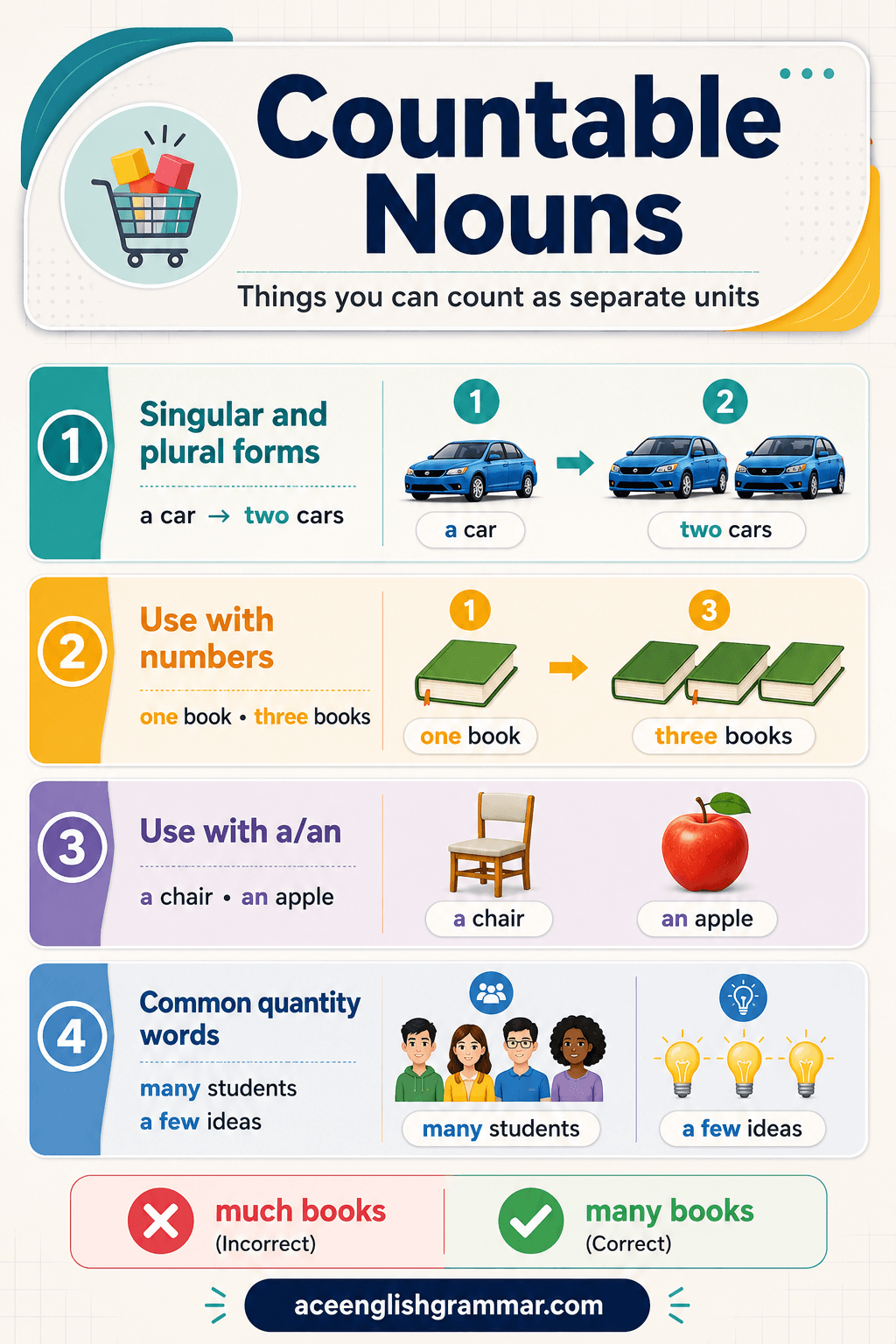
A countable noun can appear as the subject, object, or part of a longer noun phrase. The form still depends on number and sentence meaning.
Singular countable nouns usually need an article or determiner.
- A teacher explained the lesson clearly.
- The child opened a window.
- I bought a notebook yesterday.
Plural countable nouns can work with numbers, quantifiers, or no article when speaking generally.
- Several students asked questions after class.
- Three buses stopped outside the station.
- Books can change how people think.
Questions and negatives often use any and many.
- Do you have any pencils?
- She does not have many books.
- Are there any empty seats left?
Notice how the noun phrase changes, but the basic countable pattern stays the same. The sentence shows one item, many items, or an unknown number of items.
Countable Nouns And Articles
Article choice becomes easier once you know that a noun is countable. English uses articles to show whether the noun is one general item, one specific item, or something already known.
Use a before consonant sounds.
- A book
- A student
- A chair
Use an before vowel sounds.
- An apple
- An orange
- An umbrella
The choice depends on sound, not spelling.
- An hour
- A university
Use the for specific or already-known nouns.
- The teacher entered the classroom.
- The students are waiting outside.
- Please close the door.
In these sentences, the points to a specific teacher, group of students, or door. The reader or listener can identify which one you mean.
Difference Between Countable And Uncountable Nouns
Countable nouns name separate units. Uncountable nouns name things English usually treats as a whole amount, material, idea, or category.
| Feature | Countable nouns | Uncountable nouns |
|---|---|---|
| Basic meaning | Separate items | Whole amount or category |
| Number use | Takes numbers directly | Does not usually take numbers directly |
| Singular and plural | Has both forms | Usually stays singular |
| Article use | Can use a or an in singular form | Usually does not use a or an |
| Common quantifiers | Many, few, several | Much, little, some |
| Examples | Book, chair, apple, student | Water, advice, furniture, rice |
Compare the sentence patterns:
- I bought three apples.
- I bought some rice.
You can count apples directly because each apple is a separate item. You cannot normally say three rice because English treats rice as a mass. To count it, add a measurement word.
- A bowl of rice
- Two bags of rice
The countable word is bowl or bag, not rice.
Common Mistakes With Countable Nouns
Countable noun mistakes usually happen when the noun phrase does not show number clearly or when a learner uses an uncountable pattern with a countable noun.
Forgetting an article before a singular countable noun
- I saw cat in the garden. ❌
- I saw a cat in the garden. ✅
The noun cat names one animal, so it needs an article.
Using much with plural countable nouns
- There is much chairs in the room. ❌
- There are many chairs in the room. ✅
Use many when the noun is plural and countable.
Using the wrong irregular plural
- Two childs were playing outside. ❌
- Two children were playing outside. ✅
The noun is countable, but its plural form is irregular.
Forgetting the plural ending after a number
- She bought three book. ❌
- She bought three books. ✅
A number greater than one usually requires the plural form.
How To Test A Countable Noun
A quick way to test a countable noun is to place a number before it.
- One chair, two chairs
- One apple, five apples
- One student, many students
If the noun works naturally with a number and changes into a plural form, it is usually countable.
You can also test the singular form. If the noun sounds incomplete by itself after a verb or preposition, it may need an article or determiner.
- I bought a notebook.
- She sat on the chair.
- He spoke to my teacher.
A singular countable noun rarely stands alone because English expects the noun phrase to show which one, whose one, or how many.
FAQs
Q1. What is a countable noun?
A countable noun names something English treats as a separate item, such as book, chair, apple, student, or ticket. It can usually appear in singular and plural form.
Q2. How do you identify a countable noun?
Place a number before the noun. If the phrase sounds natural and the noun has a plural form, the noun is usually countable.
- One apple → two apples
- One chair → several chairs
Q3. Can countable nouns be singular and plural?
Yes. Countable nouns normally have both forms.
- Book → books
- Student → students
- Child → children
Q4. Which quantifiers are used with countable nouns?
Use many, few, a few, several, and a number of with plural countable nouns.
- Many books
- A few questions
- Several students
Q5. What are common mistakes with countable nouns?
Common mistakes include forgetting articles before singular nouns, using much instead of many, missing plural endings, and using incorrect irregular plurals.
Download PDF
To make learning easier, we have compiled a detailed list of countable nouns along with their descriptions and examples in a PDF format. This downloadable PDF will help you understand countable noun better and serve as a quick reference for study or teaching purposes.
Conclusion
Countable nouns shape the grammar around them. They take singular and plural forms, work with numbers, and often need articles or quantifiers to make the noun phrase complete. When you can see whether a noun is one item, several items, or a specific item, the correct sentence form becomes much easier to choose.
Read More