Compound nouns join two or more words to name one person, place, thing, or idea. Words like toothbrush, ice cream, and mother-in-law work as single nouns, even though they are built from smaller words.
The main challenge is not the meaning alone. It is knowing whether a compound noun should be written as one word, two words, or with hyphens. That is why bedroom, bus stop, and runner-up all belong to the same grammar family but look different on the page.
A strong understanding of compound nouns gives you better control over spelling, sentence structure, plural forms, and meaning. The sections below move from the basic idea to real examples, formation patterns, common mistakes, and plural rules.
What Are Compound Nouns?
A compound noun is a noun made from two or more words that work together as one noun. It names a single person, place, thing, animal, event, or idea.
For example, a toothbrush is not any brush. It is a brush used for teeth. A raincoat is not simply rain and a coat together. It is a coat worn in rainy weather.
In sentence structure, a compound noun behaves like one noun. It can be the subject, the object of a verb, a complement, or the object of a preposition.
- The toothbrush fell on the floor.
- Maya packed her schoolbag.
- They waited at the bus stop.
In the first sentence, toothbrush is the subject. In the second sentence, schoolbag is the object of the verb packed. In the third sentence, bus stop comes after the preposition at. The spelling changes, but the noun function stays the same.
Types Of Compound Nouns
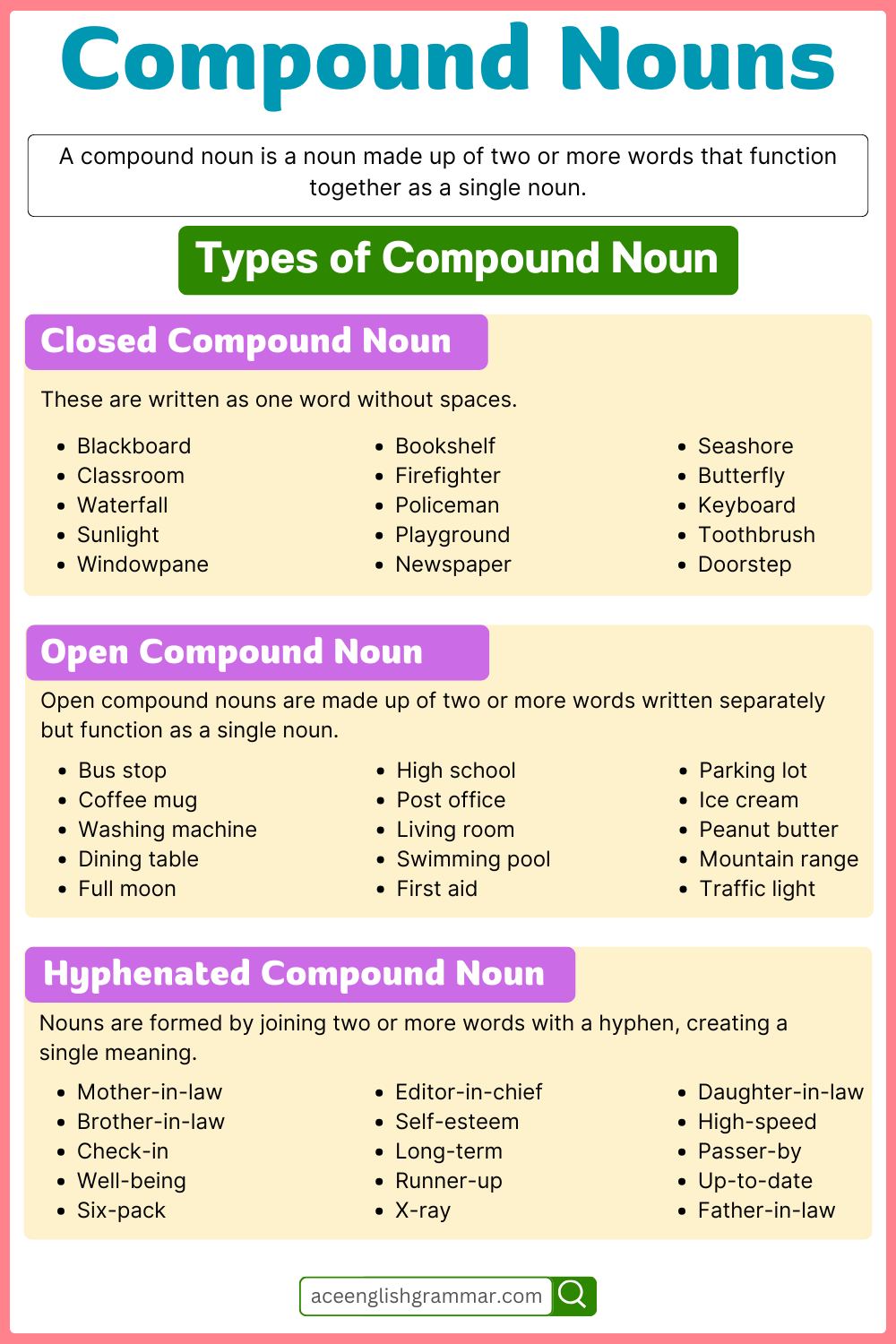
Compound nouns have three main written forms: closed compound nouns, open compound nouns, and hyphenated compound nouns. The written form changes, but each one still names one noun idea.
| Type | How it is written | Examples |
|---|---|---|
| Closed compound noun | One word | toothbrush, notebook, bedroom |
| Open compound noun | Two separate words | ice cream, bus stop, dining room |
| Hyphenated compound noun | Words joined with hyphens | mother-in-law, check-in, runner-up |
These forms matter because English does not use one spelling pattern for every compound noun. Some words have become fixed as one word, while others remain separate or hyphenated.
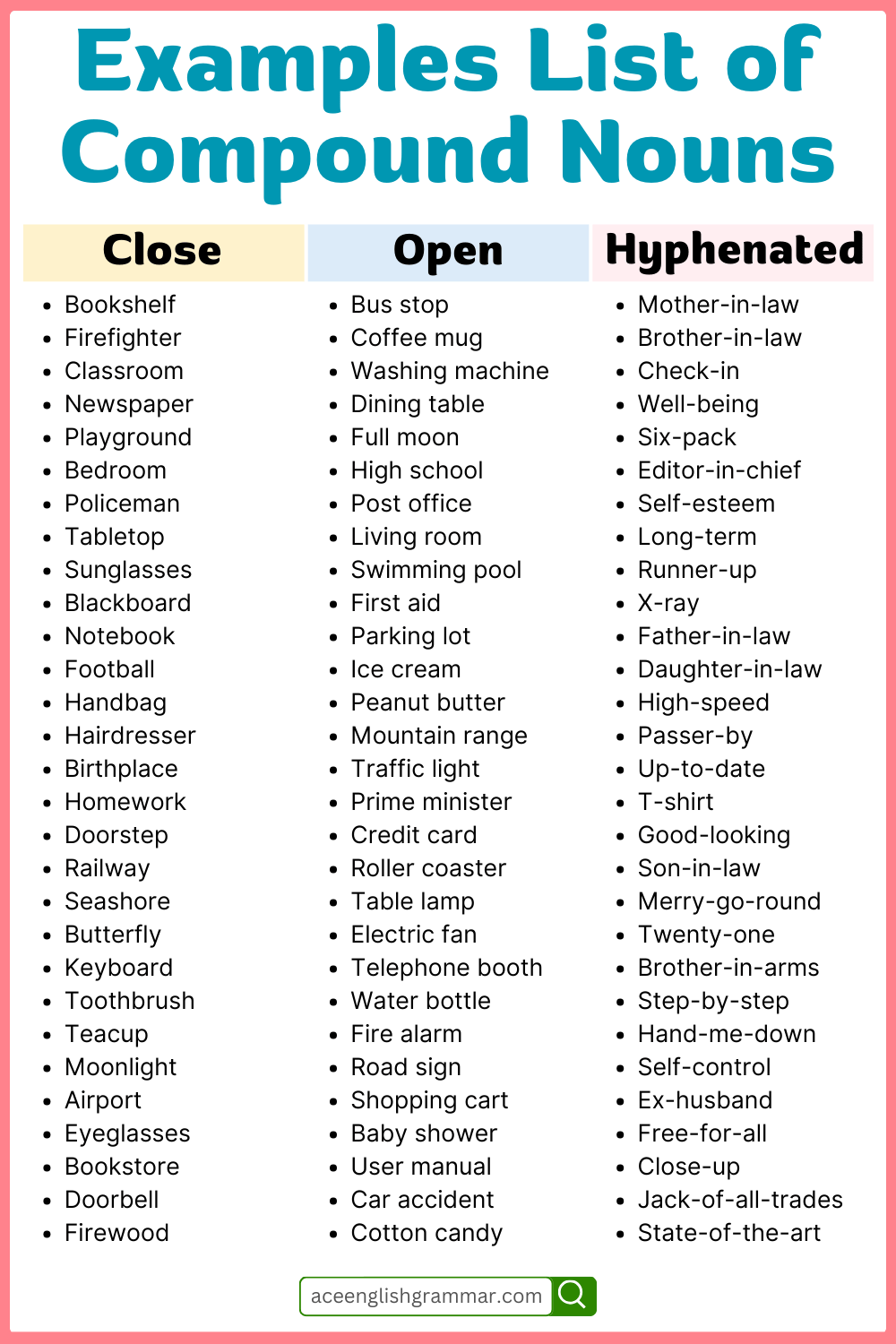
Closed Compound Nouns
A closed compound noun is written as one word. These are common for everyday objects, places, and familiar ideas.
Examples:
- backpack
- bathroom
- classroom
- football
- raincoat
- toothpaste
- notebook
- bookshelf
- flashlight
- keyboard
Sara placed her notebook on the desk before class.
Closed compound nouns often feel like single words because people use them often. Still, the two parts remain meaningful. In bookshelf, the first part tells what the shelf is for, and the second part names the main object.
Open Compound Nouns
An open compound noun is written as two separate words, but the words work together as one noun.
Examples:
- ice cream
- bus stop
- swimming pool
- dining room
- coffee table
- credit card
- high school
- parking lot
- washing machine
- office chair
The children waited at the bus stop after school.
Even with a space between the words, bus stop names one place. This is why spacing alone does not decide whether a noun is compound.
Hyphenated Compound Nouns
A hyphenated compound noun uses one or more hyphens between the words. These are common in family relationships, roles, and nouns formed from short phrases.
Examples:
- mother-in-law
- father-in-law
- sister-in-law
- runner-up
- check-in
- check-out
- passer-by
- editor-in-chief
- merry-go-round
- six-pack
Her mother-in-law arrived for dinner on Friday.
Hyphenated compound nouns often need extra attention in plural form. The plural marker does not always go at the end, as you will see later in the plural rules.
Compound Nouns List With Meanings
As you read the list, notice how the first word often narrows the second word. A schoolbag is a type of bag, a coffee table is a type of table, and a birthday cake is a type of cake.
| Compound noun | Meaning |
|---|---|
| airport | A place where airplanes take off and land |
| airplane | A flying vehicle with wings and engines |
| alarm clock | A clock that rings at a chosen time |
| apartment building | A building with several homes inside |
| apple pie | A baked dessert made with apples |
| babysitter | A person who takes care of children for a short time |
| backache | Pain in the back |
| backpack | A bag carried on the back |
| ballroom | A large room used for dancing |
| bank account | A record of money kept in a bank |
| baseball | A bat and ball sport |
| basketball | A sport played by throwing a ball through a hoop |
| bathroom | A room with a toilet, sink, bath, or shower |
| bedroom | A room used for sleeping |
| billboard | A large outdoor advertising board |
| birthday cake | A cake eaten at a birthday celebration |
| blackboard | A dark board used for writing with chalk |
| bookcase | A piece of furniture for books |
| bookstore | A shop that sells books |
| bus stop | A place where buses pick up passengers |
| businessman | A man who works in business |
| car seat | A seat made for a child in a car |
| car wash | A place or service for washing cars |
| cardboard | Thick paper material used for boxes |
| cellphone | A mobile phone |
| check-in | The process of registering at a hotel or airport |
| check-out | The process of leaving a hotel or paying before departure |
| cheesecake | A dessert made with soft cheese |
| childcare | Care given to children |
| classroom | A room where students learn |
| classmate | A person in the same class |
| coffee table | A low table usually placed near a sofa |
| cookbook | A book with cooking recipes |
| cowboy | A person who works with cattle, often on horseback |
| credit card | A card used to buy things and pay later |
| cupcake | A small cake baked in a paper cup |
| daydream | Thoughts that drift away from the present moment |
| deadline | The final time or date for finishing something |
| dining room | A room used for eating meals |
| dishwasher | A machine that washes dishes |
| doorbell | A bell used to call someone at the door |
| doorway | The opening where a door is placed |
| driveway | A short private road beside a house |
| dustbin | A container for rubbish or waste |
| earthquake | A shaking of the ground |
| earring | Jewelry worn on the ear |
| eyeglasses | Glasses worn to improve eyesight |
| farmhouse | A house on a farm |
| firefighter | A person trained to put out fires and rescue people |
| fireplace | A place inside a room where a fire burns |
| firewood | Wood used for burning |
| fish tank | A glass container where fish are kept |
| flagpole | A pole used to fly a flag |
| flashlight | A small portable electric light |
| footpath | A path for walking |
| football | A team sport played with a ball |
| footstep | The sound or mark made by a foot |
| friendship | A relationship between friends |
| front door | The main door at the front of a home |
| garage door | A large door on a garage |
| garbage can | A container for waste |
| gift shop | A shop that sells small gifts |
| girlfriend | A female romantic partner |
| greenhouse | A glass building used for growing plants |
| hairbrush | A brush used for hair |
| haircut | The act or style of cutting hair |
| handbag | A small bag carried by hand or on the shoulder |
| handshake | The act of holding and shaking hands |
| headache | Pain in the head |
| headlight | A light at the front of a vehicle |
| high school | A school for older students |
| highway | A main road for fast travel |
| homework | Schoolwork done at home |
| housekeeper | A person who cleans or manages a home |
| ice cream | A frozen sweet food |
| ink bottle | A bottle that holds ink |
| internet café | A café where people use internet-connected computers |
| jacket pocket | A pocket on a jacket |
| jellyfish | A sea animal with a soft body and stinging tentacles |
| keyboard | A set of keys used for typing |
| keyhole | A hole where a key is placed |
| kitchen sink | A sink used in a kitchen |
| ladybug | A small round beetle, often red with black spots |
| laptop | A portable computer |
| lawmaker | A person who helps make laws |
| lighthouse | A tower with a strong light near the sea |
| lifeboat | A boat used for rescue |
| lifeguard | A person who watches swimmers for safety |
| lipstick | Colored makeup for the lips |
| mailbox | A box where letters are placed |
| makeup | Products used on the face |
| marketplace | A place where buying and selling happen |
| milkshake | A cold drink made with milk and flavoring |
| moonlight | Light from the moon |
| motorcycle | A two-wheeled motor vehicle |
| newspaper | Printed or digital news publication |
| nightstand | A small table beside a bed |
| notebook | A book used for writing notes |
| office chair | A chair used at a desk or office |
| online shop | A shop that sells products on the internet |
| overcoat | A long warm coat worn over clothes |
| paintbrush | A brush used for painting |
| pancake | A flat round cake cooked in a pan |
| parking lot | An area where cars are parked |
| passport | An official travel document |
| password | A secret word used to access an account |
| paycheck | Money paid for work |
| peanut butter | A spread made from peanuts |
| photo album | A book or digital collection of photos |
| playground | A place where children play |
| postcard | A card sent by mail, often with a picture |
| raincoat | A coat worn in rain |
| rainbow | Colored bands seen in the sky after rain |
| road map | A map that shows roads |
| rock band | A group that plays rock music |
| roommate | A person who shares a room or home |
| sandcastle | A castle shape made from sand |
| schoolbag | A bag used for school |
| screenshot | A picture taken of a screen |
| seatbelt | A safety belt in a vehicle |
| shopping cart | A cart used for carrying items in a store |
| shoelace | A lace used to tie a shoe |
| skateboard | A board with wheels used for riding |
| skyscraper | A very tall building |
| sleeping bag | A padded bag used for sleeping outdoors |
| smartwatch | A watch with digital features |
| snowman | A figure made from snow |
| software | Computer programs |
| soundtrack | Music used in a film, show, or game |
| spaceship | A vehicle designed for travel in space |
| spotlight | A strong light focused on one area |
| staircase | A set of stairs |
| starfish | A sea animal shaped like a star |
| stopwatch | A watch used to measure time |
| strawberry | A small red fruit |
| sunlight | Light from the sun |
| sunset | The time when the sun goes below the horizon |
| superhero | A fictional character with special powers |
| tablecloth | A cloth placed over a table |
| teacup | A cup used for tea |
| teaspoon | A small spoon |
| textbook | A book used for study |
| thunderstorm | A storm with thunder and lightning |
| toothbrush | A brush used for cleaning teeth |
| toothpaste | Paste used for cleaning teeth |
| toolbox | A box for tools |
| traffic light | A light that controls road traffic |
| trash can | A container for waste |
| treehouse | A small structure built in a tree |
| typewriter | A machine used for typing on paper |
| wallpaper | Decorative paper or digital background |
| washing machine | A machine that washes clothes |
| watchdog | A dog trained to guard a place |
| wheelchair | A chair with wheels for someone who cannot walk easily |
| windshield | The front glass window of a vehicle |
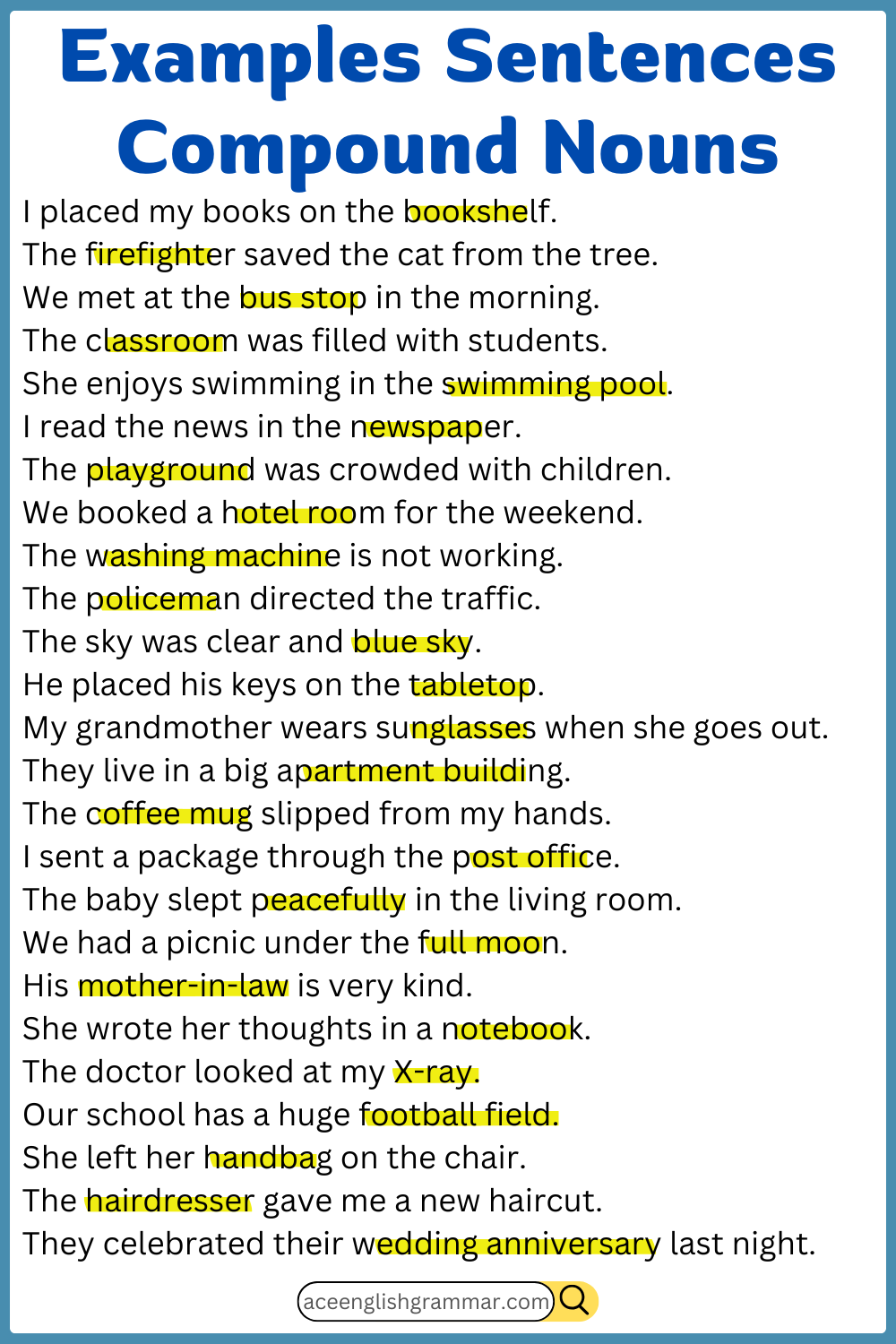
Compound Nouns In Sentences
A compound noun does not only need the right spelling. It also needs a natural place inside the sentence. Like any other noun, it can work as the subject, the object of a verb, or the object of a preposition.
In the first few examples below, notice how the compound noun behaves as one unit, even when it is written as two words.
- Amina packed her backpack before school.
- The doorbell rang twice before dinner.
- The children waited near the bus stop after the rain.
In the first sentence, backpack is the object of the verb packed. In the second sentence, doorbell is the subject. In the third sentence, bus stop follows the preposition near.
More examples:
- Daniel left his notebook on the kitchen table.
- Sofia wore a raincoat during the storm.
- A firefighter carried the child away from the smoke.
- Omar parked his car in the driveway.
- Mia placed her coffee mug on the coffee table.
- The baby slept in a small car seat.
- We bought fresh bread from the marketplace.
- The traffic light turned red at the corner.
- He forgot the password for his email account.
- The lighthouse shone across the dark water.
- Emma cleaned her bedroom before her cousins arrived.
- The team practiced on the playground after lunch.
- A thunderstorm moved across the city at night.
- The chef used a teaspoon of salt in the soup.
- Leena kept old family photos in a photo album.
- The washing machine stopped halfway through the cycle.
- A rainbow appeared above the trees after the shower.
The sentence position may change, but the compound noun keeps its single meaning. Washing machine has two words, yet it still names one machine.
How Compound Nouns Are Formed
Compound nouns follow several common formation patterns. These patterns show the relationship between the parts of the noun. They are not spelling rules by themselves, so the final written form still depends on accepted usage.
Noun + Noun
This is one of the most common patterns. The first noun often tells the type, place, material, or purpose of the second noun.
| Pattern | Examples |
|---|---|
| noun + noun | football, toothpaste, classroom, raincoat, bookshelf |
A classroom is a room for a class. A bookshelf is a shelf for books. A raincoat is a coat for rain. The second word usually carries the main noun idea, while the first word narrows it.
Adjective + Noun
Some compound nouns begin with an adjective, but the full word or phrase names one specific thing.
| Pattern | Examples |
|---|---|
| adjective + noun | blackboard, greenhouse, software, high school |
A greenhouse is not just any green house. It is a glass building where plants grow. This is why compound nouns must be understood by meaning, not only by the separate words inside them.
Verb + Noun
Some compound nouns begin with a verb form that points to purpose or activity.
| Pattern | Examples |
|---|---|
| verb + noun | washing machine, swimming pool, driving license, reading lamp |
A washing machine is a machine for washing clothes. A swimming pool is a pool for swimming. The first part often tells what the second part is used for.
Noun + Verb
In this pattern, the noun connects with an action, event, or result.
| Pattern | Examples |
|---|---|
| noun + verb | haircut, rainfall, sunrise, sunset |
A haircut is the cutting of hair. A rainfall is the fall of rain. These nouns often name an event, result, or natural process.
Preposition + Noun
Some compound nouns begin with a preposition and carry a fixed meaning.
| Pattern | Examples |
|---|---|
| preposition + noun | underworld, afterthought, background, bystander |
An afterthought is a thought that comes later. A bystander is a person standing near an event without taking part. These compounds are often less literal than everyday object nouns.
Why Spacing Does Not Decide Meaning
Once you know the three written forms, it is important to separate spelling from grammar function. A compound noun can be one word, two words, or hyphenated, but it still works as one noun in the sentence.
| Form | Example | Why it is a compound noun |
|---|---|---|
| Closed | toothbrush | It names one object used for teeth |
| Open | ice cream | It names one type of food |
| Hyphenated | sister-in-law | It names one family relationship |
The spelling usually follows accepted usage, not a rule you can apply to every new combination. That is why toothbrush is one word, but ice cream remains two.
When you are unsure, check a trusted dictionary. Guessing the spelling often leads to unnatural forms such as icecream or tablelamp.
Compound Nouns With Different Meanings
Some compound nouns look close to ordinary adjective plus noun phrases, but the meaning changes. This is one of the most important points for serious learners because spacing can signal a different meaning.
Greenhouse Vs Green House
A greenhouse is a glass building used for growing plants.
A green house is a house that is green in color.
Blackboard Vs Black Board
A blackboard is a board used for writing with chalk.
A black board could be any board that is black.
Ice Cream Vs Ice And Cream
Ice cream is a frozen dessert.
Ice and cream means two separate things: ice and cream.
These pairs show why meaning matters more than spacing. A compound noun often names a fixed idea that cannot be guessed from the separate words alone.
Compound Nouns And Word Stress
Spoken English often gives compound nouns stronger stress on the first word. This can help you hear the difference between a compound noun and an ordinary adjective plus noun phrase.
Compare:
- GREENhouse: a glass building for plants
- green HOUSE: a house that is green
- BLACKbird: a type of bird
- black BIRD: any bird that is black
This stress pattern is not the only test for compound nouns, but it is common in natural speech. It also explains why greenhouse and green house do not sound exactly the same when spoken carefully.
Singular And Plural Compound Nouns
Once you know whether a compound noun is open, closed, or hyphenated, the next issue is number. Some compound nouns become plural in the usual way, while others change the main noun inside the phrase.
The main noun is the word that carries the core meaning. In mother-in-law, the main relationship word is mother, so the plural becomes mothers-in-law.
| Singular | Plural |
|---|---|
| toothbrush | toothbrushes |
| notebook | notebooks |
| classroom | classrooms |
| handbag | handbags |
| washing machine | washing machines |
| parking lot | parking lots |
| mother-in-law | mothers-in-law |
| father-in-law | fathers-in-law |
| passer-by | passers-by |
| runner-up | runners-up |
| editor-in-chief | editors-in-chief |
| check-in | check-ins |
For many one-word and two-word compound nouns, the plural marker goes at the end:
- backpack → backpacks
- bedroom → bedrooms
- coffee table → coffee tables
- washing machine → washing machines
For many hyphenated compounds with a main noun inside the phrase, the main noun becomes plural:
- mother-in-law → mothers-in-law
- passer-by → passers-by
- editor-in-chief → editors-in-chief
Earlier, toothbrush worked as one object name. In plural form, it behaves like a regular count noun: toothbrushes. Hyphenated relationship terms behave differently because the main noun sits inside the phrase.
How To Make Compound Nouns Plural
Plural compound nouns are easier to manage when you look for the main noun first. In many cases, the plural marker goes on the main noun, not automatically at the end of the full phrase.
Add S Or ES To The End For Many Closed Compounds
Closed compound nouns usually take the plural marker at the end.
- toothbrush → toothbrushes
- notebook → notebooks
- backpack → backpacks
- bookcase → bookcases
- flashlight → flashlights
She bought two toothbrushes for the trip.
This pattern is familiar because closed compounds behave like regular single-word nouns.
Add S To The Main Noun In Many Open Compounds
Open compound nouns often make the final word plural when that word is the main noun.
- coffee table → coffee tables
- parking lot → parking lots
- washing machine → washing machines
- office chair → office chairs
- bus stop → bus stops
The city added three new bus stops near the school.
Here, stop is the main noun in bus stop, so the plural form is bus stops.
Change The Main Word In Many Hyphenated Compounds
Many hyphenated compounds change the main noun inside the phrase.
- mother-in-law → mothers-in-law
- sister-in-law → sisters-in-law
- passer-by → passers-by
- runner-up → runners-up
Both runners-up received medals after the contest.
In mother-in-law, the main noun is mother. Adding s at the end, as in mother-in-laws, is a common mistake because the whole phrase looks like one block.
Watch Irregular Plural Forms
Some compound nouns contain words with irregular plural forms.
- manservant → menservants
- woman doctor → women doctors
- gentleman farmer → gentlemen farmers
These are less common in everyday writing, but they show why the main word matters. A compound noun may look fixed, but its plural form still follows the grammar of the noun inside it.
Common Mistakes With Compound Nouns
Compound noun mistakes often happen because learners focus on the two visible words but miss the fixed meaning or the main noun inside the phrase.
Mistake 1: Treating Every Compound Noun As One Word
Not every compound noun is closed. Ice cream, bus stop, and swimming pool are usually written as two words.
Incorrect: I bought icecream.
Correct: I bought ice cream.
This mistake happens because many common compounds, such as toothbrush and notebook, are closed. English, however, keeps many compound nouns open.
Mistake 2: Putting The Plural S In The Wrong Place
Some hyphenated compound nouns do not take the plural marker at the end.
Incorrect: mother-in-laws
Correct: mothers-in-law
Incorrect: passer-bys
Correct: passers-by
This mistake happens because the phrase looks like one unit. Grammatically, the plural belongs on the main noun inside the compound.
Mistake 3: Missing The Meaning Difference
A compound noun can have a fixed meaning that differs from the separate words.
A blackbird is a type of bird. A black bird is any bird that is black.
A greenhouse is a plant-growing structure. A green house is a house painted green.
The difference is not cosmetic. It changes the meaning of the noun phrase.
Mistake 4: Using Unnatural Spellings
Some spellings look logical but are not standard in common English.
Use table lamp, not tablelamp.
Use road sign, not roadsign, in most general writing.
Use PIN, not PIN number, when you want to avoid repetition, because PIN already contains the word number.
The safest habit is to check the whole compound as one item, not just the separate words.
Mistake 5: Forgetting Regional Differences
Some compound nouns vary between American and British English.
| American English | British English |
|---|---|
| windshield | windscreen |
| trash can | dustbin |
| bookstore | bookshop |
| sidewalk | pavement or footpath |
Both forms may be correct, but the better choice depends on your audience. For a mainly American page, windshield, trash can, and bookstore will usually feel more natural.
Compound Nouns By Category
Compound nouns often grow around familiar parts of daily life: home, school, food, jobs, travel, and weather. Seeing them by setting makes the word patterns easier to notice without treating every word as a separate grammar rule.
Home And Daily Objects
- bedroom
- bathroom
- doorbell
- bookshelf
- hairbrush
- toothbrush
- toothpaste
- tablecloth
- flashlight
- washing machine
These nouns name objects and places used at home. Many of them are closed compounds because they are common daily words.
School And Learning
- classroom
- classmate
- schoolbag
- textbook
- notebook
- homework
- blackboard
- high school
- reading lamp
- bookcase
These compound nouns are common in study, school routines, and classroom settings. Some are closed, such as classroom and homework, while others remain open, such as high school.
Food And Drink
- apple pie
- cupcake
- pancake
- cheesecake
- milkshake
- peanut butter
- ice cream
- seafood
- strawberry
- teacup
Food compounds often stay open when the phrase is still read as two separate words, such as apple pie and ice cream. Others become closed, such as cupcake and pancake.
People And Jobs
- babysitter
- firefighter
- housekeeper
- lifeguard
- lawmaker
- mailman
- postman
- photographer
- businessman
- cowboy
These nouns name people by their work, role, or activity. The first part often points to the task, place, or social role connected with the person.
Places And Travel
- airport
- highway
- bus stop
- parking lot
- farmhouse
- lighthouse
- marketplace
- playground
- driveway
- railroad
These compounds name fixed places, travel points, roads, or buildings. Several are open compounds because they still read naturally as two-word place names.
Nature And Weather
- moonlight
- sunlight
- sunset
- sunshine
- rainfall
- rainbow
- earthquake
- thunderstorm
- snowball
- starfish
Nature-related compound nouns often combine a natural object with light, weather, movement, or shape. Words like sunlight, rainfall, and thunderstorm show how a compound can name a natural event or condition.
Compound Noun Examples With Meanings And Sentences
The examples below show meaning and sentence use together. This is often the most practical way to learn a compound noun because you see both the noun idea and its grammar position.
Backpack
A backpack is a bag carried on the back.
Lena packed her backpack with books and lunch.
Raincoat
A raincoat is a coat made for rainy weather.
He wore a yellow raincoat on the walk home.
Bus Stop
A bus stop is a place where buses pick up and drop off passengers.
We stood at the bus stop for ten minutes.
Mother-In-Law
A mother-in-law is the mother of someone’s husband or wife.
My mother-in-law made dinner for the family.
Toothbrush
A toothbrush is a small brush used for cleaning teeth.
Adam replaced his toothbrush after three months.
Greenhouse
A greenhouse is a glass structure where plants grow in controlled warmth.
The tomatoes grew faster inside the greenhouse.
Washing Machine
A washing machine is a machine used for washing clothes.
The washing machine stopped before the final spin.
Firefighter
A firefighter is a person trained to put out fires and rescue people.
The firefighter climbed the ladder toward the window.
Playground
A playground is an outdoor area where children play.
The playground was full after school.
Deadline
A deadline is the latest time or date when work must be finished.
The project deadline is Friday afternoon.
Final Rules To Remember
Compound nouns name one noun idea, even when they are built from more than one word. The spelling may be closed, open, or hyphenated, but the words work together as a single noun in sentence structure.
The most important rules are:
- Closed compounds are written as one word: toothbrush, notebook, bedroom
- Open compounds are written as separate words: ice cream, bus stop, washing machine
- Hyphenated compounds use hyphens: mother-in-law, check-in, runner-up
- Many compounds become plural at the end: notebooks, backpacks, washing machines
- Some hyphenated compounds change the main noun: mothers-in-law, passers-by, runners-up
- Meaning matters: greenhouse and green house do not name the same thing
When you meet a new compound noun, learn three things together: what it means, how it is written, and how it changes in plural form. That habit keeps your spelling, meaning, and grammar connected.
FAQs About Compound Nouns
A compound noun is a noun made from two or more words that work together as one noun. It names one person, place, thing, animal, event, or idea. Examples include toothbrush, ice cream, bus stop, and mother-in-law.
The three main types are closed compound nouns, open compound nouns, and hyphenated compound nouns. Closed compounds are written as one word, open compounds use separate words, and hyphenated compounds use hyphens.
Yes, ice cream is an open compound noun. It is written as two words, but the two words name one food.
Many closed and open compound nouns add s or es at the end, such as notebooks and washing machines. Some hyphenated compounds change the main noun, such as mother-in-law becoming mothers-in-law.
A compound noun names one fixed person, place, thing, or idea. A noun phrase may describe a noun without creating a new fixed meaning. For example, greenhouse is a compound noun, while green house is a noun phrase describing a house that is green.
Yes. Some compound nouns have more than two words. Examples include mother-in-law, editor-in-chief, washing machine, and high school teacher.
No. Some are written as one word, some as two words, and some with hyphens. English spelling depends heavily on accepted usage, so a dictionary is the safest choice for uncertain forms.
Download PDF
Download the Compound Nouns PDF to learn their definition, formation rules, and examples. This PDF helps you understand how compound noun is formed and used in sentences. Click here to download for easy reference and practice!👇👇
Read More