
Paste or type a passage, and every phrasal verb in it will be marked with its meaning and a formal alternative.
Paste any passage into our free phrasal verb finder, and every phrasal verb in it is marked as you type. Beside it you read its meaning, whether it is informal or neutral, and a formal single-word alternative. Choose the alternative you prefer, and the Formal Version rewrites the whole text for you, with each verb in the right form.
A learner reads a text with it and no longer stops at every put off or come up with. A student or a professional turns an essay or a report into formal English with it before submission.
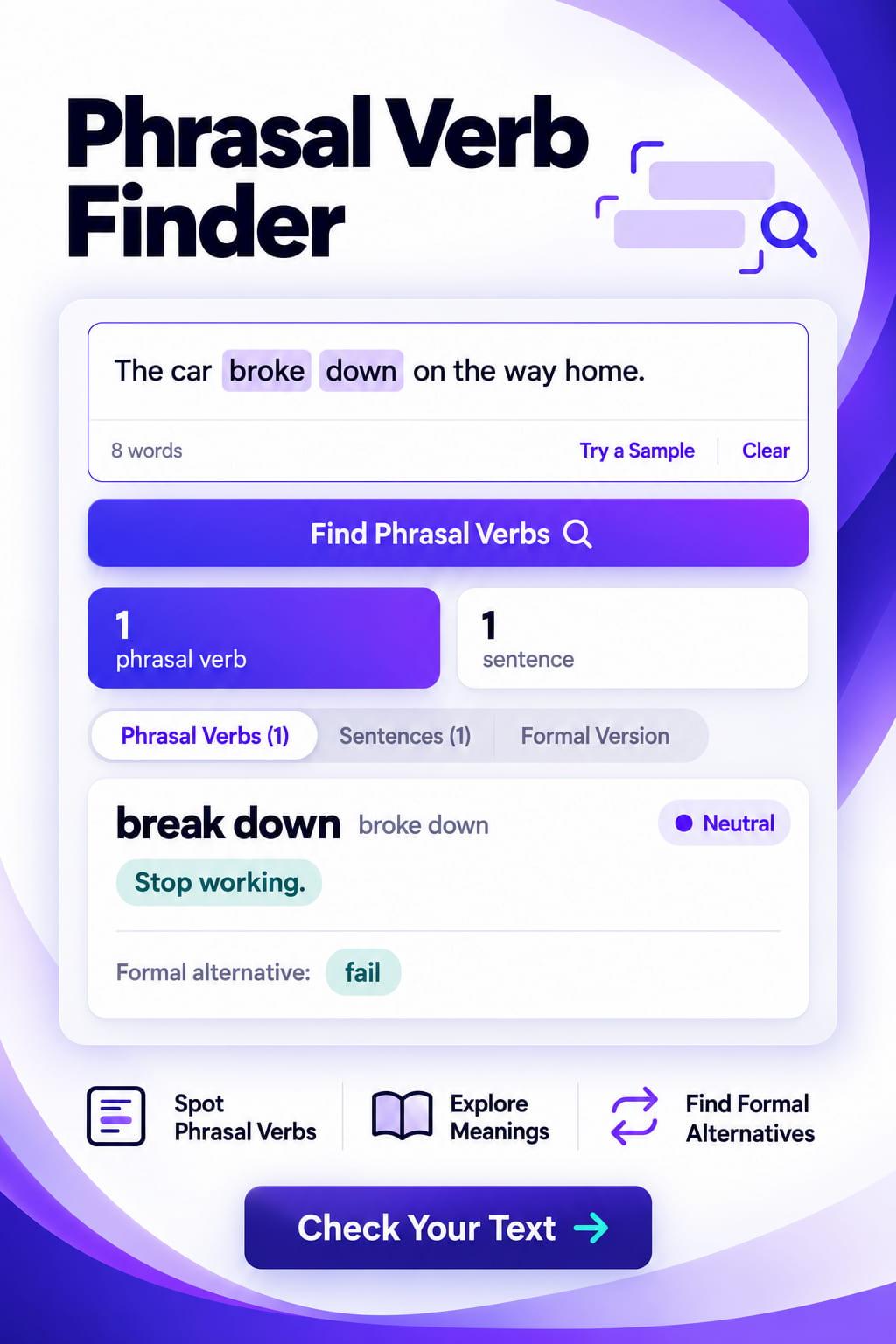
Phrasal verb finder marking set up, carried it out and came up with in a passage, with formal alternatives beneath Every phrasal verb found is listed with its meaning and a formal alternative, and the rewritten text is one click away.
Phrasal Verb Finder for Any Text
Every phrasal verb joins a verb to one or two short words such as up, off or with, and the pair means something the verb alone does not. Find out means discover, and put up with means tolerate. The phrasal verb finder recognises these pairs in whatever form they take in your text. Setting up, sets up and set up all count. So does set the meeting up, where the object stands between the two parts.
The finder treats three-part phrasal verbs as one unit as well. Look forward to, get rid of and come up with are marked whole, so the result never shows a stray up or with on its own.
Generic verb finders list single verbs and stop there, and a grammar checker ignores phrasal verbs altogether. To find phrasal verbs, this phrasal verb checker reads the verb and the word after it together. Look into therefore reads as investigate and is never mistaken for look on its own.
Phrasal Verbs Marked in Your Text as You Type
The marks appear inside the box itself, so you edit and read in one place. Change a word, and the marks update after a short pause. Paste a new passage, and the count refreshes at once.
The summary gives four counts: the phrasal verbs in the text and the different ones among them, then the informal ones and the sentences with at least one. When a text mixes informal and neutral phrasal verbs, a filter lets you show one kind at a time.
Below the summary, one view lists the phrasal verbs found. A second quotes every sentence that contains one, with the phrasal verb highlighted and its replacement beside it.
Meaning, Formality and Formal Alternatives
A card opens with a short phrasal verb meaning, so a learner understands the text without a dictionary tab. Put off is explained as postpone or discourage, and carry out as perform or complete a task.
Next comes a note on whether the phrasal verb is informal or neutral. Hang around, figure out and get rid of are informal, while set up and point out are neutral because they suit most writing. The card then lists formal single-word alternatives. Find out is paired with discover and ascertain, and bring about with cause and induce.
The card notes whether the two parts can be split. Set up accepts an object between its parts, as in set it up. Look into keeps its object after both parts. Come up with keeps all three parts together.
Formal Alternatives to Phrasal Verbs in One Click
Academic and business writing favours single-word verbs, and university writing centres ask students to avoid phrasal verbs in academic writing. Lists of academic alternatives to phrasal verbs run to hundreds of pairs, and checking a draft against one takes an afternoon. The Formal Version view identifies phrasal verbs and replaces them in one pass.
Open it, and the whole passage is shown with every phrasal verb replaced by the alternative chosen on its card. The replacement matches the form of the original. Carried it out becomes conducted it, puts off becomes postpones, and setting up becomes establishing. A separated object stays where it was, so put the vote off becomes postponed the vote.
Every replaced word is highlighted, so you read the changes before you accept them. Click a different alternative on any card, and the Formal Version updates to match. Apply to Text puts the rewritten passage back into the box, and Copy Formal Version copies it for your document.
Any phrasal verb with no single-word equivalent stays as written, and the view says how many were left.
Phrasal Verbs That Split, Stay Together or Have Three Parts
Some phrasal verbs accept an object between their two parts. Turn down, pick up, call off and hand in all take one. A short object such as it or them must go in the middle: call it off, not call off it.
Others never split, and the object always follows both parts. Look after, run into, cope with and get over never take an object between them.
Three-part phrasal verbs add a third word to the pair and stay together as one unit. Put up with, look forward to, run out of and get along with are all three-part.
The finder reads your text by these rules, which is why hand it in and called the meeting off are highlighted as single phrasal verbs rather than separate words.
How to Use the Phrasal Verb Finder
The phrasal verb finder opens empty. Try a Sample loads a short passage so you see the marks before you paste your own text.
- Paste or type your text, and wait a moment for the marks to appear.
- Read the figures in the summary, and use the filter if you want informal phrasal verbs only.
- Open the Phrasal Verbs view to read the meaning, the informal or neutral note and the alternatives on each card.
- Click your preferred alternative on any card, and the choice is kept.
- Open Formal Version to read the rewritten passage with every change marked.
- Press Apply to Text to keep it, or Copy Formal Version to paste it elsewhere.
Copy List copies every phrasal verb found with its meaning and alternatives, and Copy Marked Text copies the passage with each phrasal verb in capitals.
Who Uses a Phrasal Verb Finder
- English learners: Phrasal verbs are the hardest part of reading natural English, because the meaning rarely follows from the parts. Marking them with meanings turns an article or a story into a reading lesson.
- Essay and dissertation writers: Tutors flag phrasal verbs in academic writing as informal. One pass through the Formal Version removes them before submission.
- IELTS and Cambridge candidates: The writing papers reward formal wording. Candidates paste a practice essay and see exactly which verbs to change.
- Business writers: Reports, proposals and formal emails read better with single-word verbs. Pasting a draft reveals which paragraphs carry the most phrasal verbs.
- Teachers: Copy List turns any text into a vocabulary sheet of phrasal verbs with meanings, and the sentence view quotes each one in the sentence where it occurs.
Questions About the Phrasal Verb Finder
Q1. What does a phrasal verb finder do?
A phrasal verb finder highlights every phrasal verb in a passage and explains what each one means. This one also notes whether a phrasal verb is informal or neutral and lists formal single-word alternatives. It then rewrites the passage with the alternatives you choose.
Q2. Does it find separated phrasal verbs such as set the meeting up?
Yes, split phrasal verbs are found whenever the object stands between the two parts. Both parts are highlighted, and the card quotes the form as it appeared in your text. Three-part phrasal verbs such as put up with are found as one unit.
Q3. Are phrasal verbs acceptable in academic writing?
Rarely, because phrasal verbs read as conversational and single-word verbs read as precise, so academic style guides advise against them. Neutral ones such as carry out and point out appear in published papers, while informal ones such as figure out and get rid of do not. The Formal Version replaces either kind with a single word.
Q4. How does the Formal Version choose the form of the new verb?
The new verb takes the form of the phrasal verb it replaces. A past form gives a past form, so carried out becomes conducted. An -ing form gives an -ing form, so setting up becomes establishing. Where a verb such as set or put looks the same in the present and the past, the words around it decide.
Q5. Is the rewritten text ready to submit?
The rewritten text is a strong draft rather than a finished essay. Some phrasal verbs have two senses, and the first alternative suits the common one, so read each highlighted change and click a different alternative where the sense differs. The highlights keep that check short.
Q6. Is the phrasal verb finder free?
Yes, the phrasal verb finder is free and needs no account. The text stays in your browser, and nothing you paste is stored or sent anywhere.
More Verb Tools
The To Be Verbs Finder marks every form of be in the same way, for writers cutting weak verbs. The Verb Forms Finder shows all five forms of any verb, and the Random Verb Generator draws verbs with their past forms for practice and games.