
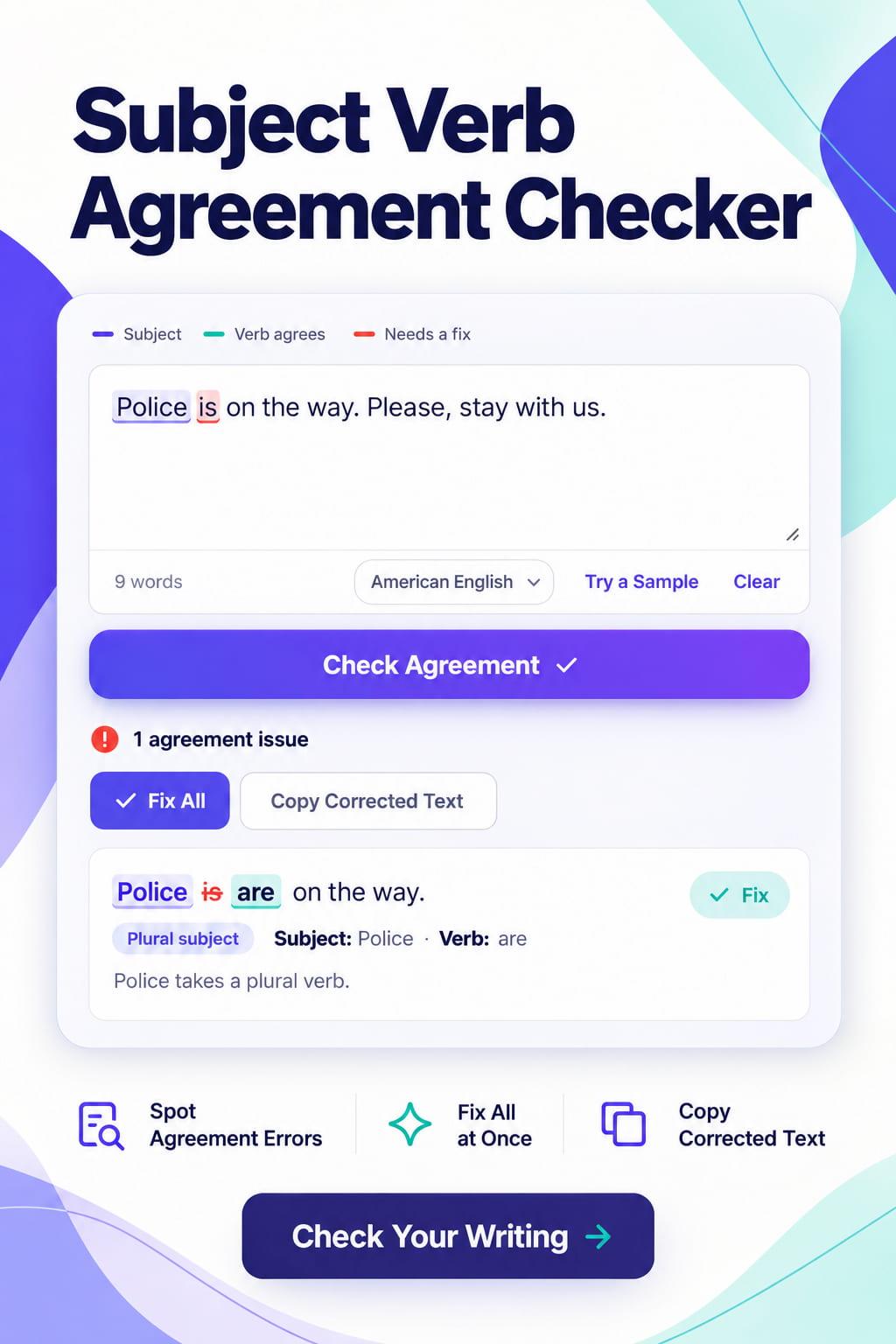
Paste a sentence or a whole passage into our free subject verb agreement checker, and the subject and the verb of every sentence are marked inside your text at once. A verb that agrees turns green, and a verb that does not turns red, with the correct form and the rule beneath the box. Fix All replaces every wrong verb in one click.
The check runs on grammar rules in your browser, so nothing else in the sentence changes. An exercise is checked before it is handed in, a corrected is shows why it became are, and a verb that drifted after a long phrase is caught before the draft goes out.
Subject Verb Agreement Checker for Sentences and Passages
The checker takes one sentence or a passage of up to 5,000 words and tests every sentence in it. A long sentence with two or three clauses is split at its commas and joining words, so the verb in a that-clause is checked against its own subject. She says that the results show improvement passes, because results and show agree, even though she and says open the sentence.
Agreement exists only in the present tense and in was and were. The checker therefore tests is and are, was and were, has and have, do and does, and the s form against the base form. A sentence in the past simple or with a modal verb is reported as having nothing to check, rather than passed in silence. The children were asleep when we arrived is tested, because were agrees with children. The children slept is left alone, because slept takes the same form after any subject.
The Subject and the Verb Are Marked in Your Text
Most grammar checkers underline a verb and stop. This subject verb agreement checker marks the subject as well, in the box, on the sentence you typed. The list of items are on the table comes back with list underlined as the subject and are in red, because the verb matched items, the nearer noun, instead of list. Everyone have their own book shows everyone as the subject and have in red.
When you ask whether a sentence has correct agreement, the text itself shows the subject, the verb, and whether the two match. A long subject such as My brother, along with his friends, is underlined as brother alone, so along with his friends is visibly left out of the count.
Under the box, one line reports the totals: how many sentences were read, how many subject and verb pairs were tested, and how many need a fix. Every subject agrees with its verb is the line shown when there is nothing to correct.
Every Mismatch Shows the Correct Verb and the Rule
Each mismatch gets its own card beneath the text. The card repeats the sentence with the wrong verb struck through and the correct verb beside it, then names the subject and whether it is singular or plural, then states the rule in one line.
Neither the coach nor the players is ready therefore shows is struck and are in its place. The subject players is marked plural, and the rule reads that or and nor make the verb agree with the nearer subject. For Ten dollars are not enough, the card strikes are, puts is beside it, and quotes the rule that a sum of money counts as one amount. She is one of the students who has passed gets have in place of has, because who refers to students, not to one.
The rule line is what a general checker never gives. In an exam answer it is the reason the marker expects, and for a learner it replaces a chart, because the rule is read against the sentence it applies to. For an editor it is the cause behind a verb written by ear.
Is or Are, Was or Were, Has or Have
The verbs behind almost every agreement error are tested in statements and in questions alike:
- Is and are: The news are good today is corrected to The news is good today, because news is singular despite its s. There is many reasons to stay takes are, because the subject after there is reasons.
- Was and were: You was right comes back as You were right, since you takes were in every sentence. In Not only the price but also the delays was a problem, was turns red and were replaces it, because delays is the nearer subject.
- Has and have: Each of the boys have a bag loses have for has, because each is singular and of the boys does not change it.
- Do and does: Do she like tea? is corrected to Does she like tea?, with the question form kept, and Does they live here? to Do they live here?
- The s form: In The man who live next door, live becomes lives, because who refers to man. The dog and the cat runs fast takes run, because and joins two subjects into a plural.
Contractions are corrected in their contracted form. The students isn’t ready is corrected to The students aren’t ready, and he don’t to he doesn’t.
Advanced Subjects the Checker Recognises
The number of a subject follows forty-four rules, and the harder ones are the ones that appear in exam papers and in edited drafts. The subject verb agreement checker applies all of them without a setting:
- Collective nouns: The team is winning passes in American English. The team are winning passes once British English is selected.
- Nouns with one form for one and many: The fish are swimming and A fish is swimming both pass. These fish is swimming is corrected, because these makes fish plural.
- Latin plurals: The criteria are met passes, and The criteria is met is corrected to are.
- The number of and a number of: The number of students is rising takes is, while A number of students are absent takes are.
- Many a and more than one: Many a student has failed and More than one answer is correct both take a singular verb.
- Names and titles ending in s: Charles is my cousin, Paris is beautiful and The Three Musketeers is a novel all pass.
- Phrases at the front: On the table are two books is checked with books as the subject, and the verb in On the table is two books turns red.
- Inversions: So am I, Neither do they and Never have I seen it pass, because the subject follows the helping verb.
- Subjunctive forms: If I were you, as if he were and suggest that he go are left alone, because the subjunctive takes no agreement.
- Gerunds and infinitives: Swimming is good exercise and To err is human both take a singular verb.
Fix All and Copy the Corrected Text
One button corrects the whole passage. Fix All replaces all the red verbs in the box with their correct forms, leaves the other words as typed, and clears the cards. Each card also has its own Fix button, so a writer who disagrees with one correction leaves that sentence alone and corrects the rest.
Copy Corrected Text copies the passage as it now reads. A student pastes the corrected exercise back into the assignment, and an editor pastes the corrected paragraph back into the draft.
Nothing is rewritten. The checker changes the verb that disagrees and no other word, so the wording, the order and the punctuation of the sentence stay as typed.
American, British and Formal English
One setting under the box sets which English the checker follows. American English is the default and treats a collective noun as singular, so The government is debating passes and The government are debating is corrected. British English accepts both forms after team, family, staff, committee and government, so neither is flagged.
Formal English adds the two rules that style guides enforce and that most writers skip in everyday prose. None of the boys are here turns red with is as the fix, because none of takes a singular verb in formal prose. There is a pen and two books on the desk is corrected to There are, because two subjects follow there.
How to Use the Subject Verb Agreement Checker
The box opens empty, with the setting on American English. Try a Sample loads seventeen sentences with the errors searchers paste most, so you see the marking before you paste your own text.
- Paste or type your sentences, then press Check Agreement.
- Read the box first. Subjects are underlined, a verb that agrees is green, and a verb that needs a fix is red.
- Scroll to the cards beneath the box, one per mismatch, with the struck verb, the correct form, the subject and the rule.
- Press Fix on one card or Fix All for the whole passage.
- Use Copy Corrected Text to paste the result elsewhere.
- Switch to British English or Formal English when the text follows either.
Everything runs in your browser, with no sign-up, no AI rewrite and no sentence limit under 5,000 words.
Who Uses a Subject Verb Agreement Checker
- School and exam students: Error-spotting questions in grammar papers ask which sentence contains an agreement error, and the card beneath each mismatch quotes the rule the answer key expects.
- English learners: Seeing the subject underlined and the verb coloured on the same sentence teaches agreement faster than a rule list, because the two words that must match are the two words marked.
- Writers and editors: A spell check misses the verb after a long phrase, after there is, after one of the and after a list of nouns. The checker reads past the phrase to the real subject.
- Teachers: Fix All on a student paragraph produces a corrected version for the board, and each card states the reason for its change.
- Non-native professionals: An email that opens with The data shows or The team are meeting is checked against the English the reader expects, in one paste.
FAQs
Q1. What is subject verb agreement?
Subject verb agreement is the match between the number of a subject and the form of its verb. A singular subject takes the s form in the present tense, as in The dog barks, and a plural subject takes the base form, as in The dogs bark. Is, are, was, were, has, have, do and does follow the same match.
Q2. How do you check subject verb agreement in a sentence?
Find the subject first, decide whether it is singular or plural, then read the verb against it and ignore every phrase between the two. The subject verb agreement checker does those three steps on each sentence and marks the subject and the verb so the match is visible. A mismatch is corrected beneath the box with the rule that applies.
Q3. Which sentence contains an error in subject verb agreement?
The sentence whose verb matches a nearby noun instead of its subject contains the error. The list of items are on the table is wrong, because the subject is list and the verb should be is. Paste the choices into the checker, and the sentence with a red verb is the one with the error.
Q4. Is it there is or there are after a list of items?
There are introduces a plural subject and there is a singular one, so There are many reasons is correct and There is many reasons is not. The checker reads the noun after there and corrects the verb to match it. Formal English also corrects There is a pen and two books to There are.
Q5. Is it the team is or the team are?
Both are correct, in different Englishes. American English treats team as singular, so The team is winning is the standard form. British English accepts The team are winning as well, and the checker follows whichever setting is selected.
Q6. Does Grammarly check for subject verb agreement?
Yes, Grammarly and the other general checkers flag an agreement error among spelling and punctuation, but they do not name the subject or quote the rule. This subject verb agreement checker shows both on every mismatch and corrects the verb without rewriting the sentence. It runs without an account or a character limit.
Q7. Is this subject verb agreement checker free?
Yes, the subject verb agreement checker is free with no account and no word limit under 5,000 words. Nothing is sent to a server, and the same sentence is checked the same way every time.
Related: