
Paste or type a sentence or a passage. Every active sentence is turned into the passive voice, with the rule shown beneath it.
Paste a sentence or a whole passage into our free active to passive voice converter, and the passive version comes back at once, with the changed verb highlighted and the tense named under it. Switch the direction, and the same box turns passive sentences back into the active voice. The conversion runs on grammar rules in your browser, so only the voice changes.
Students check voice change answers with it before an exam, writers turn a passive draft into active sentences in one paste, and teachers download any conversion as a card.
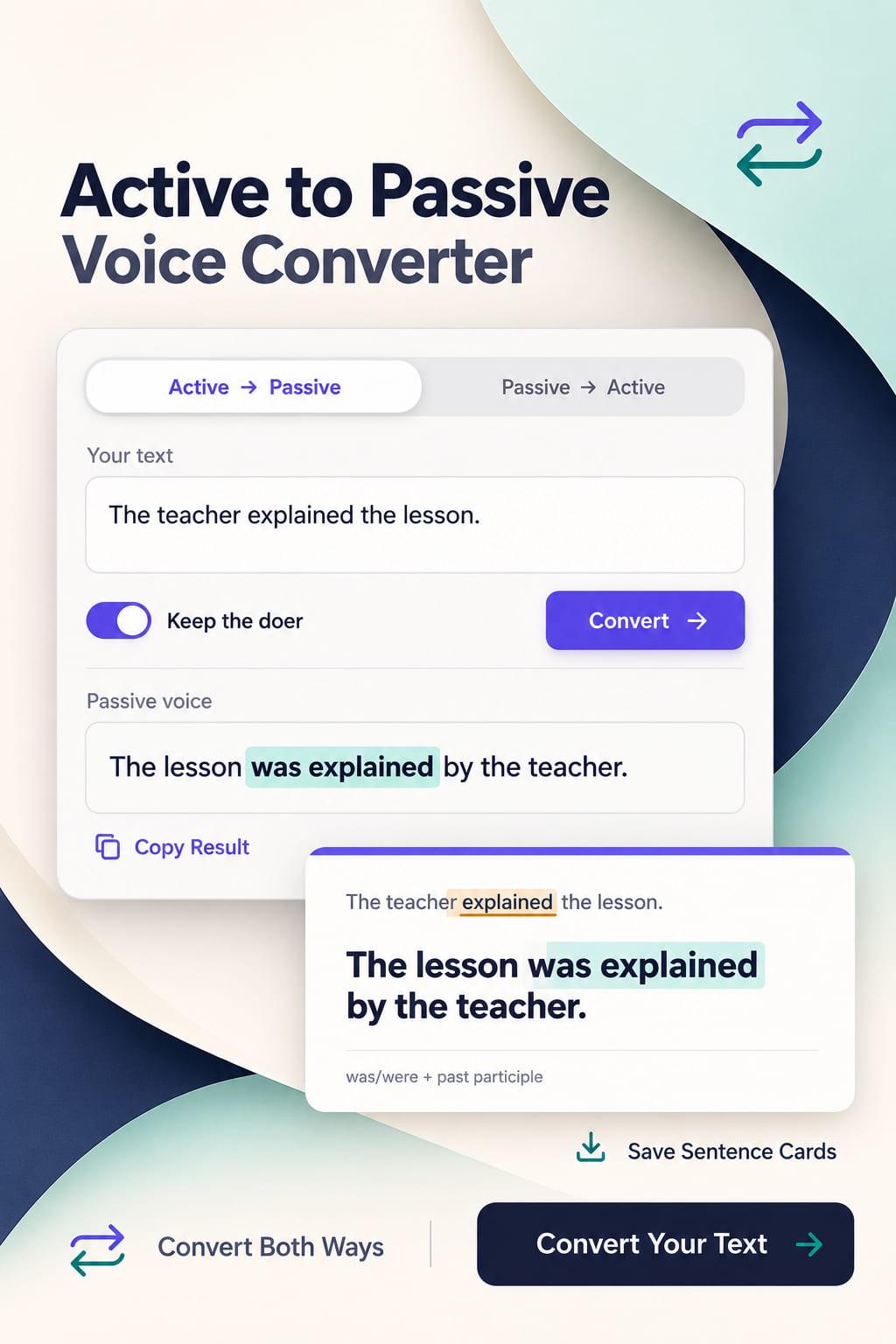
Active to passive voice converter with The lesson was explained by the teacher converted, the highlighted verb, the past simple tense and its formula The converted passage comes first, then one card per sentence with the original, the result and the tense.
Active to Passive Voice Converter for Whole Passages
The converter takes one sentence or a full passage of up to 5,000 words and converts every sentence in it. The result comes back as a passage first, with the new verbs highlighted, so a paragraph reads as a paragraph and not as a list of fragments. Copy Result copies it in one click.
Sentences convert in every tense that has a passive form: present and past simple, both continuous forms, both perfect forms, and the three futures with will, going to and will have. Can, must, should and the other helping verbs convert in their plain and perfect forms, and so do has to, ought to, used to, is able to and needs to.
Two forms have no passive in standard English, will be doing and has been doing. The converter leaves them as written, and the result says why.
Agreement follows the new subject. A book is read by John, books are read by John, and I am going to call him becomes He is going to be called by me, with the pronoun switched.
Passive to Active Voice Converter in the Same Box
Click Passive to Active at the top, and the active to passive voice converter runs the other way. The doer after by becomes the subject, the verb returns to its active form in the same tense, and the old subject takes the object position. The report was written by the committee last week becomes The committee wrote the report last week.
Passive sentences without a doer convert as well. Mistakes were made has nobody named, so the converter inserts Someone and tells you so under the result. Replace Someone with the real doer when you know it, or leave it, as exam answer keys do.
Convert Back sends the result into the box and flips the direction. A student checks an answer in both directions without retyping, and a writer compares the two versions of a paragraph side by side.
Every Converted Sentence Shows Its Tense and Formula
Under the passage, one card per sentence puts the original and the result together. The verb of the original is highlighted in one colour and the new verb in another, so the change is visible at a glance. Explained becomes was explained, has finished becomes has been finished, and will send becomes will be sent.
Beneath the two sentences, the card names the tense and quotes the formula that produced the result: Past simple, was/were plus past participle. A student copies that line as the working for an exam answer, and a learner reads the be plus past participle form against the sentence instead of against a table.
Sentences that cannot convert say so in the same place. He slept has no object to move to the front, and the card reports that. She is a doctor describes rather than acts, and the card leaves it as written with the reason.
Questions, Negatives and Imperatives Convert Too
Most converters stop at plain statements. This one converts the sentence kinds that fill exam papers:
- Questions keep their question form. Did he eat the cake? becomes Was the cake eaten by him? Who wrote this? becomes By whom was this written? What did she say? becomes What was said by her? How many books did she buy? becomes How many books were bought by her?
- Negatives keep not in place: She did not write the letter becomes The letter was not written by her, and didn’t or won’t expand first.
- Imperatives take Let: Open the door becomes Let the door be opened, and Please close the window keeps its please.
- Two objects give She was given a book by him from He gave her a book, the form answer keys expect.
- Phrasal verbs stay together: He turned the light off becomes The light was turned off by him.
Advanced Structures the Converter Recognises
The structures tested in upper-school exams, IELTS writing and university style guides all convert, in both directions:
- Verbs with their own preposition: They laughed at him becomes He was laughed at by them, and The nurse looked after the children becomes The children were looked after by the nurse.
- Make, let, see, hear and help with a second verb: They made him work hard becomes He was made to work hard by them. They let him go becomes He was allowed to go by them.
- Reporting verbs: People say that he is rich becomes It is said that he is rich. In the other direction, It was reported by the police that the thief had escaped becomes The police reported that the thief had escaped.
- Want, expect and need with a second verb: I want someone to help me becomes I want to be helped.
- Two verbs on one subject: He opened the door and switched on the light becomes The door was opened and the light was switched on by him, with one by-phrase at the end. The letter was written and posted by him becomes He wrote the letter and posted it.
- Get instead of be: He got fired by the manager converts to The manager fired him.
Keep the Doer or Drop the By-Phrase
One switch under the box sets whether the doer stays. Keep the doer is on by default, so The dog bit the boy becomes The boy was bitten by the dog, the full form exam answers require. Turn it off, and the same sentence becomes The boy was bitten, the shorter form editors prefer when the doer is obvious or unimportant.
General doers drop out on their own. Someone stole my bike becomes My bike was stolen, because a by-phrase with someone, people, nobody or everyone adds nothing, and the card notes the omission.
Save Any Conversion as a Card
Save Card on any converted sentence downloads it as an image: the original sentence with its verb highlighted, the converted sentence with the new verb highlighted, the formula beneath, and the site name. The image is drawn in your browser at a size that reads on a phone, a class group, a revision board or a Pinterest pin.
Teachers use the cards as worked answers for the board, and students keep them as revision notes, one sentence per card.
How to Use the Active to Passive Voice Converter
The converter opens in the active to passive direction with an empty box. Try a Sample fills it with a few sentences so you see the result before you paste your own.
- Paste or type your sentences, and the conversion runs after a short pause. Convert runs it at once.
- Choose the direction at the top, Active to Passive or Passive to Active.
- Read the converted passage first, with the changed verbs highlighted.
- Compare the cards beneath it, one per sentence, with the original, the result, the tense and the formula.
- Turn Keep the doer off when the by-phrase is not wanted.
- Press Copy Result for the text, Convert Back to check the other direction, or Save Card to download a sentence.
Everything runs in your browser, with no sign-up, no AI rewrite and no sentence limit.
Who Uses an Active Passive Voice Converter
- School and exam students: Voice change questions appear in grammar papers at every level, and the card under a sentence quotes the tense and formula the answer key expects.
- English learners: Reading the active and passive forms side by side, with the verb highlighted in both, teaches be plus past participle faster than a rule list.
- Writers and editors: The passive to active direction of the active to passive voice converter turns was decided and were made into sentences with a named doer, one paste at a time.
- Academic writers: Methods sections prefer the passive, so a draft written in the first person converts to The samples were collected in one pass.
- Teachers: Save Card produces a worked answer for the board, and Copy Result produces an answer key for a worksheet.
FAQs
Q1. What does an active to passive voice converter do?
The converter moves the object to the subject position, changes the verb to a form of be in the same tense plus the past participle, and places the doer after by. The dog bit the boy therefore becomes The boy was bitten by the dog. The tense and the formula appear under the result.
Q2. Does the tense change when a sentence goes from active to passive?
No, the tense stays the same in the active to passive voice converter, and only the verb form changes. Bit becomes was bitten and has finished becomes has been finished. The form of be carries the tense.
Q3. Which sentences will not convert?
Sentences without an object, such as He slept, have no passive form, and linking sentences such as The cake is delicious describe rather than act. Will be doing and has been doing have no passive in standard English either. The card under each one says why it stayed as written.
Q4. Can the converter change a question into the passive voice?
Yes, questions convert with the helping verb kept at the front. Did he eat the cake? becomes Was the cake eaten by him?, and Who wrote this? becomes By whom was this written?
Q5. What happens to a passive sentence with no doer?
The active to passive voice converter inserts Someone as the subject in the active direction and says so under the result. Mistakes were made becomes Someone made mistakes, and you replace Someone with the real doer when you know it.
Q6. Is this an active to passive voice converter without AI?
Yes, the conversion follows grammar rules in your browser. Nothing is rewritten, paraphrased or sent to a server, and the same sentence converts the same way every time.
Q7. Is the converter free?
Yes, the active to passive voice converter is free with no account and no sentence limit. Passages up to 5,000 words convert in one pass.
Related: