
The em dash is a punctuation mark that signals a strong pause, sets off information from the rest of the sentence, or replaces other punctuation for emphasis. It is written as a long horizontal line and is longer than both the en dash and the hyphen.
There are more than eight distinct uses of the em dash in English writing, from replacing commas in appositive constructions to marking interruptions in speech and setting off parenthetical elements. Some uses are style choices; others fit specific grammatical patterns. Spacing around the em dash also depends on the style guide the writer follows.
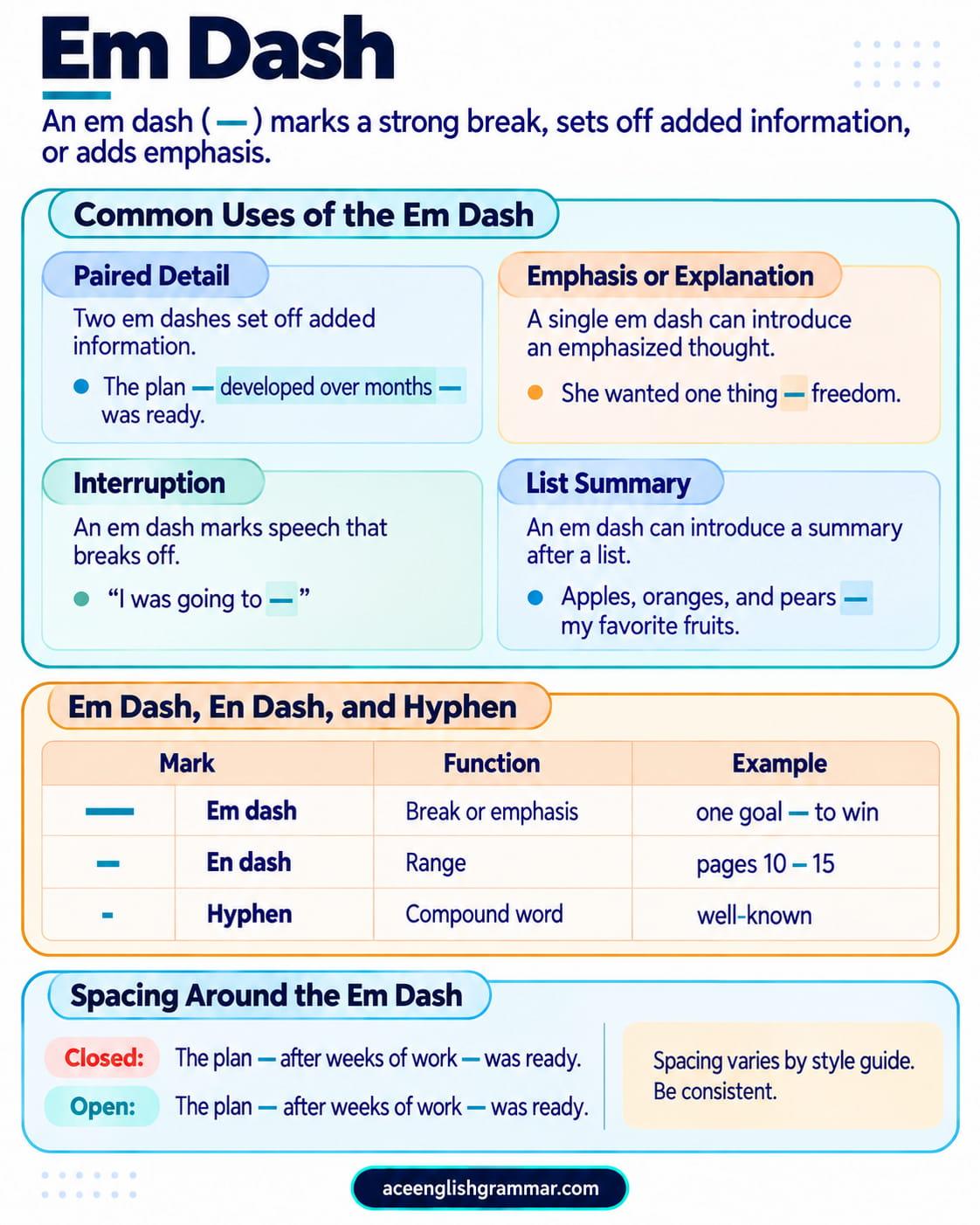
What Is an Em Dash?
An em dash is a punctuation mark that signals a strong pause, sets off information from the rest of the sentence, or replaces other punctuation for emphasis. It is longer than both the en dash and the hyphen, and it appears in writing as a long horizontal line.
The name comes from typography: the em dash is about the same width as the capital letter M, while the en dash is about the width of the letter N. Writers use the em dash to create pauses stronger than a comma but softer than a period.
- She finally made a decision—there was no turning back.
- The teacher—my old friend from college—waved from the doorway.
- One thing mattered above all—success.
- The plan—developed over months—was ready.
Note that the em dash is more informal than the punctuation marks it replaces. Most style guides advise using it sparingly, especially in academic and technical writing.
Common Uses of the Em Dash in English
The em dash has more than eight established uses in English writing. The most common uses are listed here with one example each; each rule is covered in detail later.
- In place of commas: The house—the one with the red door—was empty.
- In place of parentheses: The plan—which we had discussed for weeks—was rejected.
- In place of colons: She wanted one thing—freedom.
- In place of semicolons: The rain had stopped—the sun came out.
- For emphasis: He cared about only one thing—money.
- For parenthetical elements: The conference—all 500 attendees—was fully booked.
- For interruption: “I was going to say—” she paused. “Never mind.”
- For missing portions of words: The witness, Mr. J——, refused to answer.
- With a summary after a list: Apples, oranges, and pears—these are my favorite fruits.
Em Dash vs En Dash vs Hyphen
Three horizontal punctuation marks appear in English writing: the hyphen, the en dash, and the em dash. Each has its own length, function, and grammatical role, and the three are not interchangeable.
The Hyphen
The hyphen (-) is the shortest of the three marks. It joins two words into a compound (self-esteem, well-known, mother-in-law), separates a prefix from its base word (co-worker, ex-wife), and appears in compound numbers (twenty-one, ninety-nine).
- She is a well-known author.
- The six-year-old child laughed.
- His ex-wife lives in Paris.
- The co-founder left the company.
The En Dash
The en dash (–) is longer than the hyphen and shorter than the em dash. It shows a range of numbers, dates, or times (2020–2025), or a connection between two words (the London–Paris flight).
- Read pages 10–15 for tomorrow.
- The 1939–1945 war affected everyone.
- The New York–London flight is long.
- Office hours: 9 a.m.–5 p.m.
The Em Dash
The em dash (—) is the longest of the three marks. It signals a strong pause, sets off information from the rest of the sentence, or replaces other punctuation for emphasis in the sentence.
- She finally made a decision**—there was no turning back**.
- The plan**—developed over months—**was ready.
- One thing mattered**—success**.
Note that the three marks are not interchangeable. Each has its own function, and using the wrong one produces incorrect punctuation.
Em Dash in Place of Other Punctuation
The em dash can replace commas, parentheses, colons, or semicolons in certain sentence structures. Each replacement adds emphasis or a stronger pause than the original punctuation would.
In Place of Commas
An em dash can replace a pair of commas that set off information in the middle of a sentence. The em dashes create a stronger pause and give the interruption more weight, which is useful when the writer wants the reader to focus on the interrupting information.
- With commas: The house, the one with the red door, was empty.
- With em dashes: The house**—the one with the red door—**was empty.
- With commas: My brother, John, is a chef in Paris.
- With em dashes: My brother**—John—**is a chef in Paris.
Note that the em dash is especially useful when the information being set off already contains commas, since a pair of em dashes prevents the reader from getting lost.
Compare:
- All three of us, Melissa, Shelly, and I, went to the same university. ✗ (unclear)
- All three of us**—Melissa, Shelly, and I—**went to the same university. ✓
In Place of Parentheses
An em dash can replace parentheses that enclose additional information within a sentence. The em dash version reads as more integrated with the main sentence, while parentheses feel more like a side note or an aside.
- With parentheses: The plan (which we had discussed for weeks) was rejected.
- With em dashes: The plan**—which we had discussed for weeks—**was rejected.
- With parentheses: The teacher (a substitute) knew everyone’s name.
- With em dashes: The teacher**—a substitute—**knew everyone’s name.
Note that em dashes tie the extra information more tightly to the main sentence than parentheses do. If the writer wants the aside to feel more separate, parentheses are the better choice.
In Place of Colons
An em dash can replace a colon that introduces a word, phrase, or clause explaining or expanding on the main clause. The em dash version reads as slightly less formal than a colon and adds more emphasis to what follows.
- With colon: She wanted one thing: freedom.
- With em dash: She wanted one thing**—freedom**.
- With colon: The answer was simple: eat less, exercise more.
- With em dash: The answer was simple**—eat less, exercise more**.
Note that an em dash cannot replace a colon that introduces a formal list. We say “Buy these items: bread, milk, and eggs,” not “Buy these items—bread, milk, and eggs.”
In Place of Semicolons
An em dash can replace a semicolon that joins two related independent clauses. The em dash version is more informal and adds a stronger sense of pause between the two clauses.
- With semicolon: The rain had stopped; the sun came out.
- With em dash: The rain had stopped**—the sun came out**.
- With semicolon: She loved cooking; her sister loved baking.
- With em dash: She loved cooking**—her sister loved baking**.
Note that this replacement works only when the two clauses are closely related. If they are not, a period is the better choice.
Em Dash for Emphasis
The em dash sets off a word or phrase at the end of a sentence for dramatic emphasis. This use draws the reader’s attention to the final element and makes it stand out from the rest of the sentence.
- He cared about only one thing**—money**.
- She had one goal in life**—to become a doctor**.
- There was just one problem**—no one showed up**.
- The answer was clear**—we had to leave**.
Note that this use is more informal than a colon in the same position. A colon reads as formal (“She had one goal in life: to become a doctor”); the em dash reads as more emphatic and dramatic.
Em Dash for Parenthetical Elements
A pair of em dashes sets off a parenthetical phrase or clause in the middle of a sentence. The em dash version emphasizes the parenthetical more than commas or parentheses would, and it keeps the extra information tightly connected to the main sentence.
- The conference**—all 500 attendees—**was fully booked.
- He found the key**—the one she had lost last week—**under the couch.
- The proposal**—despite its flaws—**was accepted.
- Her father**—a retired engineer—**still repairs clocks.
Compare:
- The proposal, despite its flaws, was accepted. (neutral)
- The proposal (despite its flaws) was accepted. (aside)
- The proposal**—despite its flaws—**was accepted. ✓ (emphasized)
Note that parenthetical em dashes always come in pairs when the parenthetical appears in the middle of a sentence. A single em dash appears only when the parenthetical extends to the end of the sentence.
Em Dash for Interruption
The em dash marks an interruption in speech, thought, or written text. It shows that a sentence breaks off mid-flow, either because another speaker interrupts or because the current speaker trails off.
- “I was going to say**—**” she paused. “Never mind.”
- “Please don’t**—**” he began, but she had already left.
- “The answer is**—**” the phone rang before she could finish.
- I remember the day**—**but wait, that was a different year.
Note that when an interruption comes from another speaker, the em dash appears in both the interrupted line and the interrupting line, always inside the quotation marks.
Compare:
- “I promise I didn’t mean to**—**”
- “**—**Stop right there. I don’t want to hear it.”
Em Dash for Missing Portions of Words
Two or three em dashes together can stand in for the missing portion of a word. This use appears when a name is withheld for privacy, or when a taboo word is redacted in print.
- The witness, Mr. J**——**, refused to answer.
- The suspect told the officer to “—— off.”
- The letter was addressed to Miss S**——** of London.
- The article named the source only as Dr. R**——**.
Note that consistency matters when using em dashes for missing portions. A writer picks either two or three em dashes and uses the same number throughout the same piece of writing.
Em Dash With Lists
An em dash can introduce a summary phrase after a list, connecting the listed items to a concluding clause. The em dash reads as more informal than a colon in the same position and adds a slight dramatic pause.
- Apples, oranges, and pears**—these are my favorite fruits**.
- Speed, strength, and stamina**—every athlete needs all three**.
- London, Paris, and Rome**—the three cities she wanted to visit**.
- Grammar, spelling, and punctuation**—these are the three pillars of good writing**.
Note that an em dash does not replace a colon at the start of a list. We say “Buy these items: bread, milk, and eggs,” not “Buy these items—bread, milk, and eggs.” The em dash goes after the list, not before it.
Spacing Around the Em Dash
Spacing around the em dash depends on the style guide the writer follows. The two main conventions are closed spacing (no space on either side) and open spacing (one space on each side).
1. Closed spacing (Chicago Manual, MLA, APA): the em dash sits flush against the words on both sides, with no space between the dash and the adjacent letters.
- She looked at me**—**then walked away.
- The plan**—developed over months—**was ready.
- One thing mattered**—success**.
2. Open spacing (Associated Press style, some UK publications): one space appears before and after the em dash, separating it from the adjacent words.
- She looked at me — then walked away.
- The plan — developed over months — was ready.
- One thing mattered — success.
Note that consistency matters more than the choice itself. A writer picks one convention and follows it throughout the same piece of writing.
How to Type an Em Dash
The em dash is not on standard keyboards, so it requires a shortcut or a special character insertion. Each operating system and word processor has its own method for producing the em dash.
On Windows
On Windows, the em dash can be typed with the keyboard shortcut Alt + 0151, using the numeric keypad on the right side of the keyboard. Microsoft Word also inserts an em dash automatically when two hyphens are typed between two words without spaces.
- Alt + 0151 on the numeric keypad
- Two hyphens (–) followed by another word in Microsoft Word (AutoCorrect converts them)
On Mac
On Mac, the em dash is typed with the keyboard shortcut Option + Shift + Hyphen. This works in most Mac applications, including Pages, Word, Google Docs, and browser-based editors.
- Option + Shift + hyphen (-) on any Mac keyboard
In Microsoft Word
Microsoft Word inserts an em dash automatically through AutoCorrect. Typing a word, two hyphens, and another word with no spaces converts the double hyphen into an em dash as soon as the second word is completed. The Insert Symbol menu offers the same character for writers who prefer a direct insertion.
- Type word–word with no spaces, then press the spacebar (AutoCorrect converts it)
- Insert > Symbol > Special Characters > Em Dash for a direct insertion
- Ctrl + Alt + minus sign on the numeric keypad
Note that Word’s AutoCorrect setting can be turned off under File > Options > Proofing > AutoCorrect Options. If double hyphens are not converting, this setting is the place to check.
In Google Docs
Google Docs converts double hyphens into an em dash through its automatic substitution feature. The substitution happens as the writer continues typing, in the same way Microsoft Word handles it. A custom substitution rule can also be added for writers who want a shorter trigger.
- Type word–word with no spaces (automatic substitution converts it)
- Insert > Special Characters, then search for “em dash”
- Tools > Preferences > Substitutions to add a custom shortcut
Note that Google Docs applies substitutions only when the Automatic Substitution box is checked under Tools > Preferences.
On Mobile Devices
On iOS and Android, the em dash is available by holding down the hyphen key on the on-screen keyboard. A small pop-up menu appears with the hyphen, en dash, and em dash options.
- Hold the hyphen key (-) and slide to the em dash in the pop-up menu
Note that some word processors and messaging apps automatically convert double hyphens (–) into an em dash when the AutoCorrect feature is enabled.
Em Dash Symbol and Character Codes
The em dash symbol is not on standard keyboards, so writers copy it directly or insert it through a character code. The character has one Unicode point and several code representations depending on the format.
Copy the em dash directly from here:
—
The character codes for the em dash across formats:
| Format | Code |
|---|---|
| Unicode | U+2014 |
| HTML entity | — |
| HTML numeric | — |
| Windows Alt code | Alt + 0151 |
| CSS content | \2014 |
| LaTeX | — |
| Python / JavaScript | \u2014 |
Note that the em dash has no ASCII equivalent, since ASCII covers only the first 128 characters and the em dash sits at decimal 8212. Plain-text systems that do not support Unicode fall back to a double hyphen (–) in its place.
Compare:
- Em dash: — (U+2014)
- En dash: – (U+2013)
- Hyphen: – (U+002D)
Why AI Writing Uses Em Dashes
AI writing tools produce em dashes at a much higher rate than most human writers. The pattern comes from the training data these models learn from, which includes large volumes of published journalism, essays, and blog writing where the em dash appears frequently.
Is an Em Dash a Sign of AI Writing?
A single em dash is not a reliable sign of AI-generated text. Skilled human writers have used the em dash for centuries, and its presence alone proves nothing about who wrote a passage.
What does signal AI writing is the frequency and the pattern. Text with an em dash in most paragraphs, always used for the same purpose (setting off a parenthetical or adding emphasis at the end of a sentence), suggests machine generation more than any single instance does.
- Human pattern: an em dash appears occasionally, for genuine emphasis or a real interruption
- AI pattern: an em dash appears in most paragraphs, always in the same grammatical position
- Human pattern: punctuation varies across commas, colons, semicolons, and parentheses
- AI pattern: the em dash replaces most of these marks throughout the text
Note that AI detection tools do not rely on em dash frequency alone. Punctuation patterns are one signal among many, and no single feature identifies AI text with certainty.
How to Remove Em Dashes From AI Text
Em dashes in AI-generated text are removed by replacing each one with the punctuation mark it stands in for. The replacement depends on what the em dash is doing in that specific sentence.
1. Replacing a parenthetical em dash pair: use commas or parentheses.
- Before: The plan—developed over months—was ready.
- After: The plan, developed over months, was ready.
2. Replacing an emphasis em dash at the end of a sentence: use a colon, or split into two sentences.
- Before: She wanted one thing—freedom.
- After: She wanted one thing: freedom.
3. Replacing an em dash joining two clauses: use a period or a semicolon.
- Before: The rain stopped—the sun came out.
- After: The rain stopped. The sun came out.
A prompt instruction also prevents em dashes at the generation stage. Adding “Do not use em dashes. Use commas, colons, semicolons, or periods instead” to the prompt stops most models from producing them.
Note that removing every em dash is a style choice, not a grammar correction. The em dash is correct punctuation when used properly, and human writing uses it legitimately.
Capitalization After an Em Dash
The word after an em dash is not capitalized, unless it is a proper noun or begins a new sentence. The em dash does not signal a sentence boundary; it signals a pause or a set-off within the sentence.
- The plan**—which we had discussed for weeks—**was rejected.
- She looked at me**—then walked away**.
- One thing mattered**—success**.
- The witness, Mr. Smith**—the only person who saw the accident—**refused to testify.
Compare:
- She looked at me**—Then walked away**. ✗ (wrong: “then” is not a proper noun)
- She looked at me**—then walked away**. ✓
- The keys were with**—John**. ✓ (proper noun capitalized)
Note that when the em dash appears between quoted speech and a speaker tag, capitalization follows the normal quotation rules.
When Not to Use an Em Dash
Five situations require punctuation other than the em dash. Choosing the em dash in these contexts produces incorrect or unclear writing.
1. At the start of a list introduced by a full clause. A colon is required when a full independent clause introduces a list.
- Buy these items**—bread, milk, and eggs**. ✗
- Buy these items**: bread, milk, and eggs**. ✓
2. In compound adjectives. Compound adjectives take a hyphen, not an em dash.
- The well**—known** author gave a talk. ✗
- The well**-known** author gave a talk. ✓
3. To show a range of numbers or dates. An en dash is the correct mark for ranges.
- Read pages 10**—15** tonight. ✗
- Read pages 10**–15** tonight. ✓
- The 2020**—2025** period was difficult. ✗
- The 2020**–2025** period was difficult. ✓
4. As a substitute for every comma. Overuse makes writing feel choppy and dramatic. Most sentences need only commas.
- She**—thanking her hosts—then—having said goodbye—**left. ✗
- She, thanking her hosts, then, having said goodbye, left. ✓
5. In formal academic writing where a colon or semicolon fits. The em dash reads as informal; academic writing prefers standard marks.
- The study reached one conclusion**—the hypothesis was correct**. (informal)
- The study reached one conclusion**: the hypothesis was correct**. (formal)
Common Errors With the Em Dash
Six errors recur most commonly when writers use the em dash in English.
- Confusing the em dash with the en dash or hyphen. We use the em dash for pauses and interruptions, the en dash for ranges, and the hyphen for compound words. Mixing them produces incorrect punctuation.
- Overusing the em dash. We use no more than two em dashes in the same sentence, except for missing portions of words. Three or more em dashes in a sentence confuse the reader and break the sentence rhythm.
- Capitalizing the word after an em dash. We say “She looked at me—then walked away,” not “She looked at me—Then walked away.” Only proper nouns get capitalized after an em dash, not common nouns or verbs.
- Using an em dash to start a list. We say “Buy these items: bread, milk, and eggs,” not “Buy these items—bread, milk, and eggs.” A colon introduces a list; an em dash does not.
- Inconsistent spacing. We use either closed spacing (no space) or open spacing (space on each side) throughout the same document. Mixing spacing styles in one piece is a common error.
- Using an em dash for compound adjectives. We say “well-known author,” not “well—known author.” Compound adjectives take a hyphen, not an em dash.
FAQs
Q1. What is an em dash?
An em dash is a punctuation mark that signals a strong pause, sets off information from the rest of the sentence, or replaces other punctuation for emphasis. It is longer than both the en dash and the hyphen, and it appears in writing as a long horizontal line. The em dash is one of the most versatile marks in English writing.
Q2. What is the difference between an em dash, an en dash, and a hyphen?
The three marks differ in length and function. The hyphen (-) is the shortest and joins two words into a compound (self-esteem). The en dash (–) is medium length and shows a range (2020–2025). The em dash (—) is the longest and signals a strong pause or sets off information (She had one goal—to succeed).
Q3. How do I type an em dash?
On Windows, use Alt + 0151 on the numeric keypad. On Mac, use Option + Shift + Hyphen. On mobile devices, hold the hyphen key on the keyboard and slide to the em dash in the pop-up menu. Microsoft Word and many other word processors also convert double hyphens (–) into an em dash automatically.
Q4. Do I put spaces around an em dash?
Spacing depends on the style guide the writer follows. Chicago Manual, MLA, and APA use closed spacing (no space): “She looked at me—then left.” Associated Press style and some UK publications use open spacing (one space on each side): “She looked at me — then left.” Consistency within one document matters more than the choice itself.
Q5. Do I capitalize the word after an em dash?
No. The word after an em dash is not capitalized unless it is a proper noun. The em dash does not signal a new sentence; it signals a pause within one sentence. We say “She looked at me—then walked away,” not “She looked at me—Then walked away.”
Q6. Can an em dash replace a colon or semicolon?
Yes, in most cases. An em dash can replace a colon that introduces a word or phrase for emphasis (“She wanted one thing—freedom”), and it can replace a semicolon that joins two related clauses (“The rain stopped—the sun came out”). The em dash version reads as more informal. An em dash cannot replace a colon that introduces a formal list.
Q7. When should I not use an em dash?
The em dash is wrong in five situations: at the start of a list introduced by a full clause (use a colon), in compound adjectives (use a hyphen), for ranges of numbers or dates (use an en dash), as a replacement for every comma in a sentence (overuse produces choppy writing), and in formal academic writing where a colon or semicolon fits the tone better.

Leave a Comment