
The comma is a punctuation mark that separates elements within a sentence. It signals a brief pause or a grouping of related items, and it clarifies the structure of a sentence so the reader can follow the meaning without confusion.
There are more than ten distinct uses of the comma in English, from separating items in a list to setting off nonrestrictive clauses, joining independent clauses with a conjunction, and clarifying dates and numbers. Some uses are grammatical requirements; others are style choices that vary between American and British English.
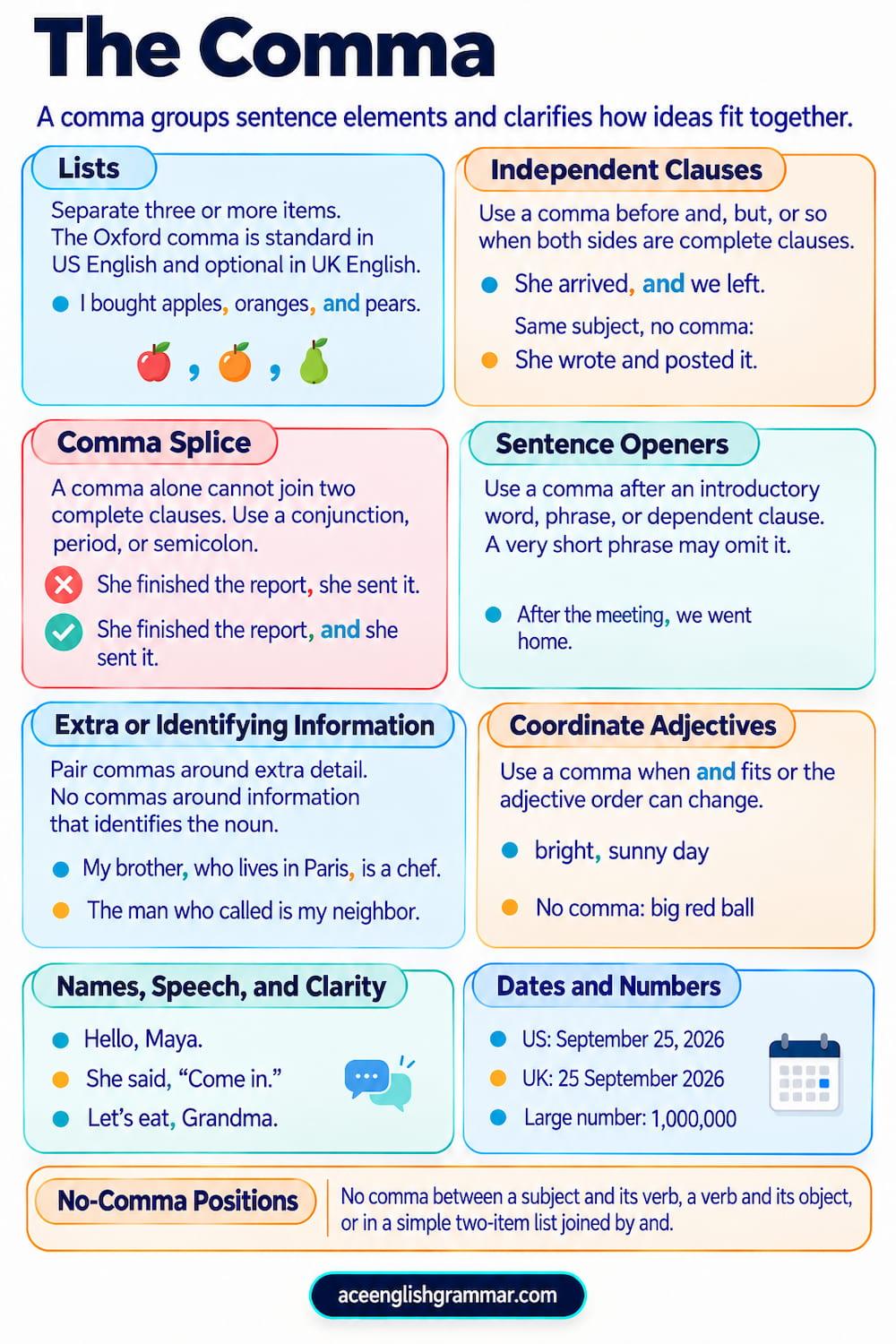
What Is a Comma?
A comma is a punctuation mark (,) that separates elements within a sentence. It signals a short pause and helps the reader see the structure of the sentence at a glance.
The comma is one of the most-used punctuation marks in English, and it also causes the most confusion. Some uses of the comma are required by grammar rules; others depend on style, dialect, or the writer’s judgment.
Note that the comma is a lighter separator than the period (which ends a sentence) or the semicolon (which joins two related independent clauses). The three marks operate at different levels of sentence structure.
Comma is spelled with two m’s. A coma, with one, is a prolonged state of unconsciousness and shares no root with the punctuation term.
The types of commas are named by function rather than by shape, since the mark itself never changes. The serial comma, the coordinating comma, the introductory comma, the parenthetical comma, and the coordinate-adjective comma all use the same character in different positions.
Common Uses of the Comma with Examples
The comma has more than ten established uses in English writing. The most common are listed here with one example each; each rule is covered in detail in the sections that follow.
- In a list: I bought apples, oranges, and pears.
- Before a coordinating conjunction (FANBOYS): She arrived, and we left.
- After an introductory element: After the meeting, we went home.
- Around a nonrestrictive clause: My brother, who lives in Paris, is a chef.
- Between coordinate adjectives: It was a bright, sunny day.
- In direct address: Hello, John.
- Before a quotation: She said, “Come in.”
- In dates: September 25, 2026.
- In numbers: 1,000,000.
- For contrast: It was hot, not cold.
- For clarity: Let’s eat, Grandma.
Comma in a List
A comma separates three or more items in a list. The rule applies whether the items are words, phrases, or short clauses, and the comma comes after each item except the last.
- I bought apples, oranges, and pears.
- The meeting was long, difficult, and unproductive.
- She travelled to London, Paris, and Rome.
- He can speak English, French, and Spanish fluently.
Note that a two-item list joined by “and” takes no comma. We say “salt and pepper,” not “salt, and pepper.”
The Oxford Comma (American vs British)
The Oxford comma (also called the serial comma) is the comma placed before the “and” that joins the last two items in a list. Its use is standard in American English and optional in British English, though Oxford University Press itself uses it.
- With Oxford comma (American standard): I bought apples, oranges, and pears.
- Without Oxford comma (common British style): I bought apples, oranges and pears.
Both forms are grammatical, but the Oxford comma prevents ambiguity in certain sentences.
Compare:
- I dedicate this book to my parents, Ayn Rand and God. (without Oxford comma: suggests the parents are Ayn Rand and God)
- I dedicate this book to my parents, Ayn Rand, and God. (with Oxford comma: three separate items)
Note that the Oxford comma is the safer choice in any writing where clarity matters, and most style guides now recommend it even in British English.
Comma Before Coordinating Conjunctions
A comma comes before a coordinating conjunction (for, and, nor, but, or, yet, so, remembered by the acronym FANBOYS) when the conjunction joins two independent clauses. An independent clause is a group of words that could stand as a complete sentence on its own.
- She finished the report, and she sent it to the client.
- I wanted to help, but I had no time.
- We can leave now, or we can wait for the others.
- He was tired, so he went to bed early.
Compare:
- She finished the report and sent it to the client. (no comma: “sent it” is not a full clause; the subject “she” is shared)
- She finished the report, and she sent it to the client. (comma: both clauses have their own subject)
Note that a comma is not used when the coordinating conjunction joins two verbs or phrases with the same subject. We say “She wrote the letter and posted it,” not “She wrote the letter, and posted it.”
Comma After Introductory Elements
A comma comes after a word, phrase, or clause that opens a sentence before the main clause begins. The introductory element sets the scene, gives a condition, or connects the sentence to what came before, and the comma marks the boundary.
Introductory Words
A single introductory word takes a comma when it functions as a conjunctive adverb, a transitional signal, or an interjection. Common examples include however, therefore, meanwhile, first, next, finally, yes, and no.
- However, the meeting was cancelled.
- First, heat the oil in a pan.
- Yes, I will attend the conference.
- Meanwhile, she waited in the lobby.
Note that a comma follows even a short introductory word when it functions as a transition or a marker.
Introductory Phrases
A prepositional or participial phrase that opens a sentence takes a comma before the main clause. The comma separates the phrase from the subject that follows.
- After the meeting, we went home.
- In the middle of the night, the phone rang.
- Walking home from work, she saw an old friend.
- Tired from the long journey, he fell asleep at once.
Note that very short prepositional phrases (three words or fewer) do not always need a comma. We can write “In 2020 she moved to London” or “In 2020, she moved to London” depending on the pause the writer intends.
Introductory Clauses
A dependent clause that opens a sentence takes a comma before the main clause. Dependent clauses begin with subordinating conjunctions such as when, if, because, although, since, while, and unless.
- When she arrived, we began the meeting.
- If it rains tomorrow, we will cancel the picnic.
- Because he was late, the interview was rescheduled.
- Although she was tired, she finished the report.
Note that the comma is dropped when the dependent clause comes at the end of the sentence. We say “We began the meeting when she arrived,” not “We began the meeting, when she arrived.”
Comma With Nonrestrictive Elements
A pair of commas sets off information that adds detail to the sentence but is not essential to the core meaning. The test is whether the sentence keeps its meaning if the element is removed; if it does, the element is nonrestrictive and takes commas.
Nonrestrictive Clauses
A nonrestrictive clause gives extra information about a noun without limiting which one is meant. In modern English, nonrestrictive clauses begin with “which” or “who”; restrictive clauses (which limit the noun) begin with “that” or “who” and take no commas.
- My brother, who lives in Paris, is a chef. (nonrestrictive: extra detail about a specific brother)
- The book, which she wrote in 2010, became a bestseller. (nonrestrictive)
- The man who called earlier is my neighbour. (restrictive: identifies which man; no commas)
- The book that she wrote in 2010 became a bestseller. (restrictive: identifies which book; no commas)
Compare:
- My sister, who lives in Tokyo, works at a bank. (nonrestrictive: I have one sister; the location is extra)
- My sister who lives in Tokyo works at a bank. (restrictive: I have more than one sister; the location identifies which one)
Note that the “which vs that” rule is stricter in American English than in British English. Under American style “which” is reserved for nonrestrictive use, while either form is acceptable under British style.
Appositives
An appositive is a noun or noun phrase that renames or explains another noun. A nonrestrictive appositive is set off by commas; a restrictive appositive takes none.
- Marie Curie, the famous scientist, won two Nobel Prizes. (nonrestrictive)
- My friend, Sarah, lives in Boston. (nonrestrictive: I have one specific friend in mind)
- The poet Robert Frost was born in San Francisco. (restrictive: identifies which poet; no commas)
- My friend Sarah lives in Boston. (restrictive: I have more than one friend; “Sarah” identifies which one)
Parenthetical Phrases
A parenthetical phrase interrupts the flow of a sentence to add information or comment. Common parenthetical phrases include “however,” “for example,” “on the other hand,” “in fact,” and “of course.”
- The proposal, however, was rejected by the board.
- She, for example, finished the project early.
- The results, in fact, were better than expected.
- He, of course, knew the answer immediately.
Note that a parenthetical phrase always takes a comma on both sides when it appears in the middle of a sentence. We say “The proposal, however, was rejected,” not “The proposal however was rejected.”
Comma With Coordinate Adjectives
A comma separates two or more coordinate adjectives that describe the same noun independently. Two tests distinguish coordinate adjectives from cumulative adjectives: the “and-test” (can you insert “and” between them?) and the “reorder test” (can you swap their order?).
- It was a bright, sunny day. (coordinate: bright and sunny; sunny and bright both work)
- She wore a long, flowing dress. (coordinate)
- He is a tall, handsome man. (coordinate)
Compare with cumulative adjectives, which take no comma:
- She wore a beautiful red silk dress. (cumulative: “beautiful and red and silk” fails; the order is fixed)
- He drove a shiny new sports car. (cumulative)
Note that if either test fails, the adjectives are cumulative and no comma is used. We say “a big red ball,” not “a big, red ball,” because “red big ball” sounds wrong.
Comma With Direct Address and Quotations
Commas separate the person being addressed from the rest of the sentence and mark the boundary between a speaker tag and a quotation. Each of the three sub-uses has its own placement rule.
Direct Address
A comma sets off the name or title of the person being addressed. The comma comes before the name if the name is at the end of the sentence, after the name if the name is at the start, and on both sides if the name is in the middle.
- Hello, John. (name at end)
- John, please come here. (name at start)
- I think, John, that we should leave. (name in middle)
- Please pass the salt, Sarah.
Compare:
- Let’s eat Grandma. ✗ (suggests eating Grandma)
- Let’s eat, Grandma. ✓ (invites Grandma to eat)
Quotations
A comma separates a speaker tag from the quotation it introduces or follows. The comma comes before the opening quotation mark if the tag comes first, and inside the closing quotation mark (in American English) if the tag comes second.
- She said, “Come in.” (tag first)
- “Come in,” she said. (tag second, comma inside quotes: American style)
- “Come in”, she said. (tag second, comma outside quotes: British style)
- He asked, “Are you ready?” (question mark replaces comma)
Note that in American English, commas and periods always go inside the closing quotation mark. In British English, they go outside unless they belong to the quotation itself.
Tag Questions
A comma separates a statement from its tag question at the end. A tag question is a short question added to a statement to seek confirmation, such as “isn’t it?” or “don’t you?”
- You are coming, aren’t you?
- She lives in London, doesn’t she?
- It is cold today, isn’t it?
- They finished on time, didn’t they?
Comma in Dates and Numbers
Commas separate the parts of a date and the digit groups in a large number. The rules differ between American and British English, and the format the writer chooses depends on the audience.
Dates
In American English, a comma comes after the day and after the year when the full date appears in a sentence. In British English, the format is different and the comma is not used.
- American: She was born on September 25, 2026, in New York.
- American: The report is due by June 30, 2026.
- British: She was born on 25 September 2026 in London. (no comma)
- British: The report is due by 30 June 2026.
Note that when only the month and year appear, no comma is used in either style. We say “She was born in September 2026,” not “She was born in September, 2026.”
Numbers
A comma separates every group of three digits from the right in numbers of four or more digits. This is standard in American and British English for most contexts.
- 1,000 (one thousand)
- 10,000 (ten thousand)
- 1,000,000 (one million)
- The population was 1,247,893.
Note that dates, page numbers, addresses, and years use no comma. We say “the year 2026,” not “the year 2,026.”
Addresses
A comma separates the street from the city, the city from the state or country, and the state from the rest of the sentence. No comma comes between the state and the postal code.
- She lives at 14 Mill Road, Bahawalpur, Punjab.
- The office moved to 220 King Street, Manchester, M1 4LZ.
- He was born in Lahore, Pakistan.
- Send the parcel to Flat 9, Rose Court, Leeds.
Note that when an address appears mid-sentence, a comma also follows the final element. We say “She lives in Lahore, Pakistan, with her family,” not “She lives in Lahore, Pakistan with her family.”
Compare:
- We flew to Karachi, Sindh last week. ✓ (address ends the clause)
- We flew to Karachi, Sindh, last week. ✓ (address sits mid-sentence)
Comma Before Common Connecting Words
Whether a comma comes before a connecting word depends on what that word joins. Coordinating conjunctions take a comma when they join two independent clauses. Subordinating conjunctions take a comma when the clause they open comes first. Conjunctive adverbs take a comma in almost every position.
| Word | Comma before it? | Governing rule |
|---|---|---|
| And | Only between independent clauses | She wrote the letter, and she posted it. |
| But | Only between independent clauses | I wanted to help, but I had no time. |
| Or | Only between independent clauses | We can leave now, or we can wait. |
| So | Only between independent clauses | He was tired, so he went to bed. |
| Yet | Only between independent clauses | She studied hard, yet she failed. |
| Nor | Only between independent clauses | He did not call, nor did he write. |
| For | Only between independent clauses | She left early, for the roads were icy. |
| Because | No comma in most sentences | She left because she was tired. |
| Although | Only when the clause comes first | Although she was tired, she finished. |
| Though | Only when the clause comes first | Though it rained, we walked. |
| While | Depends on meaning | He read while I cooked. (time, no comma) |
| Since | Depends on meaning | Since you asked, I will explain. (reason, comma) |
| If | Only when the clause comes first | If it rains, we will cancel. |
| When | Only when the clause comes first | When she arrived, we began. |
| Unless | Only when the clause comes first | Unless you object, I will proceed. |
| However | Yes, on both sides in mid-position | The plan, however, was rejected. |
| Therefore | Yes, on both sides in mid-position | The result, therefore, was clear. |
| Then | Only between independent clauses | She ate, then she left. |
| Also | Yes, when it opens a sentence | Also, we need more time. |
| Too | Optional at the end of a sentence | She wants to come(,) too. |
| As well as | No comma in most sentences | She speaks French as well as German. |
| Such as | No comma before a restrictive list | Sports such as tennis and squash. |
| Including | No comma before a restrictive list | Countries including Spain and Italy. |
Note that “because,” “as well as,” “such as,” and “including” take no comma when the information that follows identifies or limits what came before. A comma appears only when the information is extra rather than defining.
Compare:
- She left because she was tired. ✓ (reason identifies why: no comma)
- She did not leave, because she was tired. ✓ (comma changes the meaning: tiredness is why she stayed)
- Sports such as tennis and squash suit her. ✓ (restrictive: no comma)
- She enjoys racket sports, such as tennis and squash. ✓ (extra detail: comma)
Comma for Contrast
A comma sets off a phrase that expresses contrast with the main statement. Common contrast markers include “not,” “unlike,” “rather than,” and “instead of.”
- It was hot, not cold.
- She is a teacher, not a lawyer.
- We wanted coffee, rather than tea.
- The decision was hers, unlike the last one.
Note that the comma marks the shift in direction that the contrast introduces. Without the comma, the contrast reads as continuation rather than opposition.
Comma for Clarity
A comma prevents misreading when the absence of a pause would confuse the reader. This use is grammatical judgment rather than a fixed rule, and it applies whenever the sentence could be read two ways.
- Let’s eat, Grandma. (with comma: invitation to Grandma)
- Let’s eat Grandma. (without comma: suggests eating Grandma)
- Outside, the dog barked loudly. (with comma: sets the scene)
- Outside the dog barked loudly. (without comma: could be misread as “outside the dog” as a place)
- After eating, the children played. (with comma: the children ate, then played)
- After eating the children played. (without comma: suggests eating the children)
Note that the clarity comma is used sparingly and only where genuine ambiguity would occur. Overuse of clarity commas produces choppy writing.
Capitalization After a Comma
The word after a comma stays lowercase unless it is a proper noun or the first word of a quoted sentence. A comma separates elements inside one sentence rather than ending it, so the sentence continues.
- After the meeting, we went home. ✓
- She bought apples, oranges, and pears. ✓
- He called on Monday, Tuesday, and Friday. ✓ (proper nouns keep their capitals)
- She said, “Come in.” ✓ (quoted sentence takes a capital)
Compare:
- After the meeting, We went home. ✗
- After the meeting, we went home. ✓
Note that this differs from the colon rule, where a capital before a complete sentence is acceptable under American style. A comma never permits one outside those two exceptions.
Comma Splice
A comma splice is the error of joining two independent clauses with only a comma, without a coordinating conjunction. It is one of the most common punctuation errors in English writing.
- Wrong: She finished the report, she sent it to the client.
- Right: She finished the report, and she sent it to the client. (add coordinating conjunction)
- Right: She finished the report. She sent it to the client. (use a period)
- Right: She finished the report; she sent it to the client. (use a semicolon)
Note that a comma alone is not strong enough to join two independent clauses. The three fixes are: add a coordinating conjunction after the comma, replace the comma with a period, or replace the comma with a semicolon.
Compare:
- I came, I saw, I conquered. ✗ (comma splice, though famous)
- I came; I saw; I conquered. ✓ (semicolons)
- I came, and I saw, and I conquered. ✓ (coordinating conjunctions)
When Not to Use a Comma
Six situations require no comma even when writers add one by habit. Knowing where the comma is wrong is a core part of comma competence.
- Between a subject and its verb. No comma separates the subject from the verb, even when the subject is long.
- The tall man in the blue coat, waved at me. ✗
- The tall man in the blue coat waved at me. ✓
2. Between a verb and its object. No comma separates the verb from its direct object or complement.
- She said, that she was tired. ✗
- She said that she was tired. ✓
3. Before a restrictive “that” clause. No comma comes before “that” when it introduces a restrictive clause that identifies the noun.
- The book, that I bought yesterday is on the table. ✗
- The book that I bought yesterday is on the table. ✓
4. Between cumulative adjectives. No comma comes between adjectives when they build on each other in a fixed order.
- A big, red ball ✗ (fails the reorder test)
- A big red ball ✓
5. Between two items in a list. No comma comes between just two items joined by “and.”
- She bought apples, and oranges. ✗
- She bought apples and oranges. ✓
6. Before a coordinating conjunction that joins phrases (not clauses). No comma comes when the conjunction joins two verbs or phrases sharing one subject.
- She wrote the letter, and posted it. ✗
- She wrote the letter and posted it. ✓
Common Errors With the Comma
Six errors recur most commonly when writers use the comma in English.
- Comma splice. We say “She finished the report, and she sent it,” not “She finished the report, she sent it.” Two independent clauses need a coordinating conjunction after the comma, or a period or semicolon instead.
- Missing comma before a coordinating conjunction. We say “She arrived, and we left,” not “She arrived and we left.” Two independent clauses joined by FANBOYS take a comma before the conjunction.
- Comma between subject and verb. We say “The tall man waved at me,” not “The tall man, waved at me.” A subject and its verb are never separated by a comma, however long the subject is.
- Comma before a restrictive “that” clause. We say “The book that I bought is on the table,” not “The book, that I bought, is on the table.” Restrictive clauses take no commas.
- Missing Oxford comma where it prevents ambiguity. We say “my parents, Ayn Rand, and God,” not “my parents, Ayn Rand and God,” when ambiguity would confuse the reader. The Oxford comma is optional in style but necessary for clarity in sentences that could be misread.
- Comma after the coordinating conjunction, not before it. We say “She arrived, and we left,” not “She arrived and, we left.” The comma comes before the conjunction, not after.
FAQs
Q1. What is a comma?
A comma is a punctuation mark (,) that separates elements within a sentence. It signals a brief pause and helps the reader see the structure of the sentence. The comma has more than ten established uses in English, from separating items in a list to setting off nonrestrictive clauses and marking dates.
Q2. When do I use a comma?
Use a comma to separate items in a list of three or more, before a coordinating conjunction that joins two independent clauses, after an introductory word or phrase, around a nonrestrictive clause or appositive, between coordinate adjectives, in direct address, before or after a quotation, in dates and large numbers, and for contrast or clarity when needed.
Q3. What is the Oxford comma?
The Oxford comma (also called the serial comma) is the comma placed before the “and” that joins the last two items in a list of three or more. It is standard in American English and optional in British English. Both forms are grammatical, but the Oxford comma prevents ambiguity in sentences where the last two items could be mistaken for one item.
Q4. Do I use a comma before “but”?
Use a comma before “but” when it joins two independent clauses: “I wanted to help, but I had no time.” Do not use a comma before “but” when it joins two phrases or when “but” introduces a short contrast within one clause: “She is smart but lazy.”
Q5. How do I fix a comma splice?
A comma splice joins two independent clauses with only a comma. Fix it in one of three ways: add a coordinating conjunction after the comma (“She finished the report, and she sent it”), replace the comma with a period (“She finished the report. She sent it”), or replace the comma with a semicolon (“She finished the report; she sent it”).
Q6. Can I put a comma between the subject and the verb?
No. A comma never separates a subject from its verb, however long the subject is. “The tall man in the blue coat waved at me” is correct; “The tall man in the blue coat, waved at me” is wrong. This is one of the most common comma errors in English writing.
Q7. What is the difference between a comma and a semicolon?
A comma is a lighter separator that marks a brief pause or groups related items within a sentence. A semicolon is a stronger separator that joins two related independent clauses without a coordinating conjunction (“She finished the report; she sent it”) or separates items in a complex list where the items already contain commas. A comma alone cannot join two independent clauses (comma splice); a semicolon can.

Leave a Comment