
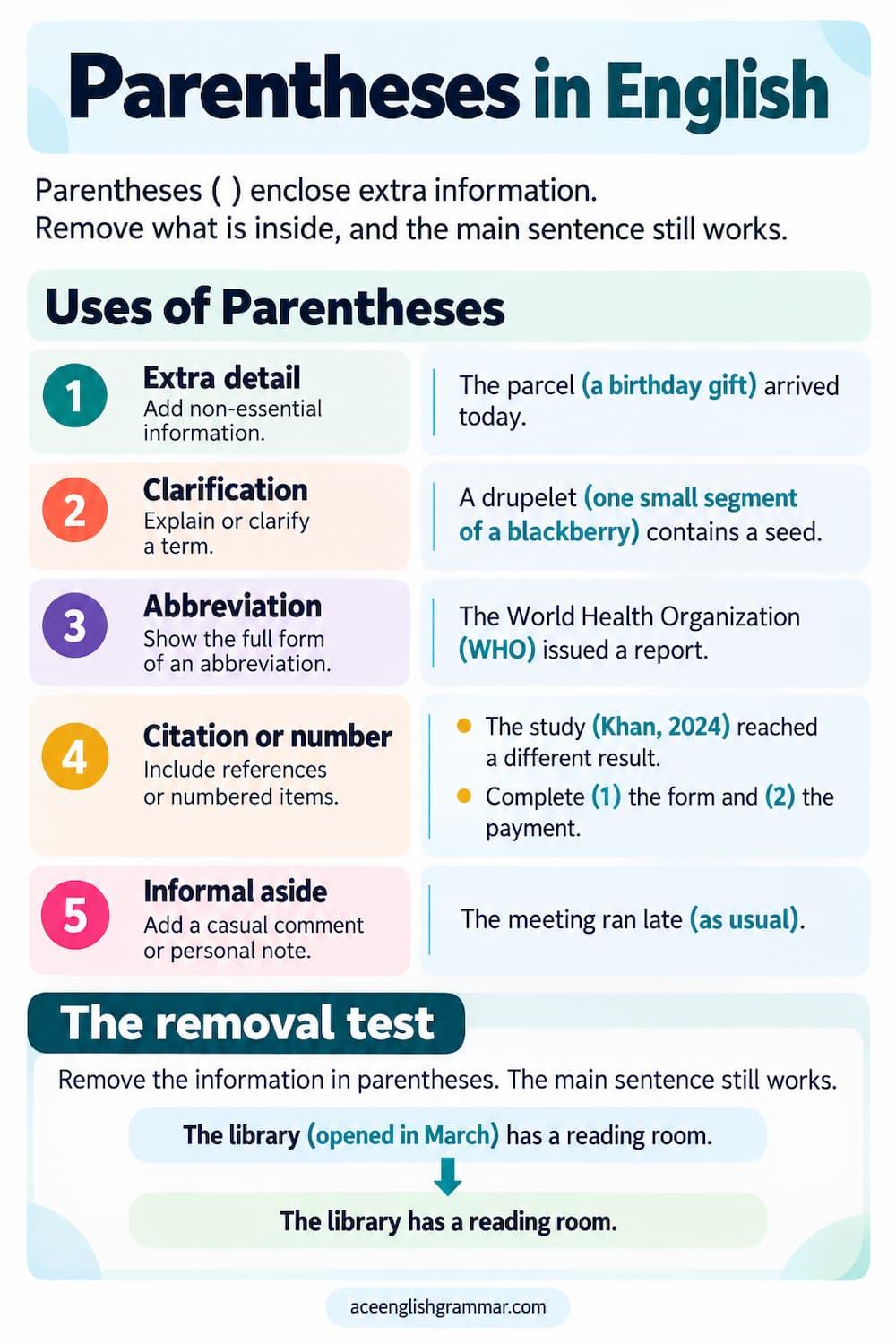
Parentheses are a pair of curved punctuation marks ( ) that enclose extra information inside a sentence. The material they enclose can be removed without breaking the grammar or changing the core meaning.
There are five main uses of parentheses in English: adding extra information, clarifying or defining a term, introducing an abbreviation, enclosing numbers and citations, and marking asides in informal writing. The hardest rule concerns punctuation placement, where the period goes inside or outside depending on whether the enclosed material is a complete sentence.
What Are Parentheses?
Parentheses are a pair of curved marks ( ) that enclose material added to a sentence without being essential to it. The opening parenthesis is ( and the closing parenthesis is ).
The test for parentheses is removability. If the sentence still reads correctly and keeps its core meaning after the enclosed material is deleted, the parentheses are used correctly.
- My daughters (aged 5 and 7) love the neighbour’s dog.
- The conference (held in Lahore) attracted 500 delegates.
- She finished the report (all forty pages) in one night.
- The results (published last week) surprised everyone.
Note that parentheses always come in pairs. A single parenthesis appears only in list numbering, as in “1)” or “a)”.
Parenthesis vs Parentheses
“Parenthesis” is the singular form and names one curved mark. “Parentheses” is the plural form and names the pair, which is why the plural appears in almost every grammatical discussion of the mark.
- One mark is a parenthesis.
- The pair together are parentheses.
- Open the parenthesis before the word.
- Put the phrase in parentheses.
Note that “parenthesis” also names the enclosed material itself in rhetoric, where a parenthesis is an interrupting remark rather than the mark around it.
The singular and plural forms cause frequent spelling trouble, and “parens” is a further informal short form used in editing, publishing, and programming. It is a spoken and working abbreviation rather than a term for formal prose.
Compare:
- She used a parentheses to set off the date. ✗
- She used parentheses to set off the date. ✓
- The closing parenthesis is missing. ✓
Common Uses of Parentheses with Examples
Parentheses have five established uses in English writing. The most common uses appear here with one example each; each rule is covered in detail later.
- Extra information: My daughters (aged 5 and 7) love dogs.
- Clarification or definition: The drupelet (the small segment of a blackberry) ripens last.
- Abbreviations and acronyms: The World Health Organization (WHO) issued a warning.
- Numbers and citations: The study (Khan, 2024) found the opposite.
- Asides in informal writing: The meeting ran late (as usual).
Parentheses for Extra Information
Parentheses enclose information that adds detail without being necessary to the sentence. The reader can skip the enclosed material and still follow the meaning, which is what separates parenthetical information from essential information.
- The new library (opened in March) has a reading room.
- Her brother (a surgeon in Multan) flew in for the wedding.
- The proposal (all ninety pages of it) arrived by courier.
- The team won their final match (3–2) on Saturday.
Note that parentheses signal the lowest level of emphasis among the three marks that set off extra information. Commas hold the material in the flow, em dashes give it emphasis, and parentheses move it into the background.
Compare:
- The proposal, all ninety pages, arrived by courier. (neutral)
- The proposal—all ninety pages—arrived by courier. (emphasized)
- The proposal (all ninety pages) arrived by courier. (backgrounded)
Parentheses for Clarification and Definitions
Parentheses enclose a definition, a translation, or a clarifying detail that helps the reader understand a term in the main sentence. This use is common in technical writing, academic prose, and language teaching.
- The drupelet (the small round segment of a blackberry) ripens last.
- She studied at the Sorbonne (in Paris) for three years.
- The manuscript was written in Urdu (the national language of Pakistan).
- Add 200 grams (about seven ounces) of flour.
Note that a clarification inside parentheses stays brief. A definition that runs to a full sentence reads better as its own sentence or as a nonrestrictive clause.
Parentheses for Abbreviations and Acronyms
Parentheses introduce an abbreviation or acronym on its first appearance, so later mentions can use the short form alone. The full name comes first and the short form follows in parentheses.
- The World Health Organization (WHO) issued a warning.
- The Higher Education Commission (HEC) approved the proposal.
- Magnetic resonance imaging (MRI) shows soft tissue clearly.
- The United Nations Children’s Fund (UNICEF) runs the programme.
Note that the order reverses only when the short form is better known than the full name. In that case the acronym leads and the full name follows in parentheses, as in “NASA (the National Aeronautics and Space Administration).”
Parentheses in Numbers and Citations
Parentheses enclose numbers, dates, and source references in academic, legal, and business writing. Each of these uses follows a fixed convention rather than a judgment call.
1. In-text citations give the author and year, or the page number, in parentheses.
- The study (Khan, 2024) reached the opposite conclusion.
- Recent work contradicts this finding (Ahmed and Shah, 2023, p. 47).
2. List numbering uses parentheses around the number or letter in running text.
- Complete the form in three steps: (1) enter your details, (2) upload the file, and (3) confirm.
- The options are (a) accept, (b) decline, or (c) defer.
3. Negative figures in accounting appear in parentheses instead of taking a minus sign.
- The quarter closed with a loss of (45,000).
- Net change: (2,300) against the previous year.
4. Digits repeating a written number appear in parentheses in formal and legal documents.
- The tenant shall pay five thousand rupees (5,000) monthly.
- Delivery within thirty (30) days of the order.
Punctuation With Parentheses
Where the period, comma, question mark, or exclamation mark goes depends on whether the parentheses enclose a complete sentence or only a fragment. This rule causes more confusion than any other aspect of parentheses.
Periods
A period goes outside the closing parenthesis when the enclosed material forms part of a larger sentence, and inside when the parentheses enclose a complete standalone sentence. The full placement rules cover every mark.
- She finished the report (all forty pages). ✓ (fragment inside a sentence: period outside)
- She finished the report. (It ran to forty pages.) ✓ (complete standalone sentence: period inside)
- The meeting ran late (as usual). ✓
- The meeting ran late. (This happens every month.) ✓
Compare:
- She finished the report (all forty pages.) ✗
- She finished the report (all forty pages). ✓
Commas
A comma never comes before an opening parenthesis. When a comma is needed at that point in the sentence, it moves to after the closing parenthesis.
- After the meeting (which ran late), we went home. ✓
- After the meeting, (which ran late) we went home. ✗
- She bought three books (all novels), two magazines, and a newspaper. ✓
- If it rains (as forecast), the match is cancelled. ✓
Question Marks and Exclamation Marks
A question mark or exclamation mark goes inside the parentheses when it belongs to the enclosed material, and outside when it belongs to the main sentence.
- She finally replied (after three weeks!). ✓ (the exclamation belongs inside)
- Did you read the report (all forty pages)? ✓ (the question belongs to the main sentence)
- He agreed to pay (can you believe it?) without argument. ✓
- Have you met her brother (the surgeon)? ✓
Parentheses Within Parentheses
Nested parentheses are avoided in most writing. When a second level is unavoidable, In American style the inner pair becomes square brackets, while a second pair of parentheses is acceptable in British style.
- American: The report (published by the Higher Education Commission [HEC]) covers three provinces.
- British: The report (published by the Higher Education Commission (HEC)) covers three provinces.
Note that rewriting the sentence is better than nesting in nearly every case. Two levels of enclosure force the reader to hold too much in mind at once.
Compare:
- The study (conducted in Lahore (Punjab) in 2024) found the opposite. ✗ (hard to read)
- The study, conducted in Lahore, Punjab, in 2024, found the opposite. ✓
Parentheses vs Brackets
The names differ between dialects, which causes constant confusion in international writing. In American English, ( ) are parentheses and [ ] are brackets. In British English, ( ) are brackets or round brackets and [ ] are square brackets.
| Mark | American name | British name |
|---|---|---|
| ( ) | Parentheses | Brackets or round brackets |
| [ ] | Brackets or square brackets | Square brackets |
| { } | Curly braces | Curly brackets |
| < > | Angle brackets | Angle brackets |
Square brackets have their own function in both dialects. They enclose an editorial insertion inside quoted material, marking words the original speaker did not say.
- The witness said, “I could hear him [the policeman] but I could not see him.”
- The report noted that “[t]he findings were inconclusive.”
- She wrote that the plan “was doomed from the start [sic].”
Note that square brackets signal editorial intervention. Parentheses signal the writer’s own aside.
Parentheses vs Em Dashes vs Commas
Three punctuation options set off extra information inside a sentence, and each signals a different level of emphasis. The choice is stylistic rather than grammatical.
- Commas keep the material in the flow of the sentence: The proposal, all ninety pages, arrived by courier.
- Em dashes give the material emphasis: The proposal—all ninety pages—arrived by courier.
- Parentheses move the material into the background: The proposal (all ninety pages) arrived by courier.
Note that parentheses suit material the reader can genuinely skip, while em dashes suit material the writer wants noticed. Using parentheses for a central point sends the wrong signal.
Compare:
- The drug cured the infection (in every single patient). ✗ (backgrounds the key finding)
- The drug cured the infection—in every single patient. ✓ (emphasizes it)
Capitalization Inside Parentheses
The first word inside parentheses is capitalized only when the enclosed material is a complete standalone sentence. A fragment inside a larger sentence stays lowercase.
- She finished the report (all forty pages). ✓ (fragment: lowercase)
- She finished the report. (It ran to forty pages.) ✓ (standalone sentence: capitalized)
- The meeting ran late (as usual). ✓
- The proposal arrived (Ahmed sent it) before noon. ✗
- The proposal arrived (Ahmed sent it) before noon. ✓ (proper noun keeps its capital)
Note that a proper noun inside parentheses keeps its capital regardless of position, as in “(Ahmed sent it)” and “(published in Karachi).”
How to Type Parentheses
Both parentheses sit on the number row of every standard keyboard, reached with the Shift key. No special code or shortcut is needed on any platform.
| Mark | Windows and Mac | Unicode | HTML |
|---|---|---|---|
| ( | Shift + 9 | U+0028 | ( |
| ) | Shift + 0 | U+0029 | ) |
| [ | The key right of P | U+005B | [ |
| ] | The key right of [ | U+005D | ] |
| { | Shift + [ | U+007B | { |
| } | Shift + ] | U+007D | } |
On iOS and Android, parentheses appear on the numbers-and-symbols keyboard layer. Holding either key reveals the square and curly bracket options.
When Not to Use Parentheses
Five situations call for different punctuation even though writers reach for parentheses.
1. For essential information. Material the sentence needs cannot go in parentheses.
- The man (who called earlier) is my neighbour. ✗ (identifies which man)
- The man who called earlier is my neighbour. ✓
2. For information the reader must notice. An em dash or a separate sentence gives the emphasis parentheses remove.
- The drug cured the infection (in every patient). ✗
- The drug cured the infection in every patient. ✓
3. More than once or twice per page in formal writing. Heavy parenthetical use breaks the reading rhythm and signals disorganised drafting.
4. To enclose a full paragraph of explanation. Long enclosed material belongs in its own sentence or a footnote.
5. Around material that already sits inside parentheses. Square brackets handle the second level in American style.
- The report (published by the commission (HEC)) covers three provinces. ✗
- The report (published by the commission [HEC]) covers three provinces. ✓
Common Errors With Parentheses
Six errors recur most commonly when writers use parentheses in English.
- Putting the period inside for a fragment. We write “She finished the report (all forty pages),” not “She finished the report (all forty pages.)” A period goes inside only when the parentheses enclose a complete standalone sentence.
- Placing a comma before the opening parenthesis. We write “After the meeting (which ran late), we went home,” not “After the meeting, (which ran late) we went home.” The comma moves to after the closing parenthesis.
- Enclosing essential information. We write “The man who called earlier is my neighbour,” not “The man (who called earlier) is my neighbour,” when the clause identifies which man. Parentheses hold only removable material.
- Nesting parentheses inside parentheses. We write “(published by the commission [HEC]),” not “(published by the commission (HEC)).” American style uses square brackets for the inner level.
- Capitalizing a fragment inside parentheses. We write “(all forty pages),” not “(All forty pages).” Only a complete standalone sentence or a proper noun takes a capital.
- Leaving a parenthesis unclosed. Every opening parenthesis needs its closing pair, except in list numbering such as “1)” or “a)”.
FAQs
Q1. What are parentheses?
Parentheses are a pair of curved punctuation marks ( ) that enclose extra information inside a sentence. The enclosed material can be deleted without breaking the grammar or changing the core sense. Common uses cover extra detail, clarifications, abbreviations, citations, and numbered lists.
Q2. What is the difference between a parenthesis and parentheses?
“Parenthesis” is the singular form and names one curved mark. “Parentheses” is the plural and names the pair together. Because the marks nearly always appear as a pair, the plural is the form used in almost every grammatical discussion.
Q3. Does the period go inside or outside parentheses?
It depends on what the parentheses enclose. A period goes outside when the enclosed material is a fragment inside a larger sentence: “She finished the report (all forty pages).” It goes inside when the parentheses enclose a complete standalone sentence: “She finished the report. (It ran to forty pages.)”
Q4. What is the difference between parentheses and brackets?
The names differ by dialect. In American English, ( ) are parentheses and [ ] are brackets. In British English, ( ) are brackets or round brackets and [ ] are square brackets. In both dialects, square brackets mark an editorial insertion inside a quotation, while parentheses mark the writer’s own aside.
Q5. Can I put parentheses inside parentheses?
Avoid it where possible. When a second level is unavoidable, the inner pair becomes square brackets in American style: “(published by the commission [HEC]).” A second pair of parentheses is acceptable in British style. Rewriting the sentence is better than nesting in nearly every case.
Q6. Do I capitalize the first word inside parentheses?
Only when the enclosed material is a complete standalone sentence or begins with a proper noun. A fragment inside a larger sentence stays lowercase: “She finished the report (all forty pages).” A standalone sentence takes a capital: “(It ran to forty pages.)”
Q7. Are parentheses too informal for academic writing?
No. Parentheses are standard in academic writing for in-text citations, abbreviations on first mention, and numbered lists. What falls outside academic register is the conversational aside, such as “(as usual)” or “(can you believe it?)”, which suits informal prose rather than formal argument.
Read More

Leave a Comment