
The colon is a punctuation mark (:) made of two dots, one over the other. It introduces something that explains, completes, or gives examples of what came before it in the sentence.
There are more than ten distinct uses of the colon in English, from introducing lists and explanations to separating hours from minutes, marking ratios, and dividing titles from subtitles. The core grammatical rule behind most of these uses is the same: a complete independent clause comes before the colon.
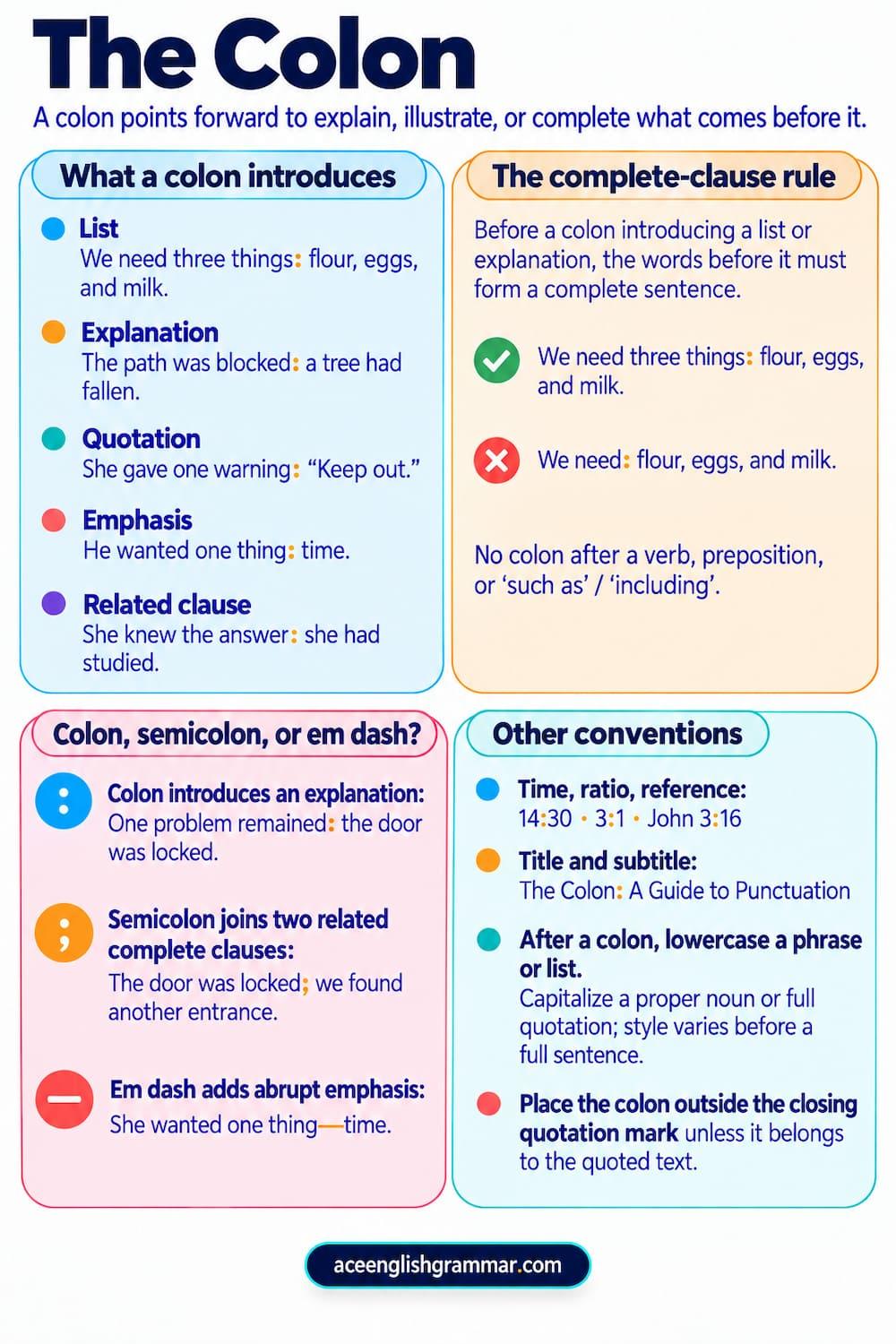
What Is a Colon?
A colon is a punctuation mark (:) consisting of two dots placed one over the other. The colon symbol signals that the second part of the sentence will explain, complete, or give examples of what the first part introduced.
The purpose of a colon is to point forward. Whatever follows it answers, expands, or specifies the statement that came before, which is what separates the colon from the semicolon (a link between two equal clauses) and the comma (a separator inside one clause).
- I am taking four classes this semester: biology, philosophy, physics, and ancient Greek.
- She had one goal in mind: to finish the marathon before sunset.
- The detective noticed something unusual: the window had been left wide open.
- He has one real strength: persistence.
Note that a complete independent clause comes before the colon in almost every grammatical use. This single rule prevents most colon errors.
Common Uses of the Colon with Examples
The colon has more than ten established uses in English writing. The most common uses are listed here with one example each; each rule is covered in detail later.
- To introduce a list: Bring three items: a coat, boots, and gloves.
- To introduce an explanation: We have a problem: the shipment never arrived.
- To introduce a quotation: The manager said: “The deadline has moved.”
- For emphasis: She wanted one thing: freedom.
- Between two independent clauses: The reason was clear: nobody had checked the figures.
- In time expressions: The train leaves at 14:30.
- In ratios: The mixture is 3:1 water to concentrate.
- Between title and subtitle: Dune: Part Two
- In business salutations: Dear Mr. Khan:
- In memo headings: To: All Staff
- In references and citations: John 3:16
The Independent Clause Rule
A complete independent clause comes before the colon. An independent clause has its own subject and verb and could stand alone as a sentence. When the words before the colon cannot stand alone, the colon is wrong.
- Correct: Sam liked three things: reading, writing, and video games.
- Incorrect: Sam liked: reading, writing, and video games.
- Correct: I love my work for two reasons: the people and the challenge.
- Incorrect: I love my work for: the people and the challenge.
The test is to read only the words before the colon. If they form a complete sentence, the colon is correct.
- The committee proposes the following recommendations: ✓ (complete clause)
- We recommend: ✗ (incomplete: the verb has no object)
- Please bring four items: ✓ (complete clause)
- Please bring: ✗ (incomplete)
Note that phrases such as “the following,” “these items,” “three reasons,” and “as follows” are common ways to complete the clause before a colon. Adding a number or a summary noun turns an incomplete introduction into a correct one.
Compare:
- You will need: orange juice, lemonade, and ice. ✗
- You will need three ingredients: orange juice, lemonade, and ice. ✓
Colon to Introduce a List
A colon introduces a list when a complete independent clause comes before it. The list that follows can be a series of words, phrases, or clauses, and it can run inline or as a vertical bulleted list.
- The following novels will be on the exam: Moby Dick, Great Expectations, and The Brothers Karamazov.
- Pick up three things from the store: oranges, apples, and pears.
- She packed everything she needed: a passport, a charger, and two books.
- The recipe calls for four ingredients: flour, butter, sugar, and eggs.
Note that no colon appears after a verb or a preposition. We say “I need butter, sugar, and flour,” not “I need: butter, sugar, and flour.”
Compare:
- My favourite colours are: blue, green, and yellow. ✗ (colon after the verb “are”)
- My favourite colours are blue, green, and yellow. ✓
- I have three favourite colours: blue, green, and yellow. ✓
Colon to Introduce an Explanation
A colon introduces a word, phrase, or clause that explains or expands the statement before it. The colon signals that what follows answers the question raised by the first part of the sentence.
- We have a problem: hundreds of people are outside and we have nothing to sell.
- She is ready to move on to a new school: this one has taught her everything it can.
- Amsterdam is filled with great museums: just walk around and you will find one.
- The project failed for one reason: nobody checked the budget.
Note that the explanation after the colon does not need to be a complete sentence. A single word or a short phrase works when it answers the statement before it.
- He knew what was missing: trust.
- The answer was obvious: money.
Colon to Introduce a Quotation
A colon introduces a quotation when the words before it form a complete independent clause. A colon is preferred over a comma when the quotation runs to two or more sentences, or when the introduction is formal.
- Detective Holt said: “The kidnapper is a man we must catch, and the sooner the better.”
- Her father often told her: “Work hard. Be honest. Always show up on time.”
- The report reached one conclusion: “The current system cannot scale.”
- The sign carried a single instruction: “Do not enter.”
Note that a comma introduces a short quotation after a brief speaker tag. We say “She said, ‘Come in,'” not “She said: ‘Come in,'” for a single quoted line in narrative writing.
Compare:
- The weather reporter said the weather was: “hot, sunny and dry.” ✗ (incomplete clause before the colon)
- The weather reporter described the weather: “hot, sunny and dry.” ✓
Colon for Emphasis
A colon sets off a single word or short phrase at the end of a sentence for emphasis. The colon creates a pause that draws attention to what follows, which makes it a common device in headlines, taglines, and persuasive writing.
- I can bring one real strength to your company: my writing.
- She said she wanted to see one place before she died: New Zealand.
- There was only one thing left to do: wait.
- The company had a single priority that year: survival.
Note that an em dash can replace a colon in this position for a more informal tone. The colon reads as more measured; the em dash reads as more dramatic.
Compare:
- She wanted one thing: freedom. (formal, measured)
- She wanted one thing—freedom. (informal, emphatic)
Colon Between Two Independent Clauses
A colon joins two independent clauses when the second clause explains, illustrates, or expands the first. Both halves are complete sentences, and the colon replaces a period or semicolon to show the explanatory relationship.
- Manchester United face a difficult task: they must win the next six matches.
- The results were surprising: the cheaper model outperformed the premium one.
- Life can be complicated: sometimes it is good and sometimes it is bad.
- The decision made itself: no other candidate had the experience.
Note that a semicolon also joins two independent clauses, but it signals equality rather than explanation. A colon points forward to an answer; a semicolon links two related statements of equal weight.
Compare:
- We can enter at the next gate; there are fewer people there. (two related statements)
- We have a problem: hundreds of people are outside. (the second explains the first)
Colon in Time, Ratios, and Numbers
A colon separates numerical elements in time expressions, ratios, proportions, and certain reference formats. These uses are mechanical rather than grammatical, and the independent clause rule does not apply to them.
1. Time: a colon separates hours from minutes, and minutes from seconds.
- The train leaves at 14:30.
- The meeting starts at 9:15 a.m.
- Her finishing time was 2:47:33.
- Ratios and proportions: a colon separates the two quantities being compared.
- Mix the concentrate at 3:1 with water.
- The student-to-teacher ratio is 18:1.
- The odds were 5:2 against.
- References and citations: a colon separates chapter from verse, or volume from page.
- The verse was John 3:16.
- The article appeared in Nature 412:437.
- See Genesis 1:1 for the opening line.
Note that no space appears on either side of the colon in these numerical uses. We write “14:30,” not “14 : 30.”
Colon Between Titles and Subtitles
A colon separates a main title from its subtitle in books, films, articles, and academic papers. This use is standard across every major style guide, and the subtitle begins with a capital letter.
- Dune: Part Two
- The Elements of Style: Fourth Edition
- Star Wars: The Empire Strikes Back
- Sapiens: A Brief History of Humankind
Note that the first word of the subtitle is capitalized in this position, even when the subtitle is not a complete sentence. This is one of the few contexts where capitalization after a colon is automatic.
Colon in Salutations and Memo Headings
A colon appears after the salutation in formal business correspondence and after each label in a memo heading. Both uses are conventions of business writing rather than grammatical rules.
- Business salutations: a colon follows the greeting in formal American business letters, where British and informal American writing uses a comma.
- Dear Mr. Khan: (formal American business letter)
- Dear Hiring Manager:
- To Whom It May Concern:
- Dear Sarah, (informal or British: comma)
2. Memo headings: a colon follows each label in a memo block.
- To: All Staff
- From: The Operations Team
- Date: 25 September 2026
- Subject: Revised Holiday Policy
Note that the colon in a business salutation marks formality. A comma in the same position signals a personal or informal letter.
The Colon With Quotation Marks
The colon always goes outside the closing quotation mark, in both American and British English. This makes it different from the comma and the period, which follow opposite rules in the two dialects.
- “Always look before you leap”: that is advice worth taking.
- She quoted the old line about “measure twice, cut once”: it applied perfectly.
- He kept repeating the phrase “not my problem”: the attitude cost him the job.
Compare:
- “Come in,” she said. (comma inside the quote: American style)
- “Come in”, she said. (comma outside the quote: British style)
- “Always look before you leap”: that is useful advice. (colon outside the quote: both styles)
Note that the colon never goes inside the closing quotation mark unless it belongs to the quoted material itself.
Colon Symbol and How to Type It
The colon symbol (:) is on every standard keyboard, reached with Shift and the semicolon key. No special code is needed on any platform, which makes it one of the few punctuation marks that requires no shortcut.
| Format | Code |
|---|---|
| Unicode | U+003A |
| HTML entity | : |
| Windows and Mac | Shift + semicolon |
| CSS content | \003A |
On iOS and Android, the colon symbol appears on the numbers-and-symbols keyboard layer beside the semicolon.
Note that two related characters are confused with the colon. The ratio sign (∶, U+2236) is used in mathematical proportions in typeset work, and the modifier letter colon (ː, U+02D0) marks vowel length in phonetic transcription.
Spacing Around the Colon
One space goes after a colon in running prose, and no space comes before it. The two-space convention comes from typewriters and is no longer standard in any current style guide.
- She wanted one thing: freedom. ✓
- She wanted one thing : freedom. ✗ (space before the colon)
- She wanted one thing:freedom. ✗ (no space after the colon)
Numerical uses take no space on either side, since the colon separates figures rather than words.
- The train leaves at 14:30. ✓
- Mix the concentrate at 3:1 with water. ✓
- The verse was John 3:16. ✓
Note that a space goes before the colon in French typography, which is why the extra space survives in text translated from French unless an editor removes it.
Capitalization After a Colon
The word after a colon is capitalized only in specific circumstances. The rule depends on what follows the colon and on which style guide the writer follows.
- Do not capitalize when a dependent clause, a phrase, or a list follows the colon.
- She wanted one thing: freedom. ✓
- Bring three items: a coat, boots, and gloves. ✓
- The weather was as expected: hot, sunny, and dry. ✓
- Capitalize when the colon introduces a proper noun, a subtitle, or a full-sentence quotation.
- She named one destination: New Zealand. ✓ (proper noun)
- Sapiens: A Brief History of Humankind ✓ (subtitle)
- The host made an announcement: “You are all staying for dinner.” ✓ (quoted sentence)
- Style guides differ when a complete independent clause follows the colon. American style permits either form; Chicago and APA prefer a capital when two or more sentences follow.
- The results were clear: the model works. (lowercase, acceptable)
- The results were clear: The model works. (capitalized, also acceptable in American style)
- Dad gave us rules to live by: Work hard. Be honest. Show up on time. (capitalized: multiple sentences follow)
Note that British usage is stricter than American usage here. Under British style the word after a colon stays lowercase unless it is a proper noun or the start of a quoted sentence.
Colon vs Semicolon vs Em Dash
Three punctuation marks connect parts of a sentence in overlapping ways, and choosing between them is a frequent source of confusion. Each mark signals a different relationship between the parts it joins.
Colon vs Semicolon
A colon points forward to an explanation, a list, or a result. A semicolon links two independent clauses of equal weight without saying that one explains the other.
- We have a problem: the shipment never arrived. (the second clause explains the first)
- I like the library; there are always good books there. (two related statements, equal weight)
- She had one goal: to finish the race. (the colon introduces the goal)
- My mother is a doctor; my father is an accountant. (parallel statements)
Note that a semicolon requires two complete independent clauses on both sides. A colon requires a complete clause only on the left, and what follows can be a single word, a phrase, or a list.
Compare:
- Sam liked three things; reading, writing, and video games. ✗ (right side is not a clause)
- Sam liked three things: reading, writing, and video games. ✓
Colon vs Em Dash
A colon and an em dash can both introduce an explanation or an emphatic phrase. The colon reads as formal and measured; the em dash reads as informal and abrupt.
- She wanted one thing: freedom. (formal)
- She wanted one thing—freedom. (informal, more emphatic)
- The answer was simple: eat less, exercise more. (formal)
- The answer was simple—eat less, exercise more. (informal)
Note that an em dash cannot replace a colon that introduces a formal list after a complete clause. We say “Buy these items: bread, milk, and eggs,” not “Buy these items—bread, milk, and eggs.”
When Not to Use a Colon
Five situations require no colon even though writers commonly add one. Each of them breaks the independent clause rule in a different way.
1. After a verb. No colon separates a verb from its object or complement.
- My favourite colours are: blue, green, and yellow. ✗
- My favourite colours are blue, green, and yellow. ✓
2. After a preposition. No colon separates a preposition from its object.
- I am grateful for: my family, my friends, and my health. ✗
- I am grateful for my family, my friends, and my health. ✓
3. After “such as,” “including,” or “for example.” These phrases already introduce what follows, so a colon is redundant.
- She enjoys sports such as: tennis, squash, and rowing. ✗
- She enjoys sports such as tennis, squash, and rowing. ✓
4. Between a subject and its verb. No colon separates the subject from the verb, even when the subject is long.
- The three people on the committee: voted against the plan. ✗
- The three people on the committee voted against the plan. ✓
5. More than one colon in a single sentence. Two colons in one sentence confuse the reader about which clause each introduces.
- She had two reasons: money and time: neither of which she mentioned. ✗
- She had two reasons, money and time, neither of which she mentioned. ✓
Common Errors With the Colon
Six errors recur most commonly when writers use the colon in English.
- Placing a colon after an incomplete clause. We say “Sam liked three things: reading, writing, and video games,” not “Sam liked: reading, writing, and video games.” A complete independent clause comes before the colon.
- Placing a colon after a verb or preposition. We say “I am grateful for my family and friends,” not “I am grateful for: my family and friends.” A colon never separates a verb or preposition from what it governs.
- Using a colon instead of a semicolon between equal clauses. We say “My mother is a doctor; my father is an accountant,” not “My mother is a doctor: my father is an accountant.” A colon signals explanation, not parallel statements.
- Capitalizing after a colon before a list or phrase. We say “Bring three items: a coat, boots, and gloves,” not “Bring three items: A coat, boots, and gloves.” Capitalization follows only a proper noun, a subtitle, or a full-sentence quotation.
- Placing the colon inside the closing quotation mark. We say “Always look before you leap”: that is useful advice, not “Always look before you leap:” that is useful advice. The colon sits outside the quote in both dialects.
- Adding a colon after “such as” or “including.” We say “sports such as tennis and squash,” not “sports such as: tennis and squash.” These phrases already perform the introducing function.
FAQs
Q1. What is a colon?
A colon is a punctuation mark (:) made of two dots, one over the other. It points the reader forward, introducing something that explains, completes, or gives examples of what came before it. The colon has more than ten established uses in English, from introducing lists and explanations to separating hours from minutes in time expressions.
Q2. When do I use a colon?
Use a colon to introduce a list, an explanation, a quotation, or an emphatic word or phrase, and to join two independent clauses when the second explains the first. Also use it in time expressions (14:30), ratios (3:1), between titles and subtitles, in formal business salutations, and in memo headings.
Q3. What comes before a colon?
A complete independent clause comes before the colon in every grammatical use. An independent clause has its own subject and verb and could stand alone as a sentence. Reading only the words before the colon is the test: if they form a complete sentence, the colon is correct.
Q4. Do I capitalize after a colon?
Capitalize after a colon only when a proper noun, a subtitle, or a full-sentence quotation follows. Do not capitalize before a list, a phrase, or a dependent clause. When a complete independent clause follows, either form is acceptable under American style, while British style leaves the word lowercase.
Q5. What is the difference between a colon and a semicolon?
A colon points forward to an explanation, a list, or a result, and requires a complete clause only on its left. A semicolon links two independent clauses of equal weight and requires a complete clause on both sides. “We have a problem: the shipment never arrived” uses a colon because the second part explains the first.
Q6. Does the colon go inside or outside quotation marks?
The colon always goes outside the closing quotation mark, in both American and British English. This differs from the comma and the period, which go inside the quote in American style and outside in British style. The colon goes inside only when it belongs to the quoted material itself.
Q7. How many spaces go after a colon?
One space follows a colon in running prose, and no space comes before it. The two-space convention comes from typewriters and no current style guide requires it. Numerical uses such as 14:30 and 3:1 take no space on either side.
Q8. Can I use a colon after “such as” or “including”?
No. Phrases such as “such as,” “including,” and “for example” already introduce what follows, so a colon after them is redundant. We say “sports such as tennis, squash, and rowing,” not “sports such as: tennis, squash, and rowing.”

Leave a Comment