
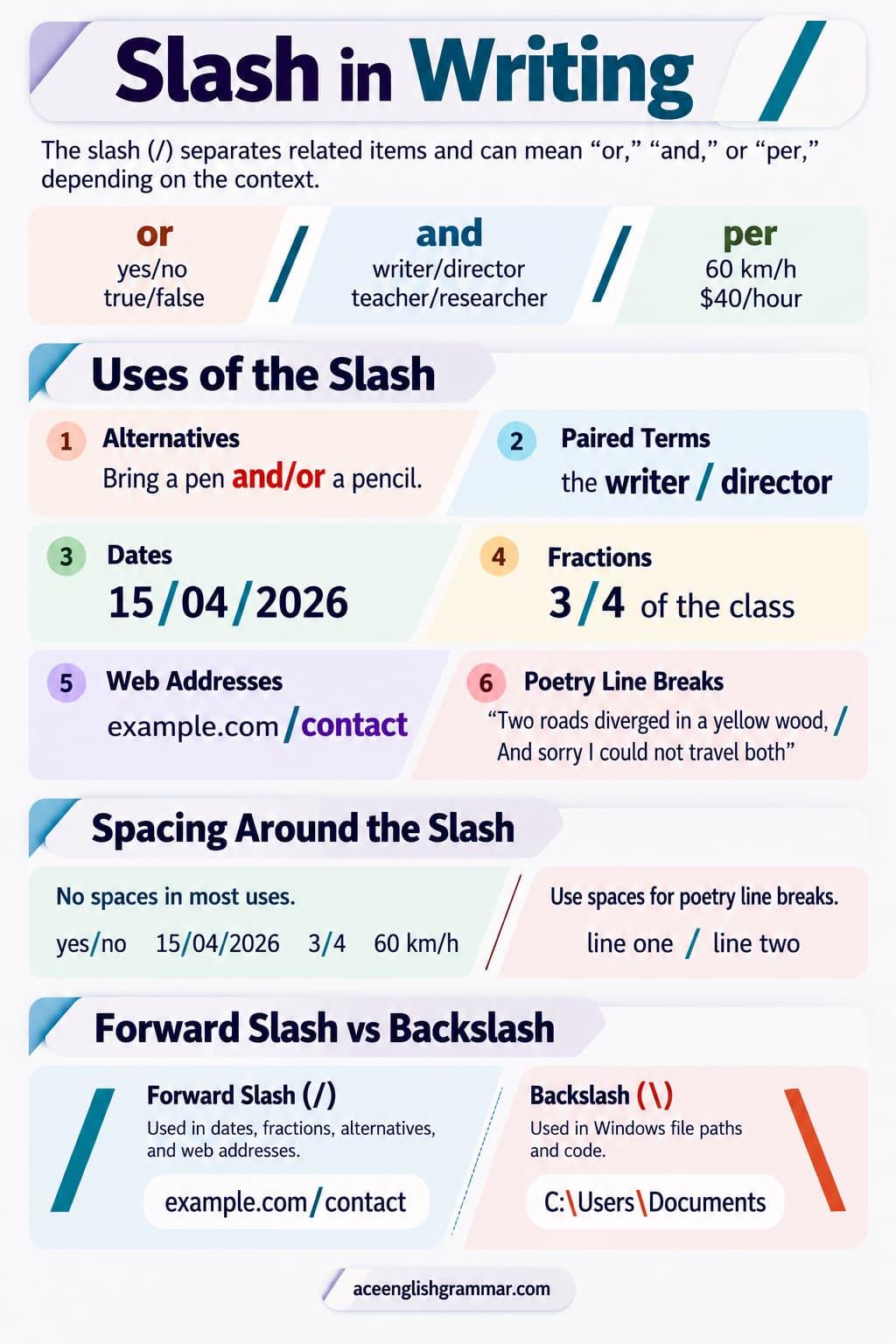
A slash is a punctuation mark (/) that separates alternatives, marks a line break in quoted poetry, and divides the elements of dates, fractions, and web addresses. It leans forward, which distinguishes it from the backslash used in file paths.
The slash has no single meaning. It stands for “or” in one construction, for “and” in another, and for “per” in a third, so the reading depends on what stands on either side of it.
What Is a Slash?
A slash is a punctuation mark (/) that separates two items standing in some relation to each other. The mark is also called the forward slash, the virgule, the solidus, or the stroke in British usage.
The slash is the least standardised mark in English punctuation. Formal writing uses it sparingly, and most of its everyday work happens in dates, addresses, and technical notation rather than in prose.
- Bring a pen and/or a pencil.
- The form is due 15/04/2026.
- Visit example.com/contact for details.
- Please sign the his/her line.
Note that the slash never takes a space on either side in these uses. Spaced slashes appear only when quoting poetry.
Types of Slash Characters
Several slanted characters look similar and carry different functions. Only the first two appear in ordinary writing.
| Character | Name | Unicode | Function |
|---|---|---|---|
| / | Forward slash, solidus | U+002F | Alternatives, dates, web addresses |
| \ | Backslash | U+005C | Windows file paths, escape character in code |
| // | Double slash | — | Protocol separator in URLs, comment marker in code |
| ⁄ | Fraction slash | U+2044 | Typeset fractions |
| ∕ | Division slash | U+2215 | Mathematical division |
| ⧸ | Big solidus | U+29F8 | Large mathematical expressions |
Note that a double slash has no function in English prose. It marks the protocol in a web address and opens a comment in several programming languages.
Forward Slash vs Backslash
The forward slash leans right and the backslash leans left. The two are never interchangeable, and the distinction matters most in addresses and file paths.
- Forward slash (/): web addresses, dates, fractions, alternatives
- Backslash (\): Windows file paths and escape sequences in code
Compare:
- https://example.com/about ✓ (forward slashes throughout a web address)
- C:\Users\Documents\report.docx ✓ (backslashes in a Windows path)
- https:\example.com ✗ (backslashes never appear in a web address)
Note that the backslash is not a punctuation mark in English. It exists for computing, and no sentence in ordinary prose requires one.
Common Uses of the Slash with Examples
The slash has six established uses in English writing. The most common uses appear here with one example each; each rule is covered in detail later.
- Alternatives: Bring a pen and/or a pencil.
- Paired terms: the writer/director gave a talk
- Dates: 15/04/2026
- Fractions: 3/4 of the class
- Web addresses: example.com/contact
- Quoted poetry: “Two roads diverged in a yellow wood, / And sorry I could not travel both”
Does a Slash Mean “And” or “Or”?
The slash covers both meanings, and the construction decides which one applies. Three readings account for nearly every use.
1. “Or” between alternatives. The reader picks one.
- Please indicate yes/no on the form.
- The role suits a graduate/postgraduate applicant.
- Tick the box marked true/false.
2. “And” between paired roles held at once. Both apply to the same person or thing.
- She is the writer/director of the film.
- The room serves as a kitchen/dining area.
- He works as a teacher/researcher.
3. “Per” in rates and measurements. The slash divides one unit by another.
- The car averages 60 km/h.
- The rate is $40/hour.
- Dosage is 5 mg/kg.
The construction “and/or” exists because the slash alone is ambiguous between the first two readings. It states explicitly that either alternative or both may apply.
- Bring a pen and/or a pencil. (one, the other, or both)
Note that formal and legal writing avoids “and/or” as imprecise. Rewriting the sentence to name the options directly is the clearer choice: “Bring a pen, a pencil, or both.”
Slash in Dates and Fractions
The slash separates the elements of a numerical date and divides the numerator from the denominator in a fraction. No space appears on either side in either use.
1. Dates take slashes in the short numerical form.
- 15/04/2026
- 04/15/2026
- The invoice is dated 3/7/25.
2. Fractions take a slash between the two figures.
- 3/4 of the class attended.
- The recipe calls for 1/2 a teaspoon.
- The map is drawn at 1/50,000.
Note that the date order differs by country and causes real confusion. British and most international usage puts the day first, giving 15/04/2026 for the fifteenth of April. American usage puts the month first, so 04/15/2026 means the same date. A date such as 3/7/25 is genuinely ambiguous between the third of July and the seventh of March.
Slash in Web Addresses and File Paths
Forward slashes divide the parts of a web address, separating the protocol, the domain, and each level of the path. Windows file paths use backslashes instead.
- https://example.com/guides/punctuation
- www.example.co.uk/contact
- The double slash after “https:” separates the protocol from the domain.
Compare:
- /guides/punctuation ✓ (forward slashes in a web path)
- C:\Users\Sara\Documents ✓ (backslashes in a Windows path)
- /home/sara/documents ✓ (forward slashes in a Mac or Linux path)
Note that Mac and Linux systems use forward slashes in file paths, which means the backslash belongs to Windows alone.
Slash in Abbreviations
A small set of abbreviations takes a slash between the letters. These are fixed forms rather than a productive pattern, so the slash cannot be added to other abbreviations by analogy.
- w/ (with)
- w/o (without)
- c/o (care of)
- n/a (not applicable)
- a/c (account)
- 24/7 (all day, every day)
Note that these belong to notes, forms, and informal writing. Formal prose spells the words out.
Slash in Poetry and Quoted Line Breaks
When lines of poetry are quoted inside running prose, a slash marks each line break. This is the one use that takes a space on both sides of the mark.
- “Two roads diverged in a yellow wood, / And sorry I could not travel both”
- “Shall I compare thee to a summer’s day? / Thou art more lovely and more temperate”
A double slash marks a stanza break in the same way.
- “The woods are lovely, dark and deep, / But I have promises to keep // And miles to go before I sleep”
Note that a quotation running to more than three lines of verse is set as a block quotation instead, indented and with the line breaks preserved.
Spacing Around the Slash
The slash takes no space on either side in almost every use. The single exception is quoted poetry, where a space on each side keeps the lines readable.
- No space: and/or, 15/04/2026, 3/4, example.com/contact, 60 km/h
- Spaced: “Two roads diverged in a yellow wood, / And sorry I could not travel both”
A second exception applies when either side of the slash is more than one word. A space on each side prevents the reader from mis-grouping the terms.
- the writer/director ✓ (single words, closed)
- the head of department / director of studies ✓ (multi-word terms, spaced)
Note that inconsistent spacing within one document is the error to avoid. Pick the closed form for single words and reserve spacing for poetry and multi-word terms.
Slashed Letters and Symbols
Several characters carry a slash through them and are unrelated to the punctuation mark. Each has its own meaning and its own Unicode point.
| Character | Name | Meaning |
|---|---|---|
| Ø ø | O with stroke | A letter in Danish, Norwegian, and Faroese |
| ∅ | Empty set | A set with no members, in mathematics |
| ≠ | Not equal to | Inequality, in mathematics |
| ⌀ | Diameter sign | Diameter, in engineering drawings |
| 0̸ | Slashed zero | A zero distinguished from the letter O |
Note that the slashed zero appears in technical writing and older computer displays to separate the digit from the capital letter. The Scandinavian Ø is a distinct letter of the alphabet rather than a modified O.
How to Type a Slash
Both the forward slash and the backslash sit on standard keyboards. The specialist slash characters need a code.
| Character | Windows | Mac | Unicode | HTML |
|---|---|---|---|---|
| / | The key left of right Shift | Same key | U+002F | / |
| \ | The key above Enter | Option + Shift + 7 | U+005C | \ |
| ⁄ fraction | Alt + 8260 | Option + Shift + 1 | U+2044 | ⁄ |
| Ø | Alt + 0216 | Option + Shift + O | U+00D8 | Ø |
| ≠ | Alt + 8800 | Option + = | U+2260 | ≠ |
On iOS and Android, the forward slash appears on the numbers-and-symbols keyboard layer, and the backslash requires a second tap to the extended symbols layer.
Slash vs Dash
The slash separates alternatives and the dash marks an interruption or a range. The two have no overlapping function, though a slash sometimes appears where a dash or a hyphen belongs.
- the writer/director ✓ (slash: two roles held at once)
- the London–Paris route ✓ (en dash: a range between two points)
- She paused—then spoke. ✓ (em dash: an interruption)
- a well-known author ✓ (hyphen: a compound modifier)
Compare:
- the London/Paris route ✗ (a slash suggests one or the other)
- the London–Paris route ✓ (an en dash connects the two)
When Not to Use a Slash
Five situations call for different wording or a different mark.
1. In formal prose where a conjunction fits. Write the word out.
- The policy affects students/staff. ✗
- The policy affects students and staff. ✓
2. In place of a hyphen in a compound modifier.
- a well/known author ✗
- a well-known author ✓
3. In place of an en dash for a range.
- pages 10/15 ✗
- pages 10–15 ✓
4. For gendered pronouns in modern writing. The singular “they” or a rewrite reads better.
- Each student must bring his/her form. (dated)
- Each student must bring their form. ✓
- All students must bring their forms. ✓
5. In academic and legal writing, for “and/or”. Name the options instead.
- Submit a passport and/or a driving licence. ✗
- Submit a passport, a driving licence, or both. ✓
Common Errors With the Slash
Six errors recur most commonly when writers use the slash in English.
- Using a backslash in a web address. We write https://example.com with forward slashes. The backslash belongs to Windows file paths and code.
- Adding spaces around a slash in dates or fractions. We write 15/04/2026 and 3/4, not 15 / 04 / 2026. Only quoted poetry takes a spaced slash.
- Using “and/or” in formal writing. We name the options directly: “a passport, a driving licence, or both.” The construction reads as imprecise in academic and legal prose.
- Using a slash for a range. We write pages 10–15 with an en dash. A slash suggests alternatives rather than a span.
- Mixing spaced and closed slashes in one document. We close the slash for single words and space it only for poetry and multi-word terms.
- Reading a numerical date without checking the convention. We confirm whether 3/7/25 follows the British day-first or the American month-first order before acting on it.
FAQs
Q1. What is a slash?
A slash is a punctuation mark (/) that separates alternatives, divides the elements of dates and fractions, and marks line breaks in quoted poetry. It is also called the forward slash, the virgule, the solidus, or the stroke in British usage.
Q2. Does a slash mean “and” or “or”?
Both, depending on the construction. Between alternatives it means “or,” as in yes/no. Between two roles held at once it means “and,” as in writer/director. In rates it means “per,” as in 60 km/h. The form “and/or” exists because the first two readings are otherwise ambiguous.
Q3. Is there a space after a slash?
No, in almost every use. Dates, fractions, web addresses, and paired single words take a closed slash with no space. Quoted poetry takes a space on each side to mark line breaks, and multi-word terms on either side take spaces to prevent mis-grouping.
Q4. What is the difference between a forward slash and a backslash?
The forward slash (/) leans right and appears in web addresses, dates, fractions, and alternatives. The backslash (\) leans left and belongs to Windows file paths and code. The backslash is not a punctuation mark in English, and no sentence in ordinary prose requires one.
Q5. What does a double slash mean?
A double slash (//) separates the protocol from the domain in a web address, as in https://example.com. In several programming languages it opens a comment. In quoted poetry it marks a stanza break. It has no function in ordinary English prose.
Q6. What does an O with a slash through it mean?
It depends on the character. Ø is a letter in Danish, Norwegian, and Faroese. ∅ is the empty set in mathematics. ⌀ is the diameter sign in engineering drawings. A slashed zero distinguishes the digit from the capital letter O in technical writing.
Q7. Should I use “and/or” in formal writing?
Avoid it. Academic and legal writing treats “and/or” as imprecise, since the reader cannot tell whether both options may apply together. Naming the options directly is clearer: “a passport, a driving licence, or both” rather than “a passport and/or a driving licence.”

Leave a Comment