
The hyphen is a punctuation mark (-) that joins two or more words into a single unit or separates a word at the end of a line. It is the shortest of the three horizontal marks in English, ahead of the en dash and the em dash.
There are six main uses of the hyphen: compound adjectives before a noun, compound nouns, prefixes and suffixes, written numbers and fractions, ages, and word division at a line break. The hyphen takes no space on either side in every one of these uses.
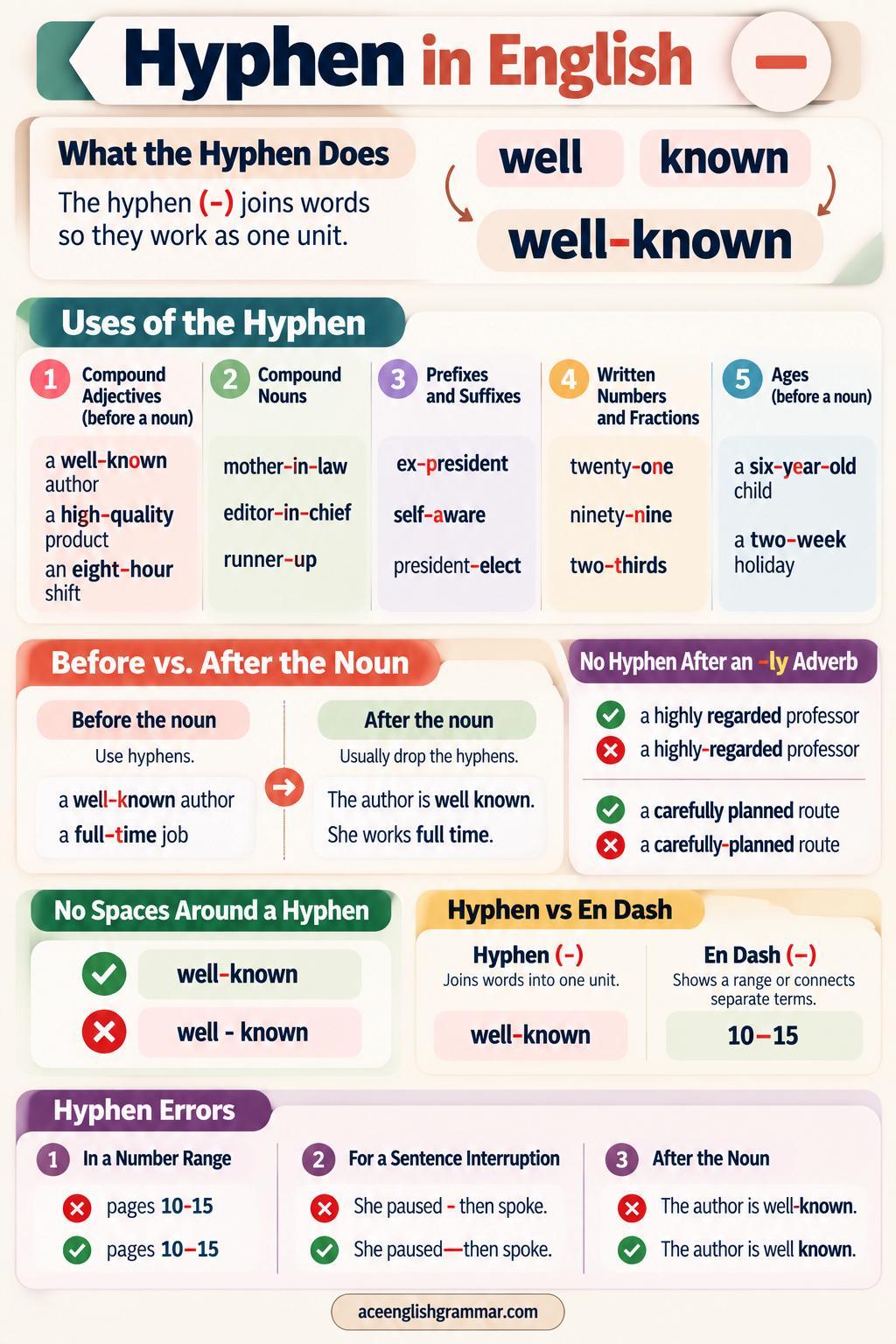
What Is a Hyphen?
A hyphen is a punctuation mark (-) that joins words into a single unit or divides a word across two lines. It is the only one of the three horizontal marks that appears directly on a standard keyboard.
The hyphen operates at word level rather than sentence level. It builds compounds and attaches prefixes, while the en dash spans ranges and the em dash interrupts sentences.
- She is a well-known author.
- The six-year-old child laughed.
- His ex-wife lives in Karachi.
- There were twenty-one applicants.
Note that a hyphen never takes a space on either side. We write “well-known,” not “well – known.”
Note also that the “long hyphen” people ask about is not a hyphen at all. A longer horizontal mark is either an en dash (–) or an em dash (—), each with its own function and its own name.
Common Uses of the Hyphen with Examples
The hyphen has six established uses in English writing. The most common uses are listed here with one example each; each rule is covered in detail later.
- Compound adjectives before a noun: a well-known author
- Compound nouns: mother-in-law
- Prefixes and suffixes: ex-president, president-elect
- Written numbers: twenty-one, ninety-nine
- Fractions and ages: two-thirds, a six-year-old
- Word division at a line break: punc-tuation
Hyphen vs En Dash vs Em Dash
Three horizontal marks appear in English writing, and each belongs to a different level of language. The hyphen builds words, the en dash spans values, and the em dash interrupts sentences.
The Hyphen
The hyphen (-) is the shortest mark and the only one on a standard keyboard. It joins two or more words into one compound and attaches prefixes to base words.
- a well-known author
- twenty-one applicants
- her mother-in-law
- an ex-president
The En Dash
The en dash (–) is longer than the hyphen. It spans a range between two values or links two words that keep their separate identities.
- Read pages 10–15.
- The 2020–2025 period saw three recessions.
- The London–Paris route runs hourly.
The Em Dash
The em dash (—) is the longest mark. It signals a strong pause or sets off information from the rest of the sentence.
- She made her decision—there was no turning back.
- The plan—developed over months—was ready.
Note that a hyphen joins, an en dash spans, and an em dash interrupts. These three functions do not overlap, and the em dash versus en dash distinction is the one writers confuse most.
Compare:
- a well-known author ✓ (hyphen joins)
- a well–known author ✗ (en dash is wrong here)
- pages 10–15 ✓ (en dash spans)
- pages 10-15 ✗ (hyphen is wrong here)
Hyphen in Compound Adjectives
A compound adjective is two or more words acting together as a single modifier. The hyphen shows the reader that the words work as one unit, which prevents misreading.
Before the Noun
A compound adjective takes a hyphen when it comes before the noun it modifies. The hyphen groups the words so the reader sees one modifier rather than two separate ones.
- a well-known author
- a high-quality product
- a full-time employee
- an eight-hour shift
- a state-of-the-art facility
Note that the hyphen changes the meaning in many pairs. A “small-business owner” owns a small business; a “small business owner” is a short person who owns a business.
Compare:
- a man-eating shark ✓ (a shark that eats people)
- a man eating shark ✗ (a man who is eating a shark)
- twenty-odd guests ✓ (about twenty guests)
- twenty odd guests ✗ (twenty strange guests)
After the Noun
A compound adjective drops the hyphen when it comes after the noun, because the risk of misreading disappears in that position.
- The author is well known.
- The product is high quality.
- She works full time.
- The facility is state of the art.
Compare:
- a well-known author ✓ (before the noun: hyphen)
- The author is well known. ✓ (after the noun: no hyphen)
- a full-time job ✓
- She works full time. ✓
With Adverbs Ending in -ly
A compound modifier takes no hyphen when the first word is an adverb ending in “-ly.” The “-ly” ending already signals that the word modifies the adjective that follows, so the hyphen adds nothing.
- a highly regarded professor ✓
- a highly-regarded professor ✗
- a beautifully written novel ✓
- a carefully planned route ✓
- a newly built house ✓
Note that this exception covers only adverbs. Adjectives ending in “-ly” still take the hyphen, as in “a friendly-looking dog” and “a lively-sounding crowd.”
Hyphen in Compound Nouns
English compound nouns come in three forms: open (two separate words), hyphenated, and closed (one word). The hyphen marks the middle stage, and a dictionary settles which form a given compound takes.
- Open: high school, post office, ice cream
- Hyphenated: mother-in-law, editor-in-chief, merry-go-round
- Closed: notebook, keyboard, bedroom
Common hyphenated compound nouns:
- her mother-in-law
- the editor-in-chief
- a passer-by
- the runner-up
- a check-in desk
- a follow-up call
Note that many compounds have moved from hyphenated to closed over time. “E-mail” became “email,” and “web-site” became “website,” which is why a current dictionary is the safest guide.
Hyphen With Prefixes and Suffixes
Most prefixes attach to a base word with no hyphen in modern English. A hyphen appears in five specific situations where the closed form would confuse the reader or look wrong.
1. Before a proper noun or a number.
- pre-Renaissance art
- anti-American sentiment
- post-1945 Europe
2. When the prefix ends and the base begins with the same vowel.
- re-elect, re-enter, co-operate
- anti-inflammatory, semi-independent
3. With the prefixes “ex-,” “self-,” and “all-.”
- an ex-president
- self-esteem, self-aware
- an all-inclusive package
4. To separate two different meanings.
- re-cover a chair (cover again) versus recover from illness
- re-sign a contract (sign again) versus resign from a job
5. With the suffix “-elect” and “-like” after certain bases.
- the president-elect
- a bell-like sound
Note that more prefix compounds are written closed in American English than in British English. The American forms are “cooperate” and “reelect,” while British style retains “co-operate” and “re-elect.”
Hyphen in Numbers, Fractions, and Ages
The hyphen joins the parts of written numbers, fractions, and ages used as modifiers. These rules are mechanical and apply consistently across style guides.
1. Compound numbers from twenty-one to ninety-nine take a hyphen when written out.
- twenty-one applicants
- forty-seven pages
- ninety-nine percent
2. Fractions written as words take a hyphen between the numerator and the denominator.
- two-thirds of the class
- three-quarters full
- a one-half share
3. Ages used as a modifier before a noun take hyphens; ages used after the noun do not.
- a six-year-old child ✓ (before the noun)
- The child is six years old. ✓ (after the noun)
- a two-week holiday ✓
- The holiday lasted two weeks. ✓
Compare:
- a ten-year-old boy ✓
- The boy is ten years old. ✓
- a ten years old boy ✗
Hyphen at a Line Break
A hyphen divides a word across two lines when the whole word does not fit at the end of a line. The break falls between syllables, and the hyphen goes at the end of the first line rather than the start of the second.
- punc-tuation
- gram-mar
- inde-pendent
- exam-ple
Note that word processors handle this automatically, and manual line-break hyphens are rare in digital writing. A word of one syllable is never divided, and a break never leaves a single letter alone on either line.
Capitalization of Hyphenated Words
In a title, each element of a hyphenated compound is capitalized when it is a word that would be capitalized on its own. Prefixes, articles, and short prepositions inside the compound stay lowercase.
- Well-Known Authors of the Century ✓
- The Mother-in-Law Question ✓ (in and law stay lowercase after the first element)
- A Self-Taught Programmer ✓
- Twenty-First Century Writing ✓
Note that the second element after a prefix takes a capital under Chicago (“Re-Elected”) and stays lowercase under AP style (“Re-elected”).
Commonly Asked Hyphenated Words
Certain compounds are asked about more than any others, because their form shifts depending on where they sit in the sentence. This reference table covers the most frequent cases.
| Compound | Before a noun | After the noun |
|---|---|---|
| In person | an in-person meeting | She attended in person |
| In house | an in-house team | The work stays in house |
| Step by step | a step-by-step guide | Explain it step by step |
| Third party | a third-party vendor | Sold to a third party |
| Evidence based | an evidence-based policy | The policy is evidence based |
| Built in | a built-in wardrobe | The wardrobe is built in |
| Open ended | an open-ended question | The question is open ended |
| Decision making | decision-making authority | She handles decision making |
| Point of view | a point-of-view shot | Written from her point of view |
| Long term | a long-term plan | Plan for the long term |
| Up to date | an up-to-date record | Keep the record up to date |
| Well being | well-being programmes | Concerned for her well being |
| Soon to be | her soon-to-be husband | The house is soon to be sold |
| Full time | a full-time role | She works full time |
| State of the art | a state-of-the-art lab | The lab is state of the art |
| In depth | an in-depth review | She studied it in depth |
| Day to day | day-to-day operations | It changes day to day |
| Face to face | a face-to-face meeting | They met face to face |
Note that the pattern is consistent across every row. A compound modifier takes hyphens before the noun and drops them after, and the full rules for when to hyphenate cover numbers, prefixes, and word count.
Hyphen Symbol and How to Type It
The hyphen is the only one of the three horizontal marks placed directly on a standard keyboard, which makes it the easiest to type and the most frequently substituted for the other two.
The character codes for the hyphen across formats:
| Format | Code |
|---|---|
| Unicode | U+002D |
| HTML entity | – |
| Keyboard | The key between 0 and = |
| Non-breaking hyphen | U+2011 |
| CSS content | \002D |
On Windows
On Windows, the hyphen is typed with the hyphen key on the top row of the keyboard. A non-breaking hyphen, which prevents a line break inside a compound, uses Ctrl + Shift + Hyphen in Microsoft Word.
- The hyphen key between 0 and = on the top row
- Ctrl + Shift + hyphen in Word for a non-breaking hyphen
On Mac
On Mac, the hyphen is typed with the same hyphen key. A non-breaking hyphen is inserted through the Special Characters menu.
- The hyphen key between 0 and = on the top row
- Edit > Emoji & Symbols, then search for “non-breaking hyphen”
On Mobile Devices
On iOS and Android, the hyphen appears on the numbers-and-symbols keyboard layer. Holding the key reveals the en dash and em dash options.
- Switch to the numbers layer, then tap the hyphen
- Hold the hyphen key to reach the en dash and em dash
British vs American Hyphenation
British and American English agree on compound adjectives but differ on prefix compounds. British style retains the hyphen in more prefix compounds, while the American forms close them up.
- British: co-operate, co-ordinate, re-elect, pre-eminent
- American: cooperate, coordinate, reelect, preeminent
- Both: a well-known author, a six-year-old child, twenty-one applicants
Note that the difference narrows each decade, as more closed forms enter British publishing. A current dictionary in the target dialect settles any individual case.
When Not to Use a Hyphen
Five situations require no hyphen even though writers commonly add one.
1. After an adverb ending in -ly.
- a highly-regarded professor ✗
- a highly regarded professor ✓
2. With a compound adjective after the noun.
- The author is well-known. ✗
- The author is well known. ✓
3. In a range of numbers or dates.
- pages 10-15 ✗
- pages 10–15 ✓ (en dash)
4. As a parenthetical interruption.
- She paused – then spoke. ✗
- She paused—then spoke. ✓ (em dash)
5. With most prefixes before a common noun.
- non-profit organisation (acceptable but dated)
- nonprofit organisation ✓ (modern American standard)
- pre-school ✗ in American usage
- preschool ✓
Common Errors With the Hyphen
Six errors recur most commonly when writers use the hyphen in English.
- Hyphenating after an -ly adverb. We write “a highly regarded professor,” not “a highly-regarded professor.” The “-ly” ending already links the adverb to the adjective.
- Keeping the hyphen after the noun. We write “The author is well known,” not “The author is well-known.” A compound modifier drops its hyphens in that position.
- Using a hyphen for a range. We write “pages 10–15,” not “pages 10-15.” A range takes an en dash.
- Using a hyphen as a parenthetical dash. We write “She paused—then spoke,” not “She paused – then spoke.” An interruption takes an em dash.
- Adding spaces around the hyphen. We write “well-known,” not “well – known.” The hyphen never takes a space on either side.
- Omitting the hyphen in a compound modifier before a noun. We write “a small-business owner,” not “a small business owner,” when the meaning is an owner of a small business. The hyphen prevents the misreading.
FAQs
Q1. What is a hyphen?
A hyphen is a punctuation mark (-) that joins two or more words into a single unit or divides a word at the end of a line. In a compound it shows that the joined words act as one. It is the shortest of the three horizontal marks in English. Common examples include “well-known,” “six-year-old,” and “mother-in-law.”
Q2. What is the difference between a hyphen, an en dash, and an em dash?
The three marks work at different levels. A hyphen (-) joins words into one compound, as in “well-known.” An en dash (–) spans a range or links two separate units, as in “pages 10–15.” An em dash (—) interrupts a sentence for emphasis, as in “She paused—then spoke.”
Q3. When do I hyphenate a compound adjective?
Hyphenate a compound adjective when it comes before the noun it modifies: “a well-known author,” “a full-time job.” Drop the hyphen when the same words come after the noun: “The author is well known,” “She works full time.” The hyphen prevents misreading in the first position only.
Q4. Do I hyphenate after an adverb ending in -ly?
No. A compound modifier takes no hyphen when the first word is an adverb ending in “-ly,” because the ending already links it to the word that follows. We write “a highly regarded professor,” not “a highly-regarded professor.” Adjectives ending in “-ly,” such as “friendly,” still take the hyphen.
Q5. Is “in person” hyphenated?
It depends on position. “In-person” takes hyphens before a noun, as in “an in-person meeting.” It drops them after the verb, as in “She attended in person.” The same pattern applies to “step by step,” “third party,” “built in,” and every other compound modifier.
Q6. How do I hyphenate numbers and ages?
Compound numbers from twenty-one to ninety-nine take a hyphen when written out. Fractions written as words take a hyphen, as in “two-thirds.” Ages take hyphens before a noun (“a six-year-old child”) and drop them after (“The child is six years old”).
Q7. Do hyphenated words count as one word or two?
A hyphenated compound counts as a single word in most word-count tools. Microsoft Word counts “well-known” as one word, while some academic word-count rules count each element separately. The target style guide settles the question for any given submission.
Read More

Leave a Comment