
The semicolon is a punctuation mark (;) that joins two closely related independent clauses without a coordinating conjunction. It marks a pause stronger than a comma and weaker than a period.
There are two main uses of the semicolon in English: joining independent clauses, and separating items in a complex list where the items already contain commas. A third rule governs the semicolon before conjunctive adverbs such as “however,” “therefore,” and “moreover.”
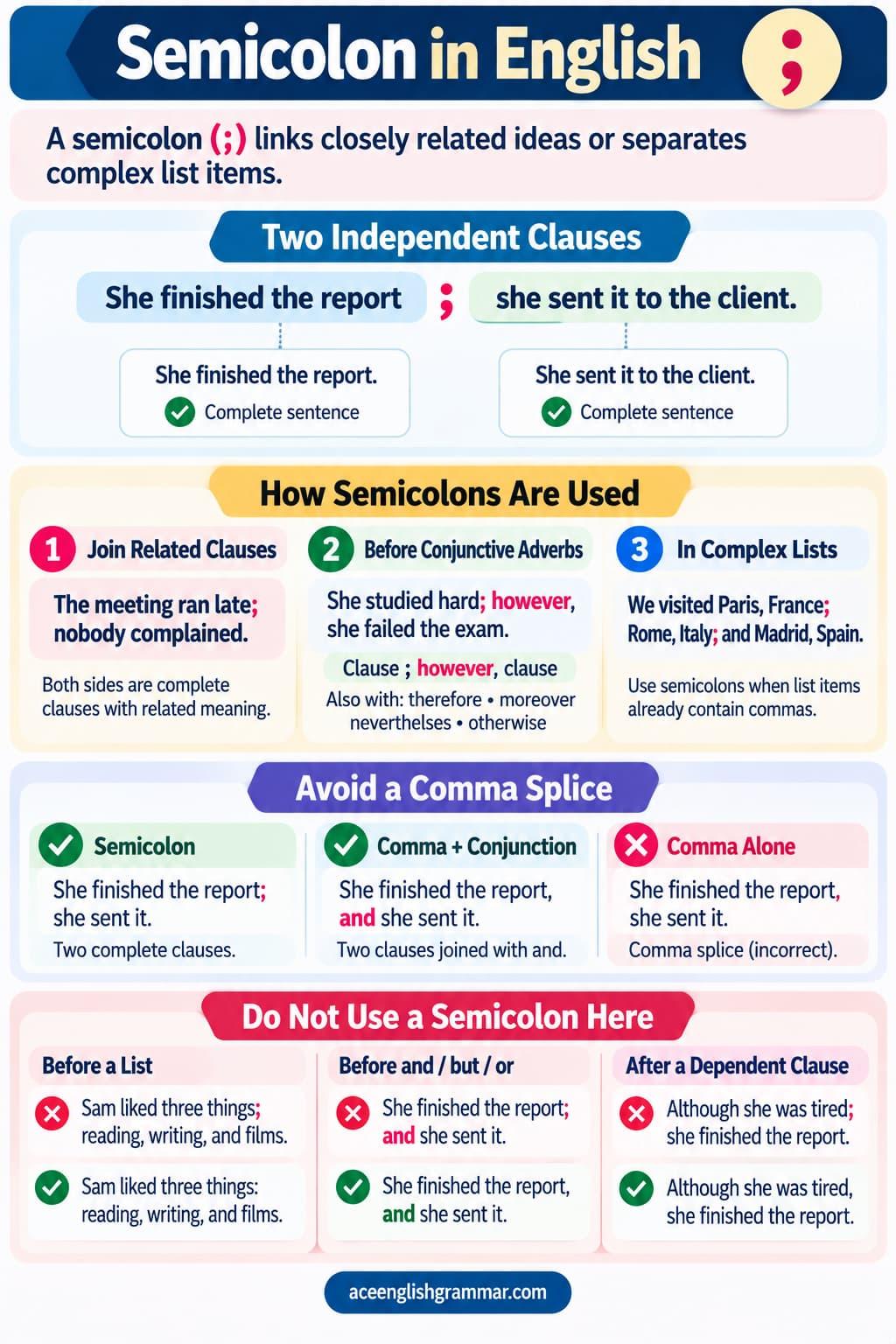
What Is a Semicolon?
A semicolon is a punctuation mark (;) made of a period over a comma. It joins two independent clauses that are closely related in meaning, without using a coordinating conjunction between them.
The semicolon signals equality. Both sides carry the same weight, which separates it from the colon (where the second part explains the first) and from the comma (which cannot join two independent clauses on its own).
- My mother is a doctor; my father is an accountant.
- The rain had stopped; the sun came out.
- She loves cooking; her sister loves baking.
- I like the library; there are always good books there.
Note that a complete independent clause stands on both sides of a semicolon. This single requirement prevents most semicolon errors.
Common Uses of the Semicolon with Examples
The semicolon has three established uses in English writing. The most common uses are listed here with one example each; each rule is covered in detail later.
- To join two independent clauses: The meeting ran late; nobody complained.
- Before a conjunctive adverb: She studied hard; however, she failed the exam.
- In a complex list: We visited Paris, France; Rome, Italy; and Madrid, Spain.
The Two Independent Clauses Rule
A complete independent clause stands on both sides of a semicolon. An independent clause has its own subject and verb and could stand alone as a sentence. When either side cannot stand alone, the semicolon is wrong.
- Correct: She finished the report; she sent it to the client.
- Incorrect: She finished the report; and sent it to the client.
- Correct: The results were surprising; nobody had expected them.
- Incorrect: The results were surprising; especially the third one.
The test is to read each side on its own. If both halves form complete sentences, the semicolon is correct.
- Sam liked three things; reading, writing, and video games. ✗ (right side is a list, not a clause)
- Sam liked three things: reading, writing, and video games. ✓ (colon introduces a list)
- Sam liked reading; his brother preferred films. ✓ (both sides are clauses)
Note that this rule is stricter than the colon rule. A colon requires a complete clause only on its left; a semicolon requires one on both sides.
Semicolon to Join Independent Clauses
A semicolon joins two independent clauses when their meanings are closely related and the writer wants a connection tighter than a period would give. The semicolon replaces both the period and the coordinating conjunction.
- The meeting ran late; nobody complained.
- She has lived in Karachi for years; she still calls Lahore home.
- The experiment failed three times; the fourth attempt succeeded.
- He never answered the email; the silence said enough.
Note that the two clauses must be genuinely related. When the connection is weak, a period is the better choice.
Compare:
- She loves cooking; her sister loves baking. ✓ (related: both about cooking preferences)
- She loves cooking; the train leaves at six. ✗ (unrelated: use a period)
Semicolon With Conjunctive Adverbs
A semicolon comes before a conjunctive adverb that joins two independent clauses, and a comma follows the adverb. Common conjunctive adverbs include however, therefore, moreover, nevertheless, furthermore, otherwise, consequently, and instead.
- She studied hard; however, she failed the exam.
- The roads were icy; therefore, we cancelled the trip.
- He arrived on time; moreover, he brought the documents.
- The offer was generous; nevertheless, she declined it.
- Finish the report today; otherwise, the client will call.
Note that a comma alone before a conjunctive adverb creates a comma splice. We say “She studied hard; however, she failed,” not “She studied hard, however, she failed.”
Compare:
- The plan was expensive, however, it worked. ✗ (comma splice)
- The plan was expensive; however, it worked. ✓
- The plan was expensive. However, it worked. ✓
Semicolon in a Complex List
A semicolon separates items in a list when the items themselves contain commas. Using commas alone in such a list makes it impossible to see where one item ends and the next begins.
- We visited Paris, France; Rome, Italy; and Madrid, Spain.
- The committee includes Dr. Khan, the chair; Ms. Ali, the treasurer; and Mr. Shah, the secretary.
- Bring a toothpaste, for hygiene; a water bottle, for the journey; and a coat, in case it rains.
- The finalists were Sara, from Lahore; Ahmed, from Multan; and Zainab, from Quetta.
Note that the semicolon replaces every comma between items in such a list, including the one before “and.” The rules for introducing and separating a list cover the colon alongside it.
Compare:
- We visited Paris, France, Rome, Italy, and Madrid, Spain. ✗ (six items or three?)
- We visited Paris, France; Rome, Italy; and Madrid, Spain. ✓ (three items, clearly separated)
Capitalization After a Semicolon
The word after a semicolon is not capitalized, unless it is a proper noun. The semicolon joins two halves of one sentence, so the second half continues rather than starts fresh.
- My mother is a doctor; my father is an accountant. ✓
- The rain had stopped; the sun came out. ✓
- She lives in Karachi; Lahore is where she grew up. ✓ (proper noun)
- The offer was generous; nevertheless, she declined. ✓
Compare:
- The rain had stopped; The sun came out. ✗
- The rain had stopped; the sun came out. ✓
Note that this rule matches the colon rule for dependent material but differs from the colon rule for full sentences, where a capital is acceptable under American style.
Semicolon vs Comma
A semicolon joins two independent clauses on its own. A comma cannot do this without a coordinating conjunction, and using a comma alone produces a comma splice, one of the most common punctuation errors in English.
- She finished the report; she sent it to the client. ✓ (semicolon)
- She finished the report, and she sent it to the client. ✓ (comma plus conjunction)
- She finished the report, she sent it to the client. ✗ (comma splice)
Note that a comma separates elements inside a single clause, while a semicolon separates two whole clauses. The two marks work at different levels of sentence structure, set out in full under comma vs semicolon.
Compare:
- Bring bread, milk, and eggs. ✓ (comma: items inside one clause)
- Bring bread; we have run out. ✓ (semicolon: two clauses)
Semicolon vs Colon
A semicolon links two independent clauses of equal weight. A colon points forward to an explanation, a list, or a result, and it requires a complete clause only on its left.
- We can enter at the next gate; there are fewer people there. (two related statements)
- We have a problem: hundreds of people are outside. (the second explains the first)
- My mother is a doctor; my father is an accountant. (parallel statements)
- She had one goal: to finish the race. (the colon introduces the goal)
Note that when both clauses are complete and closely related, either mark can work. The semicolon signals balance; the colon signals that an explanation follows.
Compare:
- The results were clear; the model works. ✓ (balanced statement)
- The results were clear: the model works. ✓ (the second explains the first)
- Sam liked three things; reading, writing, and films. ✗ (right side is not a clause)
- Sam liked three things: reading, writing, and films. ✓
Semicolon vs Em Dash
A semicolon and an em dash can both join two independent clauses. The semicolon reads as formal and measured; the em dash reads as informal and adds a stronger pause.
- The rain had stopped; the sun came out. (formal)
- The rain had stopped—the sun came out. (informal, more abrupt)
- She loved cooking; her sister loved baking. (formal)
- She loved cooking—her sister loved baking. (informal)
Note that academic and professional writing prefers the semicolon in this position. The em dash suits fiction, journalism, and conversational prose.
When Not to Use a Semicolon
Five situations require punctuation other than the semicolon. Each of them breaks the two-clause rule in a different way.
1. Before a list. A colon introduces a list; a semicolon does not.
- Sam liked three things; reading, writing, and films. ✗
- Sam liked three things: reading, writing, and films. ✓
2. With a coordinating conjunction between the clauses. A comma, not a semicolon, comes before “and,” “but,” “or,” and the rest of FANBOYS.
- She finished the report; and she sent it. ✗
- She finished the report, and she sent it. ✓
3. Between a dependent clause and a main clause. A comma joins these, not a semicolon.
- Although she was tired; she finished the report. ✗
- Although she was tired, she finished the report. ✓
4. Before a phrase that is not a clause. Both sides need a subject and a verb.
- The results were surprising; especially the third one. ✗
- The results were surprising, especially the third one. ✓
5. As a decorative pause. A semicolon carries a grammatical function and does not replace a comma for stylistic effect.
- She walked in; slowly; and sat down. ✗
- She walked in slowly and sat down. ✓
Common Errors With the Semicolon
Six errors recur most commonly when writers use the semicolon in English.
- Using a semicolon before a list. We say “Sam liked three things: reading, writing, and films,” not “Sam liked three things; reading, writing, and films.” A colon introduces a list; a semicolon joins two clauses.
- Using a semicolon with a coordinating conjunction. We say “She finished the report, and she sent it,” not “She finished the report; and she sent it.” A comma comes before FANBOYS, not a semicolon.
- Using a comma where a semicolon belongs. We say “She studied hard; however, she failed,” not “She studied hard, however, she failed.” A comma alone before a conjunctive adverb creates a comma splice.
- Capitalizing after a semicolon. We say “The rain stopped; the sun came out,” not “The rain stopped; The sun came out.” Only a proper noun is capitalized after a semicolon.
- Joining a dependent clause with a semicolon. We say “Although she was tired, she finished,” not “Although she was tired; she finished.” A dependent clause takes a comma.
- Using a semicolon where the clauses are unrelated. We use a period when two clauses have no clear connection. A semicolon claims a relationship that the sentences do not have.
FAQs
Q1. What is a semicolon?
A semicolon is a punctuation mark (;) made of a period over a comma. It joins two closely related independent clauses without a coordinating conjunction, and it separates items in a complex list where the items already contain commas. The semicolon marks a pause stronger than a comma and weaker than a period.
Q2. When do I use a semicolon?
Use a semicolon to join two independent clauses that are closely related, to precede a conjunctive adverb such as “however” or “therefore” that joins two clauses, and to separate items in a list where the items contain their own commas. In every case, complete independent clauses sit on both sides.
Q3. What is the difference between a semicolon and a comma?
A semicolon joins two independent clauses on its own; a comma cannot. Joining two independent clauses with only a comma produces a comma splice: “She finished the report, she sent it” is wrong, while “She finished the report; she sent it” is correct. A comma separates elements inside one clause.
Q4. What is the difference between a semicolon and a colon?
A semicolon links two independent clauses of equal weight and requires a complete clause on both sides. A colon points forward to an explanation, a list, or a result, and requires a complete clause only on its left. “My mother is a doctor; my father is an accountant” is balanced; “We have a problem: nobody checked” explains.
Q5. Do I capitalize after a semicolon?
No. The word after a semicolon stays lowercase unless it is a proper noun. The semicolon joins two halves of a single sentence, so the second half continues rather than begins. “The rain stopped; the sun came out” is correct.
Q6. Can I use a semicolon before “and” or “but”?
No. A comma comes before a coordinating conjunction that joins two independent clauses, not a semicolon. “She finished the report, and she sent it” is correct; “She finished the report; and she sent it” is wrong. The semicolon replaces the conjunction rather than joining it.
Q7. Why use a semicolon instead of a period?
A semicolon signals that two sentences belong together more tightly than a period would suggest. “My mother is a doctor; my father is an accountant” presents the two facts as one linked observation, while two separate sentences present them as independent statements. The choice is one of emphasis and rhythm.
Read More

Leave a Comment