
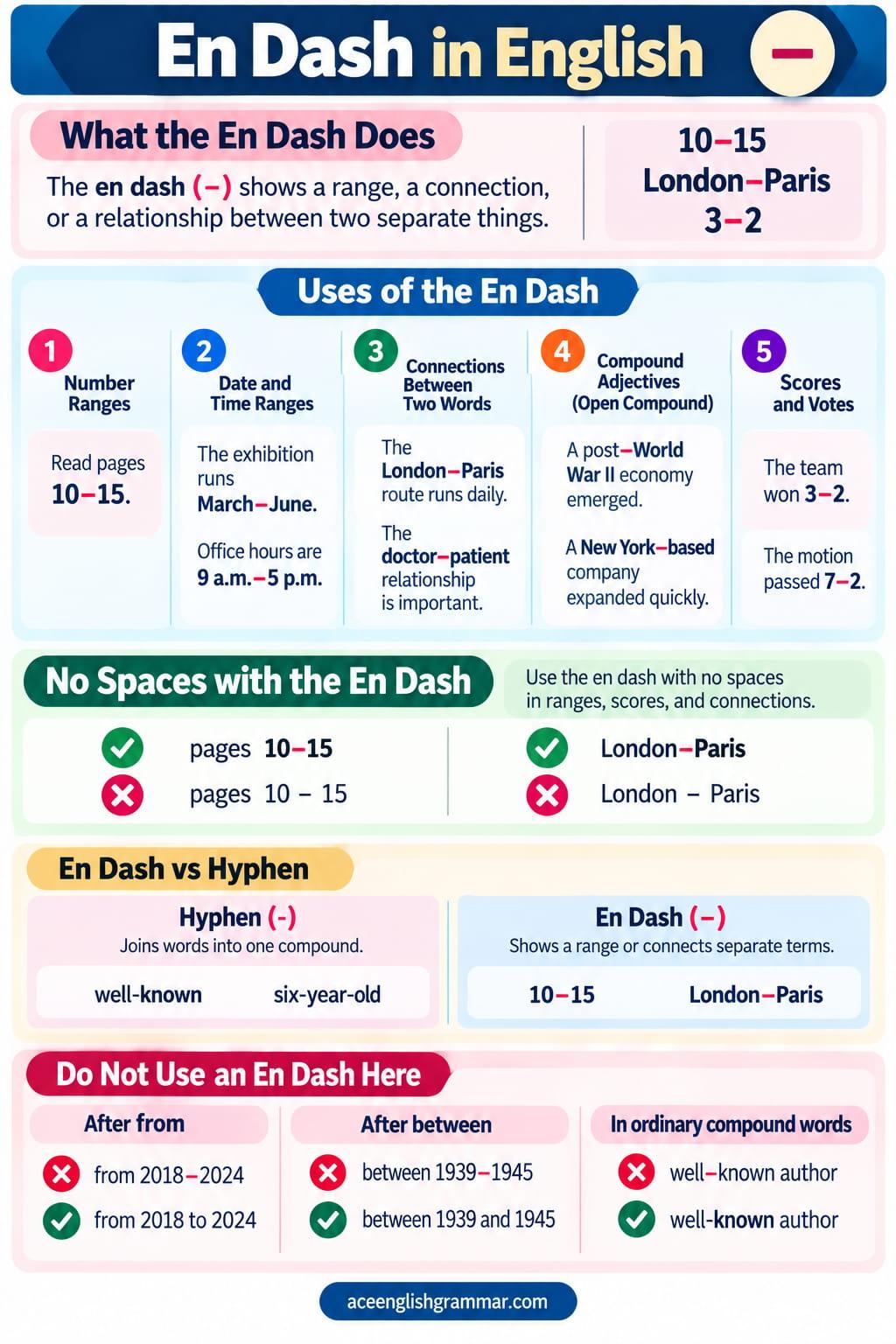
The en dash is a punctuation mark (–) that shows a range, a connection, or a relationship between two things. It is longer than the hyphen and shorter than the em dash.
There are five main uses of the en dash in English: number ranges, date and time ranges, connections between two words, compound adjectives built on an open compound, and scores or votes. The mark takes no spaces on either side in most contexts, and it has its own Unicode point separate from the hyphen.
What Is an En Dash?
An en dash is a punctuation mark (–) that shows a range between two values or a connection between two words. Its width falls between the hyphen and the em dash, which is where the name comes from.
The name is a typographic term: the en dash is about the width of the capital letter N, while the em dash is about the width of the capital letter M. The three marks look similar on screen but carry different grammatical functions.
- Read pages 10–15 for tomorrow.
- The 1939–1945 war affected every family.
- The London–Paris route runs six times a day.
- The team won the match 3–2.
Note that the en dash is not a longer hyphen. The two marks have separate Unicode points and separate uses, and substituting one for the other is a punctuation error rather than a style choice.
Common Uses of the En Dash with Examples
The en dash has five established uses in English writing. The most common uses are listed here with one example each; each rule is covered in detail later.
- Number ranges: Read pages 10–15.
- Date and year ranges: The 2020–2025 period was difficult.
- Time ranges: Office hours are 9 a.m.–5 p.m.
- Connections between two words: the doctor–patient relationship
- Compound adjectives with an open compound: a post–World War II economy
- Scores and votes: The council approved it 7–2.
En Dash vs Em Dash vs Hyphen
Three horizontal marks appear in English writing, and each has its own width and function. Reading them by length alone is unreliable on screen, so the grammatical role is the safer guide.
The Hyphen
The hyphen (-) is the shortest of the three marks. It joins two words into a single compound, separates a prefix from its base word, and appears in compound numbers written out in full.
- She is a well-known author.
- The six-year-old child laughed.
- His ex-wife lives in Karachi.
- There were twenty-one applicants.
The En Dash
The en dash (–) is longer than the hyphen and shorter than the em dash. It shows a range between two values or a connection between two words that keep their separate identities.
- The 2020–2025 period saw three recessions.
- The New York–London flight takes seven hours.
- The doctor–patient relationship depends on trust.
- Read chapters 4–9 before the seminar.
The Em Dash
The em dash (—) is the longest of the three marks. It signals a strong pause, sets off information from the rest of the sentence, or replaces other punctuation for emphasis.
- She made her decision—there was no turning back.
- The plan—developed over months—was ready.
- One thing mattered—success.
Note that a hyphen joins, an en dash spans, and an em dash interrupts. Holding these three functions apart prevents nearly every dash error, and the em dash and en dash comparison covers the pair that causes the most trouble.
Compare:
- a well-known author ✓ (hyphen joins two words into one modifier)
- pages 10–15 ✓ (en dash spans a range)
- She paused—then spoke. ✓ (em dash interrupts)
En Dash in Number and Date Ranges
The en dash replaces the word “to” or “through” between two values in a range. This is the most frequent use of the mark in English writing, and it applies to numbers, dates, years, and times alike.
Number Ranges
An en dash separates the first and last values in a numerical range, including page numbers, chapter numbers, quantities, and measurements.
- Read pages 10–15 for tomorrow.
- Answer questions 1–20 in section A.
- The recipe serves 4–6 people.
- Temperatures reached 32–35 degrees.
Date and Year Ranges
An en dash separates two years, two dates, or two months in a range. The mark stands in for “to” or “through,” so the words themselves are not repeated.
- The 1939–1945 war affected every family.
- She served as director from 2018–2024.
- The exhibition runs March–June.
- The 2020–2021 academic year moved online.
Note that an en dash is not used when the range opens with “from” or “between.” We say “from 2018 to 2024,” not “from 2018–2024,” and “between 1939 and 1945,” not “between 1939–1945.”
Compare:
- The war lasted 1939–1945. ✓
- The war lasted from 1939–1945. ✗
- The war lasted from 1939 to 1945. ✓
Time Ranges
An en dash separates a start time from an end time, in both the 12-hour and 24-hour formats.
- Office hours are 9 a.m.–5 p.m.
- The session runs 14:00–16:30.
- The shop is open 8–6 on weekdays.
- Lunch is served 12:30–2:00.
En Dash in Connections and Relationships
An en dash connects two words that keep their separate identities while forming one idea. The mark signals a relationship, a route, a conflict, or a pairing between two independent things.
- The London–Paris train departs hourly.
- The doctor–patient relationship depends on trust.
- The Democrat–Republican divide widened.
- The India–Pakistan border stretches for miles.
- The mind–body problem has occupied philosophers for centuries.
Note that a hyphen joins two words into one unit, while an en dash holds two separate units together. We write “mother-in-law” with hyphens because it names one person, and “India–Pakistan” with an en dash because it names two countries.
Compare:
- the Sino-Japanese war ✓ (hyphen: “Sino” is a prefix, not a standalone word)
- the China–Japan treaty ✓ (en dash: both are standalone names)
En Dash With Compound Adjectives
An en dash replaces the hyphen in a compound adjective when one of its elements is already an open compound of two or more words. The en dash spans the whole open compound rather than joining only the nearest word.
- a post–World War II economy
- a New York–based company
- a pre–Civil War building
- an Academy Award–winning performance
Note that a hyphen would attach only to the last word of the open compound and produce the wrong meaning. Writing “post-World War II” suggests “post-World” rather than “post–World War II.”
Compare:
- a post-World War II economy ✗ (hyphen attaches to “World” only)
- a post–World War II economy ✓ (en dash spans the whole compound)
- a New York-based company ✗
- a New York–based company ✓
En Dash in Scores and Votes
An en dash separates the two figures in a sports score, a vote count, or any other head-to-head result. The mark stands in for “to” between the two numbers.
- The team won the match 3–2.
- The council approved the motion 7–2.
- The series ended 4–1 in their favour.
- The bill passed by 218–210.
Note that no space appears on either side of the en dash in a score. We write “3–2,” not “3 – 2.”
Spacing Around the En Dash
The en dash takes no space on either side in ranges, scores, and connections. A spaced en dash appears only in British publishing, where some houses use it in place of the em dash for parenthetical asides.
1. Closed spacing (standard in all ranges and connections): no space on either side.
- pages 10–15
- the London–Paris flight
- 9 a.m.–5 p.m.
- a 3–2 win
2. Open spacing (British parenthetical use only): one space on each side, functioning as an em dash substitute.
- She looked at me – then walked away.
- The plan – developed over months – was ready.
Note that a closed em dash marks parenthetical asides under American style, while some British publishers set a spaced en dash instead. The choice belongs to the house style rather than to grammar.
En Dash Symbol and Character Codes
The en dash is not on standard keyboards, so writers copy it directly or insert it through a character code. The mark has one Unicode point and several code representations by format.
Copy the en dash directly from here:
–
The character codes for the en dash across formats:
| Format | Code |
|---|---|
| Unicode | U+2013 |
| HTML entity | – |
| HTML numeric | – |
| Windows Alt code | Alt + 0150 |
| CSS content | \2013 |
| LaTeX | — |
| Python / JavaScript | \u2013 |
Note that the en dash has no ASCII equivalent, since ASCII covers only the first 128 characters and the en dash falls at decimal 8211. Plain-text systems that lack Unicode support fall back to a single hyphen in its place.
Compare:
- Hyphen: – (U+002D)
- En dash: – (U+2013)
- Em dash: — (U+2014)
How to Type an En Dash
The en dash requires a keyboard shortcut or a character insertion on every platform. Each operating system and word processor provides its own method.
On Windows
On Windows, the en dash is typed with Alt + 0150 using the numeric keypad on the right side of the keyboard. The Character Map utility offers the same mark for keyboards without a numeric keypad.
- Alt + 0150 on the numeric keypad
- Character Map, then search for “en dash”
On Mac
On Mac, the en dash is typed with Option + Hyphen. This shortcut works in every Mac application, including Pages, Word, Google Docs, and browser-based editors.
- Option + hyphen (-) on any Mac keyboard
In Microsoft Word
Microsoft Word inserts an en dash automatically through AutoCorrect. Typing a word, a space, a hyphen, a space, and another word converts the hyphen into an en dash once the second word is finished.
- Type word – word with spaces around the hyphen (AutoCorrect converts it)
- Insert > Symbol > Special Characters > En Dash
- Ctrl + minus sign on the numeric keypad
In Google Docs
Google Docs converts a spaced hyphen into an en dash through automatic substitution, in the same way Microsoft Word does. The Special Characters menu provides a direct insertion for writers who prefer it.
- Type word – word with spaces (automatic substitution converts it)
- Insert > Special Characters, then search for “en dash”
- Tools > Preferences > Substitutions to add a custom shortcut
On Mobile Devices
On iOS and Android, the en dash is available by holding down the hyphen key on the on-screen keyboard. A pop-up menu appears with the hyphen, en dash, and em dash options.
- Hold the hyphen key (-) and slide to the en dash in the pop-up menu
British vs American Use of the En Dash
The two dialects agree on the en dash for ranges and connections but differ on the parenthetical dash. A closed em dash is standard under American style; a spaced en dash does the same work under British style.
- American: The plan—developed over months—was ready.
- British: The plan – developed over months – was ready.
- Both: Read pages 10–15 for tomorrow.
- Both: The London–Paris route runs hourly.
Note that the difference affects only the parenthetical use. Ranges, scores, and connections take a closed en dash in both dialects.
When Not to Use an En Dash
Five situations require a different mark even though writers reach for the en dash.
1. In compound words. A hyphen joins two words into a single compound.
- a well–known author ✗
- a well-known author ✓
2. After “from” or “between.” These words already set up the range, so the second half takes “to” or “and.”
- from 2018–2024 ✗
- from 2018 to 2024 ✓
- between 1939–1945 ✗
- between 1939 and 1945 ✓
3. For a parenthetical aside in American English. An em dash marks the interruption.
- The plan – developed over months – was ready. ✗ (American)
- The plan—developed over months—was ready. ✓ (American)
4. In a prefix attached to a single word. A hyphen handles a prefix when the base is one word.
- pre–war rationing ✗
- pre-war rationing ✓
- pre–World War II rationing ✓ (open compound: en dash correct)
5. In phone numbers and similar strings. A hyphen separates digit groups in telephone numbers, product codes, and serial numbers.
- 0300–123–4567 ✗
- 0300-123-4567 ✓
Common Errors With the En Dash
Six errors recur most commonly when writers use the en dash in English.
- Using a hyphen for a range. We write “pages 10–15,” not “pages 10-15.” A range takes an en dash; a hyphen joins compound words.
- Using an en dash after “from” or “between.” We write “from 2018 to 2024,” not “from 2018–2024.” These words already open the range and call for “to” or “and.”
- Adding spaces around the en dash in a range. We write “10–15,” not “10 – 15.” Ranges, scores, and connections take a closed en dash.
- Using a hyphen with an open compound modifier. We write “a post–World War II economy,” not “a post-World War II economy.” An en dash spans the whole open compound.
- Using an en dash where an em dash belongs. We write “She paused—then spoke,” not “She paused – then spoke,” in American English. A parenthetical aside takes a closed em dash.
- Using an en dash in a compound word. We write “well-known author,” not “well–known author.” A compound modifier takes a hyphen.
FAQs
Q1. What is an en dash?
An en dash is a punctuation mark (–) that shows a range between two values or a connection between two words. It is longer than the hyphen and shorter than the em dash. The name comes from typography, where the mark matches the width of the capital letter N.
Q2. What is the difference between an en dash, an em dash, and a hyphen?
The three marks differ in width and function. A hyphen (-) joins two words into one compound, as in “well-known.” An en dash (–) spans a range or links two separate units, as in “pages 10–15” or “the London–Paris flight.” An em dash (—) interrupts a sentence for emphasis, as in “She paused—then spoke.”
Q3. How do I type an en dash?
On Windows, press Alt + 0150 on the numeric keypad. On Mac, press Option + Hyphen. On mobile devices, hold the hyphen key on the on-screen keyboard and slide to the en dash. Microsoft Word and Google Docs also convert a spaced hyphen into an en dash automatically.
Q4. Do I put spaces around an en dash?
No, not in ranges, scores, or connections. We write “pages 10–15” and “the London–Paris flight” with no space on either side. A spaced en dash appears only in British publishing, where some houses use it in place of the em dash for parenthetical asides.
Q5. When do I use an en dash instead of a hyphen?
Use an en dash for a range of numbers, dates, or times, for a connection between two standalone words, and for a compound adjective whose element is an open compound. Use a hyphen to join two words into a single compound. “Pages 10–15” takes an en dash; “well-known” takes a hyphen.
Q6. Can I use an en dash with “from” or “between”?
No. The words “from” and “between” already open a range, so the second half takes “to” or “and” rather than an en dash. We write “from 2018 to 2024” and “between 1939 and 1945,” not “from 2018–2024” or “between 1939–1945.”
Q7. What is the Unicode for an en dash?
The en dash is U+2013 in Unicode. It is written as – or – in HTML, typed as Alt + 0150 on Windows and Option + Hyphen on Mac, and escaped as \u2013 in Python and JavaScript. It has no ASCII equivalent, since ASCII covers only the first 128 characters.
Read More

Leave a Comment